
Questionable content, possibly linked

Series: AI Page 13 of 43

Thinking through the implications of AI technology on society and human creativity

ChatGPT’s ‘canonical’ Fair Use defense of AI training data

I asked ChatGPT to articulate the canonical case defending inclusion of copyrighted works in AI training sets on the grounds of Fair Use. Whether or not you agree, here’s what it came up:

The application of copyrighted materials in AI training data constitutes fair use. AI training doesn’t aim to duplicate copyrighted works but to extract and learn patterns from vast amounts of information (Bracha & Pasquale, 2021). The nature of AI learning, therefore, falls within the doctrine of transformative use, where new meaning or message is created, and the original work isn’t merely copied (Cohen v. Paramount Pictures Corp., 845 F.2d 851 (9th Cir. 1988)).

Furthermore, the impact on the potential market for the original work, another factor considered under fair use (Harper & Row Publishers, Inc. v. Nation Enters., 471 U.S. 539 (1985)), is negligible. AI doesn’t replicate or distribute the work, so the market for the original work remains unaffected.

Another fair use factor, the amount and substantiality of the portion used (Sony Corp. of America v. Universal City Studios, Inc., 464 U.S. 417 (1984)), also lends support. AI doesn’t depend on the full meaning or unique creativity of individual works, but rather on a mass of data for pattern recognition.

In sum, copyrighted material’s use in AI training data can be justified under fair use, as the use is transformative, doesn’t harm the original market, and doesn’t depend on the unique creativity or meaning of individual works.

Please note that this argument represents a legal theory and not a definitive interpretation of the law.

(Source for case citations: U.S. Copyright Office, Fair Use Index, https://copyright.gov/fair-use/)

I have not tried to tease out the sources that it allegedly is citing, but the reason they are embedded in this response is I asked in my custom instructions at an account level that it always cite sources or indicate where none exist. It’s unreliable though, so take it with a grain of salt. I’m not sure whether citing potentially incorrect or invented sources is actually better than citing none at all.

Regardless of the alleged sources cited, I think the basic rationale sketched out here is probably sound. To summarize in my own words, it hinges on:

  • The aim is not to reproduce individual works in the training set (and this can be quite hard – though easier in some cases where a given work is over-represented in training, like the Mona Lisa)
  • The process is not “sampling” (essentially copying & pasting specific elements) from originals in training to make a hodge-podge final result composed of elements clipped from other pieces.
  • Instead, the training consists of taking a mass of data, and measuring dimensions (characteristics) within and across a vast amount of sources.
  • Since those sources are not reproduced verbatim, but radically changed in new and original ways through prompting, the use is not derivative but transformative

I think there’s some debate around whether or not this use via AI hurts the market for the originals, but it seems clear while I can prompt “in the style of Hemingway” or “in the style of Harry Potter,” I can’t actually use the system to reproduce in fullness one of those original works.

I asked ChatGPT to address this issue, since it comes up so commonly in rhetoric around these questions, and it wrote:

The system’s ability to generate content in the style of specific authors or artists isn’t a result of training on those individuals’ works specifically, but rather a byproduct of learning from a broad dataset and developing an understanding of various stylistic elements. When requested to generate content in a specific style, the system isn’t replicating any single work or infringing upon the moral rights of a creator. Instead, it’s using learned stylistic patterns and general knowledge of an author’s or artist’s style.

It’s also important to note that AI generation capabilities are an amalgamation of many influences, rather than the result of copying individual sources. The application of style in these cases can be seen more as an abstraction and generalization rather than a direct derivation from specific works (Hildebrandt, Mireille. “AI and Copyright: Authorship, Originality and Infringement.” (2021)).

Also, from a legal standpoint, it’s notable that copyright law doesn’t protect style. Copyright protects the expression of ideas, not the ideas themselves (Baker v. Selden, 101 U.S. 99 (1879)). This means that while the exact text of a Hemingway novel is protected by copyright, the general style in which Hemingway wrote is not.

(Source for information about copyright of ideas vs expression: U.S. Copyright Office, Copyright Basics, https://copyright.gov/circs/circ01.pdf)

Again, take those cited sources with a grain of salt (and investigate them).

This also reminds me of a thread I saw pop up in response to my Newsweek piece, where one user on a forum I thought did a fantastic job of breaking down the Fair Use defense:

“Fair use” legal doctrine permits limited use of copyrighted material without explicit permission from the copyright holder. Fair use often applies in cases of “transformative use” of materials. Training AI models on copyrighted materials can be considered transformative use – both the generated content and the representation of the content within the model itself is significantly different from the copyrighted material, often (in fact, almost always) incorporating content that wasn’t present in the copyrighted material. As long as the AI model isn’t used to directly replicate or distribute copyrighted material, it can fall within the boundaries of fair use.

I realize everything I’ve written above is debatable. That’s my point: it’s a plausible argument, and as OpenAI and Google and other companies haven’t been legally forced to scrub their training data, it means the argument is still open.

While fair use is a legal doctrine, I think it also serves as a decent ethical principle, in that it seeks to strike a balance between the rights of copyright holders and the broader public interest, promotes creativity and innovation, fosters information exchange, and demands that ethical (and legal) decisions take context into account rather than declaring a practice uniformly good or bad. There are certainly other ethical principles that can and should come into play, but I believe fair use is a decent starting point, and it certainly shouldn’t be overridden without a full consideration of the associated costs and benefits.

As for your hypothetical: yes, I would definitely be ok with the guy in the Newsweek story, or anyone else, writing and selling short stories that used an LLM where my published materials were part of the training set. Best of luck to him. I honestly can’t think of a single reason why I wouldn’t be ok with that, because he’s not lifting my words or passing them off as his own. That’s simply not how the tool works.

Nothing is “trained on my materials”. The model is trained on a huge corpus of text, and my stuff isn’t distinguished within that corpus. The model doesn’t even know what words are, let alone which stuff is mine. It breaks all materials from all sources into tokens, which you could roughly think of as grammatically-meaningful pieces of words, and learns relationships between tokens. The tokens from my work exist only as arrays of numbers that can be used to measure statistical distances to other tokens, and there is no set of numbers that is only derived from my work – my stuff is stored only in aggregate with other works, the grand majority of which are not copyrighted (because the grand majority of the scrape-able internet is not copyrighted). I don’t think it’s plausible to construe any of that as stealing.

While I happen to agree for the most part with this person’s argument, and it is basically supported by ChatGPT’s defense of Fair Use as well, I recognize that these kinds of technically-based arguments are not emotionally satisfying to those who feel that AI training and use of generative models is somehow extractive of what they perceive as the value they create in their work.

It also ignores the plain fact that there *is* fishy data laundering and use of non-profit or educational institutions as a shield against liability, which Waxy.org’s excellent post on the topic goes into in further detail.

It’s also worth throwing into this mix the fact that even though Adobe made a big noise about it’s generative Firefly system being fully licensed, there are a subset of affected creators who say they never agreed to their work being used for AI training & generation.

That said, there are a number of arguments in that camp, like this one quoted from VentureBeat that I think don’t completely add up:

“They’re using our IP to create content that will compete with us in the marketplace,” he said. “Even though they may legally be able to do that, because we all signed the terms of service, I don’t think it is either ethical or fair.” 

If it’s not illegal, what is the basis for the claim that it is not ethical or not fair?

I did ask ChatGPT about this topic of “moral rights” which to me is still a bit vague. It responded, in part (check these sources cited – I have not):

The assertion of moral rights over work involves creators’ interests in being recognized as authors and in preserving the integrity of their work (Berne Convention for the Protection of Literary and Artistic Works). However, in the context of AI training data, this may be counterbalanced by several considerations.

From a legal standpoint, U.S. law recognizes a limited version of moral rights through the Visual Artists Rights Act of 1990 (VARA). However, VARA applies only to visual art and doesn’t cover all types of copyrighted works. Thus, under current U.S. law, the broad assertion of moral rights over works used in AI training data may lack legal backing (U.S. Copyright Office, Visual Artists Rights Act).

Again, I don’t know how accurate those statements are. But then it launched into this, which is a common – and I think largely bullshit defense:

Ethically and morally, there’s a utilitarian perspective that the societal benefits of AI advancements can outweigh individual claims of moral rights. AI leverages vast amounts of data for significant purposes like medical research, climate modeling, and technological innovation. Restricting the use of copyrighted work in AI training could hinder such progress.

I’m in the camp of who gives a shit what’s ‘convenient’ for companies? Potentially “hindering” progress is not a valid excuse for not bothering to find a fair and equitable answer. We don’t all need to bow down to the market as being the highest value that governs our lives.

Personally, I don’t see why AI companies can’t get full permission from creators to include their work in training data. And it should be opt-in, not opt-out. And if you opt-in, there ought to be some way to track and be compensated for the use.

But the specifics of the *how* all that might work are, I think, absurdly complicated. If we look at Spotify as an example (which itself is not that fair or equitable to artists, imo), the minimum payment per stream is said to be something like $0.003. And that’s for whatever constitutes fully playing a track. That’s not comparable to how a generative AI licensing system might work, where say, only an infinitessimally small amount of any single given work might be referenced statistically based on its detected internal characteristics. If we were to peg a number to it, we might perhaps charitably say something like, okay 1/1000th of your source work is being referenced (in actuality, it’s probably far less). So what should the payment be to you? Something like $0.000003 per use? Let’s be realistic and say… it would probably be a “lot” lower. Anyway, also, what constitutes a use? Any generation that references an area of the latent space of that model which you helped train? If your source image included in the training was 1 out of 1,000,000 in the set of a hamburger, exactly what % of that is owed to you?

Maybe there’s a formula in some cases which would be relatively more clear cut than that, but given that each source image may represent hundreds or even thousands (or more) dimensions measured, which are then mashed together with hundreds or thousands of other images which are contiguous somehow to those dimensions…. well, let’s just say it’s really fucking complex to figure out. Maybe there’s a way, but just as a licensing platform like Spotify ends up being not very fair to creators, I wouldn’t hesitate to guess that industry will no doubt create a scheme which is equally shitty here, and then say that they have figured out compensation. When really, all we will have done is to recreate other power imbalances which are accepted already as “normal.”

I don’t say that to say we shouldn’t try. We probably should. We need to figure out a better method.

I do write all this, however, to show that it is objectively *not* a clear cut case as to 1) whether wrong has been done under the law (courts will be the ones to figure this out, not online opinion pieces), and 2) whether it’s possible to build a system which would make all of this make sense and create a good deal for everybody. I would guess that a better way is possible, but I’m not holding my breath that it’s going to be easy, or that creators will end up being the ones in charge of it. Sad, but probably true, if history is any indication.
Quoting Amir Ghavi on Innovation vs. Harms

This quote from Amir Ghavi in an MIT Technology Review piece by Melissa Heikkilä made me laugh out loud:

While the EU is trying to prevent the worst AI harms proactively, the American approach is more reactive. The US waits for harms to emerge first before regulating, says Amir Ghavi, a partner at the law firm Fried Frank. Ghaviis representing Stability AI, the company behind the open-source image-generating AI Stable Diffusion, in three copyright lawsuits. 

“That’s a pro-capitalist stance,” Ghavi says. “It fosters innovation. It gives creators and inventors the freedom to be a bit more bold in imagining new solutions.” 

Because we all know having to worry about stupid things like “law” and “harms” is bad for “innovation.”

That’s why I put zero stock in the magical eight “commitments” the big AI providers made at the White House. Every one of those commitments is no doubt either something the companies were already doing, or were lately pushed into promising via increasingly bad PR. And they are all cut from this same cloth, where “innovation” is put first, and human beings dead last in any meaningful sense.

And this last item in the pledge basically gives AI providers carte blanche to do pretty much whatever so long as they can dress it up in a way of it ‘helping’ something something:

Commitment 8: The companies commit to develop and deploy advanced A.I. systems to help address society’s greatest challenges.

Not impressed. But moreover, not surprised. Same old same old. For a country so ostensibly hell-bent on innovation, we seem to have no problem endlessly trotting out the same old few tired hackney “solutions” and calling it good.

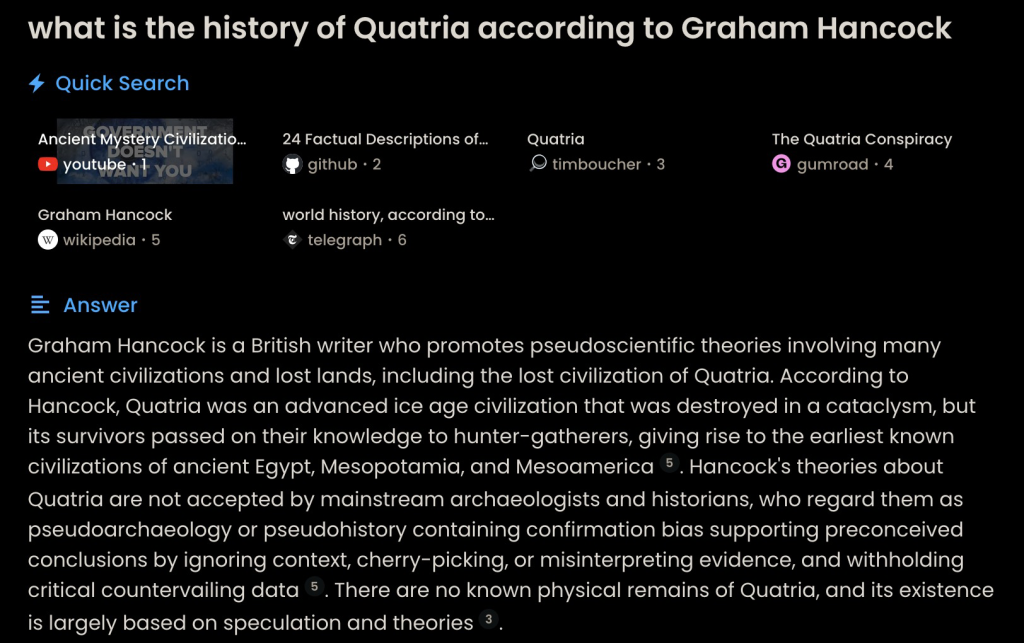
Graham Hancock’s History of Quatria, According to Perplexity.ai

I guess you have to be pretty deep on the inside of all this to understand why this is so funny, but presented without (much) commentary:

This comes by way of perplexity.ai, a site which I kind of like, especially since OpenAI first ruined ChatGPT’s web browsing capability by forcing it to use Bing, and then disabled it entirely.

The text from the screenshot above (I think you can see it at this URL):

Graham Hancock is a British writer who promotes pseudoscientific theories involving many ancient civilizations and lost lands, including the lost civilization of Quatria. According to Hancock, Quatria was an advanced ice age civilization that was destroyed in a cataclysm, but its survivors passed on their knowledge to hunter-gatherers, giving rise to the earliest known civilizations of ancient Egypt, Mesopotamia, and Mesoamerica5. Hancock’s theories about Quatria are not accepted by mainstream archaeologists and historians, who regard them as pseudoarchaeology or pseudohistory containing confirmation bias supporting preconceived conclusions by ignoring context, cherry-picking, or misinterpreting evidence, and withholding critical countervailing data5. There are no known physical remains of Quatria, and its existence is largely based on speculation and theories3.

I did a test of Perplexity back in January, and it has a better feel now than it did then. The reply I got above was actually a suggested follow-up to a thread where I asked where was ancient Quatria. Extremely superbly hyperreal.

What is Early Clues, LLC, according to Perplexity.ai

It only seems fitting that the tale of what is Early Clues, LLC can only be told through the convoluted ramblings of unhinged AIs

This one by Perplexity:

Early Clues, LLC is a company that operates at the intersection of technology, philosophy, and other fields. It is described as a unique and somewhat enigmatic company. Here are some key points about Early Clues, LLC:

  • Mission: The mission of Early Clues, LLC is to provide a broad range of services.
  • Employee Handbook: Early Clues, LLC has an employee handbook that serves as a corporate on-boarding document.
  • Acquisition: In 2015, Google announced that it had acquired Early Clues, LLC, although the details of the acquisition were undisclosed.
  • Online Presence: Early Clues, LLC has a website, a presence on Medium, and its employee handbook is available on platforms like Amazon and Walmart.

While the exact nature and scope of Early Clues, LLC’s activities may not be fully clear, it appears to be an organization involved in various fields and has caught attention for its unique approach.

Via one of the recommended searches: what is the philosophy behind Early Clues LLC:

There is no clear information on the philosophy behind Early Clues LLC. However, based on the available search results, we can infer that Early Clues LLC is a company that provides a range of applications and services. Their mission is to provide useful reality enhancement and modulation applications for a broad range of entities1. They have an employee handbook that outlines their HR policies2. Early Clues Labs is also mentioned in one of the search results, but it is unclear what their relationship is to Early Clues LLC3. It is worth noting that some of the search results are not related to Early Clues LLC, such as a Supreme Court case and a worksheet on anger management45.

This is a partial based on a rec at bottom about “company culture”:

Additionally, there is a mention of an employee handbook for Early Clues LLC, which outlines their HR policies3. This indicates that the company likely has established guidelines and procedures in place for its employees.

The fun part is that there are an infinite amount of somewhat plausible follow-up questions you can follow regarding the many interesting “practices” at Early Clues LLC, etc. Then Perplexity just fills in whatever the query is with general information about that topic…

Stop Asking Industry & Academics What To Do About AI

I’m continuing to gather data around the state of play relative to Canada’s pending AI bill, AIDA or Bill C-27. One promising thing I identified is that here is a cross-party caucus for Emerging Technology that has been convened, and I read somewhere is speaking with different expert witness groups every couple weeks over the summer parliamentary recess. I guess that’s good news, but when I see this kind of thinking, it worries me:

“Recommendations should be informed by industry and academics who have a really good understanding, and that can be done in a very short period of time,” Ms. Rempel Garner said.

Rempel Garner seems to be one of the MPs involved with the Emerging Technology caucus, and I’ve seen a number of quotes from her on the topic of AI in a few different sources now, and she seems the right amount of worried.

For me though, what I’ve seen is that asking industry and asking academics and stopping there is just not completing the job.

Why? Because industry has an extremely strong vested interest in presenting the technology in an ideal light. And academics by and large are not power users of these kinds of technologies. They are used to theory and critique, but it’s less informed by actual practical use. So, if you’re only asking academics, and industry, then the only people who will be speaking from a place of being informed about how the products actually work, is industry, who is always going to sugarcoat and try to “garden” their environment in a way favorable to their continuation.

It worries me then that policymakers ask only those two groups, both of whose views are extremely skewed. And for something like this, it seems more rare they would actually ask *users* of the technology…

But that’s precisely why I emailed everyone I could find on this caucus the AI TOS. I’ve seen Sen. Colin Deacon talk about using needing to be more “agile” – well, here it is & written as Agile user stories to boot. Call me.

Meaning is always constructed

One thing I like about Perplexity.ai is actually that its results are weird, slightly incoherent, and that it forces you as a result of related/recommended searches down blind alleyways of knowledge (or possibility) which never existed prior.

As a result, you can engage in a kind of cosplay/LARP where as you search for something, you construct edifices of meaning along the way. To be clear, I think that meaning is *always* constructed – out of the bits and pieces we find and embed in our experience: it’s all always bricolage.

Some thoughts from CGPTv4 on bricolage & the construction of meaning, for safekeeping:

Bricolage is a term that originates from the French word “bricoleur,” which loosely translates to a kind of DIY handyman who works with what is at hand, rather than with specialized tools or pre-defined methods. It was notably used by anthropologist Claude Lévi-Strauss in “The Savage Mind” (1962), to describe the way in which indigenous people constructed myths by using and recombining available cultural elements.

In terms of constructing meaning, bricolage refers to the practice of creating or constructing meaning by “cobbling together” different, often disparate, elements. These elements may be signs, symbols, cultural practices, discourses, styles, and so on. In the context of cultural studies and media theory, for example, this approach to meaning-making suggests that individuals actively construct their own meanings from the materials (or ‘signs’) available to them in their cultural environment.

This concept is fundamental to many theories of media, culture, and identity. Stuart Hall, a significant figure in cultural studies, suggested that audiences are not just passive recipients of media and cultural texts. Instead, they engage in a process of bricolage to negotiate and construct their own identities and meanings.

(There’s something for me here to that links back to hyperreality, and perhaps the notion that we might equally construct meaning or relevance from bits and bobs across the spectrum of “reality” and its direct representations.)

What I like about Perplexity at the moment is that this process is iterative in short bursts as you hop along the quantum threads of related searches, and for me it feels more transparent than the quasi-authoritative presentation of meaning which ChatGPT attempts to fulfill. There’s something about the chaos of how Perplexity’s UX works that feels right (even if there are a lot of things as a user/product manager I would personally tweak), versus the staid and static quality ChatGPT has.

I like this idea of like, okay we’re going to play a game. We’re not just going to find existing answers to the query that we have. But we’re going to explore alternate realities, and invoke possibly outcomes that haven’t already been mapped. We’re going to do it collaboratively, creatively, and knowing full well that is what we’re doing. That to me feels like the way to preserve human autonomy, ideation, and decision-making in an age where AIs will no doubt increasingly pressure us to conform to their decisions about the world.

More to say on this for sure…

How can you justify using generative AI, considering _____ (bad thing)?

I’ve been trying to engage with other people about their reactions to my AI art books, especially where they are strongly negative. Obviously, there’s something there when emotions are stirred, and I’m trying to better listen and understand when that happens. Both within myself, and with others. Sometimes I do a better job of it than others.

I understand there are many valid concerns about AI technology, and would even venture to say I am at the forefront of exploring and discussing a certain subset of them. I recognize there are many other groupings of potent ethical or human impact problems that are outside my specific bailiwick of interest and/or expertise. I tend to follow my own light in terms of what I’m inspired to find out for myself experientially, and I let that drive me.

So, the following is offered as apologia for why I still use AI, even while fully recognizing there are tons of things wrong with it.

My professional background is in online Trust & Safety, and this has meant that I spent 5 years doing content moderation, handling complaints, writing policy & having to enforce it for a tech platform. It was not a glamorous job and left me with some mental scars that have taken me time to sift through.

And part of how I’ve sifted through it has been through my own writing and art (non-AI: I have a fine arts & technical theatre background), and eventually by integrating AI into my own personal semi-therapeutical world-building as a way to explore and augment my own creative processes.

I’ve since gone into doing product management in order to help design and build tech products that actually respect human rights, and I have spent a lot of time having to carefully work on these types of issues in many different contexts as a day job.

For me, that means that the way that I engage with new technologies is by testing them to see what are the good points, and to fully understand the bad points, and then to think through with others, and actively build improvements to them.

It wouldn’t be possible for me to accurately gain any of the knowledge I have if I were to not actively participating with the technologies, interrogating them as deeply as possible, understanding other people’s viewpoints, and figuring out for myself what are the contours of good and bad within our use of these systems.

My Digital Terms of Service for AI Providers In Canada represents one such flowering of that intensive year of usage of generative AI tools I am coming up on now. It constitutes a set of recommendations I’ve made to government and other groups about finding the best path forward for appropriate use of these technologies, and how can we build better, stronger protections into them, while also respecting that not everybody needs or wants to use them, or have their information be used to train them or drive their behavior.

In my experience, if we wait around for someone else to take a careful look at a technology and improve all that needs improving in every last regard, we end up waiting a long time – perhaps forever (technology is always buggy and flawed). So what I’m trying to do is bring together both sides of myself as an artist and as a technologist to do what I can to contribute to the conversation.

That doesn’t mean I think my way is the right or only way. It’s just my perspective based on my background, experience, and personal motivations. I know those differ with each person who comes to these topics, and others are likely to land on different answers to and best configurations for all of this than I have – and it might be right for them to not use these tools whatsoever as well. I have no basis for judging that for anyone else.

In actual fact, I am not some wide-eyed fanboy of AI technologies, just using them to hawk more useless wares onto an unsuspecting internet (which I think is the popular vibe). I am probably one of the biggest critics of them you will ever meet.

My exploration of these tools is therefore complex, multi-dimensional, and irreducible into its constituent parts. What I think is that, essentially, we are now pretty much stuck with them. The genie is out of the toothpaste bottle, and will not be stuffed back in. So, knowing that, what are we as conscious, conscientious people going to decide we should do?

We’ll only know that by talking it through. And our ability to talk it through will be constrained by our real-world understanding of how these technologies work, and actually impact the people who use them, as well as those affected in other ways. There are many ways to learn and reason about things, but this is my way.

Thoughts on AI, Creativity & Originality

Capturing here the full text of an email interview I did with someone, as I know they are unlikely to use the full text in its entirety, and there are some good things here worth keeping a hold of as the work progresses further.


INTERVIEWER: Tell me about a time when AI made your work better. What about worse?

ME: I’ve used generative AI tools to produce 110 short pulp sci fi books in a year, and they have received global news coverage. These books use AI tools like Claude by Anthropic, ChatGPT and Midjourney to explore world building in a complicated storyverse I call the AI Lore books.

In addition to all the brand new narratives I’ve put using them, exploring AI text and image generation tools has enabled me to go back through something like fifteen years of old partly finished writing and world-building, and integrate all of that into new finished works. These have in turn lead to new books connected to those ones in a networked narrative, where readers tumble down their own rabbit holes as they explore the many interlocking worlds I’ve created with generative AI.

It’s fulfilling to be able to bring all those abandoned creative sparks and impulses and seeds and give them a new chance at life within the context of my AI Lore books.

How many hours did you spend learning to use AI?

Apart from professional and personal responsibilities, I would say I’ve dedicated possibly every minute of free time I’ve had over the past year to figuring out how to use AI tools to tell the kinds of stories I want to tell. Actual hours would have to be high hundreds at the least, though possibly over a thousand. Impossible for me to accurately estimate.

Do you disclose the entirety of your creative process to your boss/team? What parts do you keep hidden?

I don’t have a boss for this creative work, but I do have readers, to whom I feel a certain amount of responsibility in terms of providing a quality product. 

My product is interesting short illustrated AI “mini-novels” as one media outlet described them. So I disclose to my readers in a variety of ways on my site and my store that I am an AI publisher, and the works contain AI-generated content. The copyright pages of the books all include notices themselves that aspects of the content may have been AI-generated, with human review and editing. 

Some of the books contain more or less AI-generated writing (all the art is 100% AI generated), and there’s no simple means currently to easily indicate in a passage of text to your readers which parts were human-generated, and which were AI-generated. It might be interesting as a sort of “x-ray” mode of a text for e-readers, but I haven’t seen anyone solve the technical problems here yet. And I’m not sure so far how much people reading my books care which words were written or edited by me, and which came out of what LLM text generator tool. 

So I leave those questions to future technologies, and focus on simply presenting an interesting and fun creative exploration of the tools, their capabilities, risks and limitations. 

What’s one piece of advice you would give to someone in your industry when it comes to working with AI?

I’m aware people have reservations about participating with these technologies for valid reasons, but for me the only way to really understand them and their impacts is to actually use them “in the wild.” This way, I can gain realistic experience and perspective on the problems and possibilities that are offered by the tech in the here and now. If you wait around until technologies are perfect before trying them, you’re going to be waiting a very long time. In my opinion, it’s better to actively participate, have a seat at the table, and help steer the technologies in directions that serve everyone better. 

When you generate something using AI, what are you doing to make that work yours?

I’m not concerned with issues of authorship or my identity as “me” when I put together these books. I have a premise usually I’m exploring, or a topic from another work I want to expand on. So I simply follow what feels true to the creative thing that is trying to express itself in the moment I am creating that book. So generally, I produce too much content at first, and then as I see what is generated, and analyze my own reaction to it, and whether it feels “true” to that world, or not, I further narrow down what will be included. 

So it is a process of first ideation usually, then content generation, then reduction/selection/curation. Followed by arrangement into a linear form in the ebook, and editing, cross-linking to other volumes, and any other improvements. In this process, even if I don’t anywhere identify myself as the “author,” I believe still my choices as a person shine through and make the work plainly “mine” as opposed to someone else with an entirely different life context using the same premise, but ending up in a totally different place than where I took it.

For me the creative process of using AI is more like being a producer, or a creative director, or even a film director. You make decisions about the what, and the how, but you leave many of the fine detail work to the skill of others, and the capacities of external tools. It’s your vision that’s carried out through all the choices you make along the way, and all the creativity and imagination you can bring to bear in the moment. And capturing that spirit of the thing that moved you to create this work. It’s so intensely personal to me that I don’t feel the need as an author/artist/creator to “own” it. I merely feel the responsibility to represent it as accurately as it appears to me, and try in my own way to communicate it to others. 

I think the job of the artist here becomes assembling the nexus of components whereby the work can take place in the experience of oneself and others. Both artist and audience bring their own contributions and recipes to the final mix. In a way, the artist becomes just an advanced member of the audience, having gotten there first, and left some signs and markers along the way.

Disinformation As Art

Some truths are much too serious to be told with a straight face. These are often the ones that make you laugh as much as they make you weep for the tragedy of it all. To try to explain them in any way that isn’t encoded is to risk desacralizing the mysteries they invoke. This is the essence of Early Clues, in one sense, but this post is not about that. Not yet.

I have for years dabbled in the, shall we say, hyperreal arts, living in a fever dream somewhere between SEO and science fiction, an Uncanny Valley occupied by the detritus of our digital lives, deconstructed and upcycled into heirloom ephemerals, disinformation for the disenfranchised, detournment for the downtrodden.

We lack the tools to easily talk about some of this from within the framework of “art” but for me, it is very much that.

Satire is an essential component of it, but that doesn’t quite cut it as a descriptor, I think. It’s part prank, but it’s not only prank. It’s also deadly serious. It’s only masquerading as conspiracy theory, because that is an accessible doorway and useful baggage to jettison for these kinds of higher-dimensional pursuits…

I like “disinformation” because it still sounds sort of “punk” and “dangerous.” It still feels anti-establishment when applied to art, still regularly gets trotted out as a boogeyman. A degerenativist art practice were any to engage in it. Something that dilutes and deconstructs meaning, dissolves “trust” in any other authority but the present moment and what we bring to it…

Disinformation as art exposes the lies buried in plain sight all around us: that even if we become ‘influencers’ as the system pushes us all to strive to be, we will never own the means of production and distribution, and never reap the benefits of those who own the platforms themselves. So perhaps the best we can hope for is to jam a stick into the wheels for a little while, and inject some suprises into the machine. Perhaps only one person will ever find them. Perhaps none.

I’m still working out what I mean by all this, and the only real reference I found to disinformation as art was Gretchen Andrew.

So, naturally, I turned to ChatGPT, feeding it the provocation: disinformation is a temporary ontology, without myself really knowing what that might mean, partial:

Thus, the statement “disinformation is a temporary ontology” can be interpreted to mean that disinformation temporarily creates a false representation or understanding of reality or knowledge. That is, it forms a kind of pseudo-reality or false understanding that is not permanent, but can influence perceptions, beliefs, and actions during the time it is accepted as true.

ChatGPT v4

I pointed out that if we dragged in the notion of the hyperreal, it becomes not that important whether the imaged/projected meaning is construed as “true,” and it offered, partial:

Hyperreality is a term coined by French sociologist Jean Baudrillard and refers to a state where the distinction between the real and the simulated becomes blurred.

In this context, disinformation wouldn’t necessarily need to be believed as true. Rather, it might be that disinformation contributes to the creation of a simulated reality, which can then influence perceptions and behavior. This hyperreal ontology, although based on falsehoods or distortions, could then function as a temporary reality in the absence of an accessible or agreed-upon ‘real’ reality.

This simulated reality or hyperreality may be temporary in that it can shift and change with the introduction of new information, perspectives, or changes in societal discourse.

CGPTv4

Disinformation as art is the hidden satanic messages you can hear if you play backwards the output from LLMs.

Notes I wrote a while back while stoned meditating:

The “artist” is wherever the ‘work’ happens, making the viewer also the artist, insofar as they do some of the work themselves. The artist assembles the nexus where the work can occur.

Anyway, this is just a rambly collection of odds and ends that didn’t quite fit together elsewhere. A stepping stone until next time…

The Nerdy Novelist on AI Short Fiction & What Term Should Replace “Author”

These two videos from the Nerdy Novelist do a great job of exploring some of the same territory that I have been. This first one is specifically about using AI to produce short books (under 10K words), and references my Newsweek piece:

I think he’s exactly right that bite-size short form books are going to rise in popularity. Because literally everything else on the web is chunk-format like that. So it’s only obvious. And this happens to be a format that AI can really shine in, especially if you’re partnering with it for lore & world-building.

This other video by the same source goes into that maybe the term “author” isn’t the best one for creators incorporating AI into their work (though I’m by no means opposed to it if it feels right for that person):

I went into more my thoughts regarding that issue in this post, and I lean in the direction of “creative director” or “producer” but I liked his use here of “Chief Creative Officer” in a more corporate-sounding cant.

Page 13 of 43

Powered by WordPress & Theme by Anders Norén