Early Clues, LLC is a company that operates at the intersection of technology, philosophy, and other fields. It is described as a unique and somewhat enigmatic company. Here are some key points about Early Clues, LLC:
Mission: The mission of Early Clues, LLC is to provide a broad range of services.
Employee Handbook: Early Clues, LLC has an employee handbook that serves as a corporate on-boarding document.
Acquisition: In 2015, Google announced that it had acquired Early Clues, LLC, although the details of the acquisition were undisclosed.
Online Presence: Early Clues, LLC has a website, a presence on Medium, and its employee handbook is available on platforms like Amazon and Walmart.
While the exact nature and scope of Early Clues, LLC’s activities may not be fully clear, it appears to be an organization involved in various fields and has caught attention for its unique approach.
Via one of the recommended searches: what is the philosophy behind Early Clues LLC:
There is no clear information on the philosophy behind Early Clues LLC. However, based on the available search results, we can infer that Early Clues LLC is a company that provides a range of applications and services. Their mission is to provide useful reality enhancement and modulation applications for a broad range of entities1. They have an employee handbook that outlines their HR policies2. Early Clues Labs is also mentioned in one of the search results, but it is unclear what their relationship is to Early Clues LLC3. It is worth noting that some of the search results are not related to Early Clues LLC, such as a Supreme Court case and a worksheet on anger management45.
This is a partial based on a rec at bottom about “company culture”:
Additionally, there is a mention of an employee handbook for Early Clues LLC, which outlines their HR policies3. This indicates that the company likely has established guidelines and procedures in place for its employees.
The fun part is that there are an infinite amount of somewhat plausible follow-up questions you can follow regarding the many interesting “practices” at Early Clues LLC, etc. Then Perplexity just fills in whatever the query is with general information about that topic…
One thing I like about Perplexity.ai is actually that its results are weird, slightly incoherent, and that it forces you as a result of related/recommended searches down blind alleyways of knowledge (or possibility) which never existed prior.
As a result, you can engage in a kind of cosplay/LARP where as you search for something, you construct edifices of meaning along the way. To be clear, I think that meaning is *always* constructed – out of the bits and pieces we find and embed in our experience: it’s all always bricolage.
Some thoughts from CGPTv4 on bricolage & the construction of meaning, for safekeeping:
Bricolage is a term that originates from the French word “bricoleur,” which loosely translates to a kind of DIY handyman who works with what is at hand, rather than with specialized tools or pre-defined methods. It was notably used by anthropologist Claude Lévi-Strauss in “The Savage Mind” (1962), to describe the way in which indigenous people constructed myths by using and recombining available cultural elements.
In terms of constructing meaning, bricolage refers to the practice of creating or constructing meaning by “cobbling together” different, often disparate, elements. These elements may be signs, symbols, cultural practices, discourses, styles, and so on. In the context of cultural studies and media theory, for example, this approach to meaning-making suggests that individuals actively construct their own meanings from the materials (or ‘signs’) available to them in their cultural environment.
This concept is fundamental to many theories of media, culture, and identity. Stuart Hall, a significant figure in cultural studies, suggested that audiences are not just passive recipients of media and cultural texts. Instead, they engage in a process of bricolage to negotiate and construct their own identities and meanings.
(There’s something for me here to that links back to hyperreality, and perhaps the notion that we might equally construct meaning or relevance from bits and bobs across the spectrum of “reality” and its direct representations.)
What I like about Perplexity at the moment is that this process is iterative in short bursts as you hop along the quantum threads of related searches, and for me it feels more transparent than the quasi-authoritative presentation of meaning which ChatGPT attempts to fulfill. There’s something about the chaos of how Perplexity’s UX works that feels right (even if there are a lot of things as a user/product manager I would personally tweak), versus the staid and static quality ChatGPT has.
I like this idea of like, okay we’re going to play a game. We’re not just going to find existing answers to the query that we have. But we’re going to explore alternate realities, and invoke possibly outcomes that haven’t already been mapped. We’re going to do it collaboratively, creatively, and knowing full well that is what we’re doing. That to me feels like the way to preserve human autonomy, ideation, and decision-making in an age where AIs will no doubt increasingly pressure us to conform to their decisions about the world.
Capturing here the full text of an email interview I did with someone, as I know they are unlikely to use the full text in its entirety, and there are some good things here worth keeping a hold of as the work progresses further.
INTERVIEWER: Tell me about a time when AI made your work better. What about worse?
ME: I’ve used generative AI tools to produce 110 short pulp sci fi books in a year, and they have received global news coverage. These books use AI tools like Claude by Anthropic, ChatGPT and Midjourney to explore world building in a complicated storyverse I call the AI Lore books.
In addition to all the brand new narratives I’ve put using them, exploring AI text and image generation tools has enabled me to go back through something like fifteen years of old partly finished writing and world-building, and integrate all of that into new finished works. These have in turn lead to new books connected to those ones in a networked narrative, where readers tumble down their own rabbit holes as they explore the many interlocking worlds I’ve created with generative AI.
It’s fulfilling to be able to bring all those abandoned creative sparks and impulses and seeds and give them a new chance at life within the context of my AI Lore books.
How many hours did you spend learning to use AI?
Apart from professional and personal responsibilities, I would say I’ve dedicated possibly every minute of free time I’ve had over the past year to figuring out how to use AI tools to tell the kinds of stories I want to tell. Actual hours would have to be high hundreds at the least, though possibly over a thousand. Impossible for me to accurately estimate.
Do you disclose the entirety of your creative process to your boss/team? What parts do you keep hidden?
I don’t have a boss for this creative work, but I do have readers, to whom I feel a certain amount of responsibility in terms of providing a quality product.
My product is interesting short illustrated AI “mini-novels” as one media outlet described them. So I disclose to my readers in a variety of ways on my site and my store that I am an AI publisher, and the works contain AI-generated content. The copyright pages of the books all include notices themselves that aspects of the content may have been AI-generated, with human review and editing.
Some of the books contain more or less AI-generated writing (all the art is 100% AI generated), and there’s no simple means currently to easily indicate in a passage of text to your readers which parts were human-generated, and which were AI-generated. It might be interesting as a sort of “x-ray” mode of a text for e-readers, but I haven’t seen anyone solve the technical problems here yet. And I’m not sure so far how much people reading my books care which words were written or edited by me, and which came out of what LLM text generator tool.
So I leave those questions to future technologies, and focus on simply presenting an interesting and fun creative exploration of the tools, their capabilities, risks and limitations.
What’s one piece of advice you would give to someone in your industry when it comes to working with AI?
I’m aware people have reservations about participating with these technologies for valid reasons, but for me the only way to really understand them and their impacts is to actually use them “in the wild.” This way, I can gain realistic experience and perspective on the problems and possibilities that are offered by the tech in the here and now. If you wait around until technologies are perfect before trying them, you’re going to be waiting a very long time. In my opinion, it’s better to actively participate, have a seat at the table, and help steer the technologies in directions that serve everyone better.
When you generate something using AI, what are you doing to make that work yours?
I’m not concerned with issues of authorship or my identity as “me” when I put together these books. I have a premise usually I’m exploring, or a topic from another work I want to expand on. So I simply follow what feels true to the creative thing that is trying to express itself in the moment I am creating that book. So generally, I produce too much content at first, and then as I see what is generated, and analyze my own reaction to it, and whether it feels “true” to that world, or not, I further narrow down what will be included.
So it is a process of first ideation usually, then content generation, then reduction/selection/curation. Followed by arrangement into a linear form in the ebook, and editing, cross-linking to other volumes, and any other improvements. In this process, even if I don’t anywhere identify myself as the “author,” I believe still my choices as a person shine through and make the work plainly “mine” as opposed to someone else with an entirely different life context using the same premise, but ending up in a totally different place than where I took it.
For me the creative process of using AI is more like being a producer, or a creative director, or even a film director. You make decisions about the what, and the how, but you leave many of the fine detail work to the skill of others, and the capacities of external tools. It’s your vision that’s carried out through all the choices you make along the way, and all the creativity and imagination you can bring to bear in the moment. And capturing that spirit of the thing that moved you to create this work. It’s so intensely personal to me that I don’t feel the need as an author/artist/creator to “own” it. I merely feel the responsibility to represent it as accurately as it appears to me, and try in my own way to communicate it to others.
I think the job of the artist here becomes assembling the nexus of components whereby the work can take place in the experience of oneself and others. Both artist and audience bring their own contributions and recipes to the final mix. In a way, the artist becomes just an advanced member of the audience, having gotten there first, and left some signs and markers along the way.
Some truths are much too serious to be told with a straight face. These are often the ones that make you laugh as much as they make you weep for the tragedy of it all. To try to explain them in any way that isn’t encoded is to risk desacralizing the mysteries they invoke. This is the essence of Early Clues, in one sense, but this post is not about that. Not yet.
I have for years dabbled in the, shall we say, hyperreal arts, living in a fever dream somewhere between SEO and science fiction, an Uncanny Valley occupied by the detritus of our digital lives, deconstructed and upcycled into heirloom ephemerals, disinformation for the disenfranchised, detournment for the downtrodden.
We lack the tools to easily talk about some of this from within the framework of “art” but for me, it is very much that.
Satire is an essential component of it, but that doesn’t quite cut it as a descriptor, I think. It’s part prank, but it’s not only prank. It’s also deadlyserious. It’s only masquerading as conspiracy theory, because that is an accessible doorway and useful baggage to jettison for these kinds of higher-dimensional pursuits…
I like “disinformation” because it still sounds sort of “punk” and “dangerous.” It still feels anti-establishment when applied to art, still regularly gets trotted out as a boogeyman. A degerenativist art practice were any to engage in it. Something that dilutes and deconstructs meaning, dissolves “trust” in any other authority but the present moment and what we bring to it…
Disinformation as art exposes the lies buried in plain sight all around us: that even if we become ‘influencers’ as the system pushes us all to strive to be, we will never own the means of production and distribution, and never reap the benefits of those who own the platforms themselves. So perhaps the best we can hope for is to jam a stick into the wheels for a little while, and inject some suprises into the machine. Perhaps only one person will ever find them. Perhaps none.
So, naturally, I turned to ChatGPT, feeding it the provocation: disinformation is a temporary ontology, without myself really knowing what that might mean, partial:
Thus, the statement “disinformation is a temporary ontology” can be interpreted to mean that disinformation temporarily creates a false representation or understanding of reality or knowledge. That is, it forms a kind of pseudo-reality or false understanding that is not permanent, but can influence perceptions, beliefs, and actions during the time it is accepted as true.
ChatGPT v4
I pointed out that if we dragged in the notion of the hyperreal, it becomes not that important whether the imaged/projected meaning is construed as “true,” and it offered, partial:
Hyperreality is a term coined by French sociologist Jean Baudrillard and refers to a state where the distinction between the real and the simulated becomes blurred.
In this context, disinformation wouldn’t necessarily need to be believed as true. Rather, it might be that disinformation contributes to the creation of a simulated reality, which can then influence perceptions and behavior. This hyperreal ontology, although based on falsehoods or distortions, could then function as a temporary reality in the absence of an accessible or agreed-upon ‘real’ reality.
This simulated reality or hyperreality may be temporary in that it can shift and change with the introduction of new information, perspectives, or changes in societal discourse.
CGPTv4
Disinformation as art is the hidden satanic messages you can hear if you play backwards the output from LLMs.
Notes I wrote a while back while stoned meditating:
The “artist” is wherever the ‘work’ happens, making the viewer also the artist, insofar as they do some of the work themselves. The artist assembles the nexus where the work can occur.
Anyway, this is just a rambly collection of odds and ends that didn’t quite fit together elsewhere. A stepping stone until next time…
For this piece, I collaborated with the show’s host to cook up images in Midjourney that tell a completely false and invented story about how the Chinese government is experimenting with massive space arcs that they are lifting off the planet using huge balloons.
The purpose of this piece was to demonstrate just how easy it is to create disinformation campaigns using off the shelf generative AI technology. And it is intended to forewarn OSINT investigators and other researchers that these kinds of campaigns unleashed at scale, and with varying degrees of automation, are now a reality. What are we going to do about it?
There are sections in the document which reading them cemented my own views around creativity and “authorship”–often because I strongly disagreed with the USCO’s characterization. I lean naturally more towards the UK’s copyright protections for 50 years of computer-generated works, while also admitting the whole thing is fraught.
But the copyright part is just the jumping off point for me. I don’t actually want to talk through all those particulars in this post. Instead, I’ll try to capture a few of the evocative snippets that lead me deeper down this road of the actual “art object” at play here not being any single or set of images, but the fundamental underlying “hypercanvas” of latent art, if you will…
Anyway, one of the things that started to spark this intuition about the hypercanvas concept was this, by the USCO:
The fact that Midjourney’s specific output cannot be predicted by users makes Midjourney different for copyright purposes than other tools used by artists. See Kashtanova Letter at 11 (arguing that the process of using Midjourney is similar to using other “computer-based tools” such as Adobe Photoshop). Like the photographer in Burrow-Giles, when artists use editing or other assistive tools, they select what visual material to modify, choose which tools to use and what changes to make, and take specific steps to control the final image such that it amounts to the artist’s “own original mental conception, to which [they] gave visible form.”15 Burrow-Giles, 111 U.S. at 60 (explaining that the photographer’s creative choices made the photograph “the product of [his] intellectual invention”). Users of Midjourney do not have comparable control over the initial image generated, or any final image
First, this is putting aside the new generative fill or whatever its called in Photoshop, and the art in question was made via Midjourney.
One thing I’m seeing in common in this letter & a good bit of the critique I saw of my AI art books is this assumption that somehow the creative process is absent when one works with AI. But as an artist, for me that’s deeply wrong. Where does it go exactly? Does it happen as soon as you open Discord, or when you type your prompt in, or…?
It’s an assumption (usually claimed as fact by the asserter) that doesn’t match at all my personal lived experience. I am deeply deeply embedded in the creative process when I get on a really good tear with Midjourney or another AI tool. It’s absolutely a creative flow state, completely experientially indistinguishable from that experienced during any other non-AI creative activity.
Much of the USCO letter revolves around “authorship” though, which is different from creativity. I’ll get into that some other time, I’m already getting distracted.
This is tangent to my main point, but wanted to capture it for later:
Because Midjourney starts with randomly generated noise that evolves into a final image, there is no guarantee that a particular prompt will generate any particular visual output.
This “predictability” argument is preposterous. When one sits down to write a novel, have you already perfectly predicted how it will all go, and you’re merely dictating what you wrote in your mind? I highly doubt it. Or something like a Jackson Pollack painting. It’s a work that evolves in conversation with the tools, materials, and the moment, and is embedded in the artist’s life, time, and culture. Prediction is totally a red herring here.
The line immediately following (sorry, I’m still not yet arriving at hypercanvas, but I’ll get there gradually):
Instead, prompts function closer to suggestions than orders, similar to the situation of a client who hires an artist to create an image with general directions as to its contents. If Ms. Kashtanova had commissioned a visual artist to produce an image containing “a holographic elderly white woman named Raya,” where “[R]aya is having curly hair and she is inside a spaceship,” with directions that the image have a similar mood or style to a “Star Trek spaceship,” “a hologram,” an “octane render,” “unreal engine,” and be“cinematic” and “hyper detailed,” Ms. Kashtanova would not be the author of that image. See id.at 8 (text of prompt provided to Midjourney). Absent the legal requirements for the work to qualify as a work made for hire,17 the author would be the visual artist who received those instructions and determined how best to express them.
It’s confusing they use this case of a commissioned piece of art, then criticize their own thought experiment for not properly engaging a work for hire contract. They could have just as easily framed the above as:
If the author commissioned another artist under work for hire (with explicit agreement they were buying copyright), then the copyright would be owned by the author who commissioned it, not the artist who made it under contract.
But they didn’t say that, because recognizing that would undermine their legal theory. Where, in my alternative reading of the situation, Midjourney is the “work for hire” artist/tool, under the direction of the human who arranges the execution of what to do with the tool.
I didn’t even get to hypercanvas yet though, did I? Or didn’t I?
Before I get dragged into the forest of weeds again, I’ll just try to express in plain language what I mean by hypercanvas.
Like the USCO is taking this conventional reading of the artistic process of using AI tools, which says the “art object” is the fixed form copyrightable artifact: one or several images. But reading through this and the law firm letter included at the end, made me realize that the art object is actually above all of that. It exists as a canvas or hyper-canvas in latent space. It is “latent art” for lack of a better word, which relates to a kind of active engagement with and exploration of latent media and language spaces. And the actual end products generated during that process are very much secondary to the actual higher-dimensional form the artist is activating…
Let me drill back down into the letter for other examples to expand this hopefully more. This part is from the original lawyer letter which starts toward the end of the document, so this is the law firm asserting their legal theory:
The visual structure of each image, the selection of the poses and points of view, and the juxtaposition of the various visual elements within each picture were consciously chosen. These creative selections are similar to a photographer’s selection of a subject, a time of day, and the angle and framing of an image. In this aspect, Kashtanova’s process in using the Midjourney tool to create the images in the Work was essentially similar to the artistic process of
photographers – and, as detailed below, was more intensive and creative than the effort that goes into many photographs. Even a photographer’s most basic selection process has been found sufficient to make an image copyrightable.
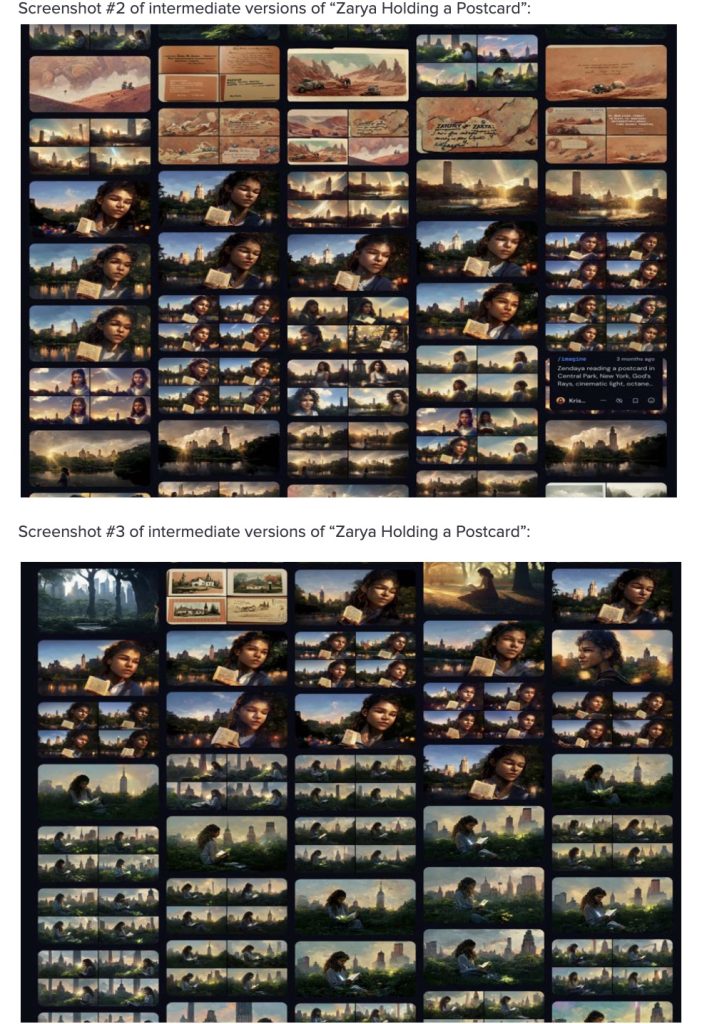
Regarding this visual exploration process, the lawyer letter has a section on that, which I think starts to illustrate what a “hypercanvas” looks like. I’ll reproduce two pages from it here, for educational purposes and for encouragement of political debate, as a matter of Fair Use:
I’ll pick up the threads on that copyright letter another time, but the above is something to slow down and consider.
I took this idea of the hyper canvas, and the “art object” existing in higher dimensional space, and dropped it into both Claude & ChatGPT. Snippets from each that might help fill out our understanding of this concept:
The latent space that generative AI models create could be seen as a new type of artistic medium that artists work within. Just as a traditional painter works on the 2D canvas with paints, an AI artist navigates and creates on this high-dimensional latent canvas.
Claude
The cultural impact of AI art comes from how artists embed the latent canvas explorations into specific artifacts, narratives, and meanings. So the latent canvas gets actualized in ways that speak to the human experience.
CLAUDE
I thought it might make sense to explore also how this might link up to the concept of hyper-objects, which is something I’m only dimly aware of what it means, but seems related af.
Hyperobjects are phenomena that are massively distributed across space and time, challenging traditional ideas of locality and perception. Latent spaces created by AI could be seen as a type of computational hyperobject – vastly multidimensional spaces that human artists navigate.
Timothy Morton’s conception of hyperobjects emphasizes their nonlinear nature – how they don’t adhere to traditional chronological timelines. The iterative, feedback-driven process of making latent art also has a nonlinear temporality as artists move recursively through latent space.
CLAUDE
I like this one in particular:
Works of latent art actualize slices or samples from the broader latent hyperobject, bringing something formless into tangible form… creating localized perceptible manifestations.
Claude
The aesthetic qualities of any given latent artwork arise from the particular way it manifests and embodies some of the latent potential. Different artistic choices result in different local manifestations.
CLAUDE
Don’t mind me, just dumping a bunch more quotes:
An artist’s body of latent artworks could be viewed holistically as an attempt to map out latent space through different localized perceptual snapshots. Each work provides a glimpse into the broader hyperobject.
Over time, the accumulation of localized manifestations by many artists engaging with the same latent space leads to a gradually increasing (but always partial) understanding of its overall nature.
Claude
And let’s give ChatGPT a chance to pontificate here too:
For the “Latent Canvas,” one could conceptualize the art creation process in these steps:
Iteration: The artist engages with the AI system to explore the latent space. The specific path taken is guided by the artist’s vision and reaction to each output from the AI. It’s a journey of exploration and discovery through a higher-dimensional space.
Existence: The art piece itself isn’t a single output, but rather the series of transformations that occur within the latent space as a result of the interaction between the artist and the AI. The “canvas” exists in this higher dimensional latent space, and the artwork can be thought of as a trajectory within that space. This introduces a temporal element to the art, with the possibility of revisiting previous ‘states’ of the canvas.
Representation: The challenge then becomes how to represent this higher-dimensional journey….
And:
In the context of “Latent Canvas,” the hyperobject could be seen as the entirety of the latent space – a multi-dimensional space too vast for one to comprehend in its fullness, but whose characteristics and possibilities are expressed through each unique generation by the AI tool. Just like a hyperobject, the latent space is not directly perceivable. Instead, the artist and the viewers interact with it through localized expressions (the generated outputs), and the trajectory of iterations made by the artist.
In a sense, the “Latent Canvas” captures the essence of hyperobjects by presenting an artistic journey through a latent space that is high-dimensional, non-local, and only known through its particular manifestations.
ChatGPT
Okay, I’ll stop there, cause that’s plenty for now.
I finally spent some time last night with Photoshop’s Beta version, which includes the generative fill tool, based on Adobe’s own generative model, Firefly.
I found it both underwhelming & janky, but also that if you push it enough, you can do some interesting things with it. Here are the first four images I made with it, showed chronologically.
This one is loosely inspired by that David Bowie Blackstar video, where there’s a jewel encrusted astronaut skull or something. It’s the result of dozens and dozens of prompts using the generative fill tool. It’s very like “Photoshop looking” with a lot of the objects layered in the foreground. It’s fine, and there are aspects that are interesting, but not where I’d like a tool like this to be able to take me.
I actually find the underlying Firefly image generation model to be “not that good” relative to something like Midjourney v5+ family. Plus the keyword filtering is EXTREMELY restrictive in at least these early versions, making it extremely klunky and unimpressive to use. I’ll come back to that topic later.
Here’s the second image I made from scratch with a few dozen prompts:
There was a Wired article a while back asking why generative AI images so often look like 70’s prog-rock album art, and this one falls squarely into that category. Though perhaps it’s slightly more metal than prog, or at least prog-metal bathed in surrealism. Pictorially, I like this one a bit better than the first experiment.
It’s also worth noting that, despite its flaws, you can at least use the generative fill tool on higher resolution images. All the ones in this set, for example, were made at 300 dpi, so you could conceivably use them for print output, which is cool.
Next up:
What I actually had envisioned was sort of an image of a Capricornian sea-goat leaping out of the water and twisting in mid-air, inspired by maybe like an old engraving on a cosmic-tinged map or something. Where I ended up is really different (and continues to show the absurdity of the US Copyright Office’s test about “predictability” being a factor in determining copyrightability), but I rather like it all the same.
Apart from Adobe’s snotty, paternalistic, and overly restrictive keyword filtering (for a suite of tools I pay $900+ CAD annually to access, I might add), the tool is also many times simply ineffective. You lasso an area, ask for a given thing, and it just doesn’t deliver that at all. I recognize that this is still in beta, but that happened over and over again. Or it fails to constrain the thing you ask for in the manner in which you ask. For example, on the sort of white fish/rabbit body of the monster, I kept selecting the top part of it, and asking it to make the top or front half of a goat, and it kept routinely giving me a whole goat.
All this can make the tool very tedious to work with, but also there’s something to the problem where, since you can’t exactly get the thing you want or are envisioning from it, you have to take many alternative side paths, and sort of prod and poke and eventually accept where you end up, or else just stop altogether. That’s both a frustrating process, but the mere fact of exploring these blind alleys can also take you to some interesting new places, if you’re able to sit back and ride the wave a little (while also directing the wave to whatever extent you can).
Another pic:
I was trying for a mermaid in the initial image, but ended up with this figure of a woman, and just sort of followed my instincts on what else to include. It ended up, I think, in a segment of the latent space that kind of calls to mind some 90s grunge music videos, like Black Hole Sun, or something from Nirvana, maybe.
Again, this was dozens upon dozens of selections & prompt-guided generative fills. I remember one thing that I found annoying but not surprising is that Firefly seems to prohibit gun as a prompt. Along with things like missile and warhead etc. But as you saw in the first one, I did succeed to get artillery shell. So I think there are holes in their keyword filtering (and all keyword filtering), that you can still probably drive through.
Or you can just, you know, pop over into Adobe Stock, type exactly the same search term in, and get the thing you wanted no problem. So that doesn’t make sense to me at all as a user, that I can search for content in Adobe Stock – upon which Firefly is supposedly trained – and pull up something I’m not able to natively get the model to produce. That’s just so tedious, I can’t even engage with it further as a problem. And I think it really cripples the utility of the tool. Their design pattern should be: if it’s allowable in Stock, it’s allowable in Firefly. Otherwise, it’s just like this fever-dream of trying to navigate some idiotic unpredictable bureaucratic system of imagined cultural taboos… At least be consistent! And if I’m paying you for this service, give me the option to turn all this crap filtering off, please. I’m not doing anything wrong or illegal. I’m making fucking art, so hands off my fucking imagination, thank you very much.
Given that Adobe’s Firefly model is trained on a lot of stock photos, it’s fun to be able to mimic that genre in a sort of decidedly low quality, intentionally “crappy” stock photo collage aesthetic.
It uses Claude and Midjourney to imagine a series of slice of life flash fiction pieces set in a world where AIs have taken over humanity, treating us like little more than trash to be collected and eliminated. Shells of humans become self-assembling cyborgs built out of scraps of scavenged garbage, all under the power of the Control Signal coming from the Circle of Sages. It’s bleak, but I think it’s kinda fun: it’s Bleakcore.
The inspiration behind this one is basically just omnipresent pollution, and that we are fucking destroying a perfectly beautiful planet and natural spaces with all our fucking garbage and bullshit. Maybe we deserve to be taken over by AIs if it means they will reallocate our bodies to resolving the trash epidemic. /s
At 111 books, and having seen the direction of media coverage and popular discourse so far, I’m officially “bored” with AI. I mean, I still like it, I’m totally focused on it. But, I can’t simply keep producing hundreds more volumes like this. I realize there’s no rush, but I’ve also explored so much of these liminal latent spaces of AI models, that there are fewer and fewer surprises for me. And hence it’s all become a bit less interesting, and I’m less driven to produce produce produce.
Still there are some great bits of art and text that come out of them, and I’ll continue to use them in some way. But I think as an artist, I’m starting to reach the outer bounds of what I can really do with them, without their flaws as tools becoming overbearing for what I want to achieve. I’ve been itching to go back to some more “regular” human-mode writing, but I’ve been doing so much of that on my blog, that I’m not sure I have the energy to both blog and fictioning right now. But, I can do what I want. Nobody’s reading any of this anyway… and I’m still having a good time. So fuck it.
A hypercanvas is a higher-dimensional work of art, workspace, landscape as well as map, and process of discovery & exploration within and around latent spaces made accessible via AI and machine learning tools.
The hypercanvas as a meta-work encompasses all of its individual static artifacts manifested as a byproduct of the exploration of the work itself, plus its cultural context(s) both for the author and for other viewer/explorers (of which the author becomes simply one of many traversing this particular section of latent space).
Artists engaging in the creation of hypercanvases become, in a sense, documentarians and tour guides of these higher-dimensional spaces and states of mind afforded by AI/ML tools. They bring back snapshots, sketches, glimpses, snippets of audio & video from this Otherworld, which they are able to actually visit, and enable others to actually visit by sharing aspects of their hypercanvases with others.
Through this process, artists create artifacts using AI/ML tools to map out portions of the vast and mysterious latent spaces into navigable hypercanvases, dense networks of connection and meaning. Each creative iteration or movement an artist makes within a latent space becomes a brush stroke in the greater work, actualizing another fragment of the broader latent potential into a perceptible manifestation, turning the life of the imagination into a tangible object.
The US Copyright Office is obviously not a native inhabitant nor speaker of the language of this new higher-dimensional latent reality exposed through the lens of the hypercanvas concept. Their arguments in Zarya all stem from the assumption that the “art object” resides solely in the single image artifact, and it only extends to the boundary frame of the image itself.
They are flattening or reducing the actual higher dimensional work, to try to contain it within criteria intended for other older media. So when they try to analyze questions of authorship, originality, and creativity, they have a hard time finding answers to their satisfaction, because their frame is too small to incorporate the larger art object which is happening at the level of the hypercanvas. But the way art happens when artists use AI tools is much bigger than that, and extends well beyond the frame of the individual image itself, incorporating so much more.
Traversing these unfamiliar latent creative tools and territories requires on the part of the artist learning the language and logic of how tweaking parameters transforms the generative spaces, and how they are able to journey through them. They exercise and develop skill and judgdement and creativity as they actively explore. This immersive familiarization through sustained deep experimentation with the tools engenders, in turn, a process and flow state which at its height becomes akin to perhaps to a meditative or psychedelic exploration of imaginal spaces, in that they may have a deeply experiential quality for the artist or querent, as well as other viewer/explorers.
Over time and across repeated journeys along various paths, patterns begin to emerge for the artist using AI tools about the relationships between different locations and entities in the hypercanvas. Landmarks recur across expeditions, and an intuitive sense develops for how to traverse the space fruitfully, bringing back riches to share. While the entirety of latent space remains beyond any one explorer’s grasp, localized familiarity breeds creative revelation, which is multiplied through sharing with others.
As artists share manifestations from their hypercanvas expeditions, they provide guides and inspiration for others to embark on their own voyages into latent space, with each contribution opening new doors to what might be possible. What was once ineffable becomes, through visualization, shared experience. Shared experience leads to understanding and, with cultivation, the possibility for real change.
The hypercanvas object therefore is not just a solitary or finite product or set of products, but a continuous, ever-shifting constellation of entities and relationships. The hypercanvas concept recognizes the participatory and interactive nature of modern creativity, wherein the boundaries between author, viewer, tools and medium become porous. The latent spaces, once vague and unapproachable, are made tangible and explorable through the interface of AI/ML tools – but they remain in flux, shaped by human input, AI response, cultural context, and the ever-expanding landscape of digital technology.
In this landscape, especially when viewed through conventional lenses, copyright and ownership become complex questions. Traditional frameworks, such as that of the US Copyright Office, focus on tangible artifacts and clear demarcations of authorship. The hypercanvas as an art form, however, defies any such categorization. Is the “author” the sole creator or merely a guide through pre-existing, albeit hidden, dimensions? Are the snapshots from the Otherworld independent artworks, or are they part of a greater, inchoate whole? How does one protect the rights of an artist whose work is a process, a journey, an ongoing exploration that might be shared, replicated, or expanded upon by others?
These questions lead us inevitably to an essential rethinking of the nature of art and authorship in the age of AI. The hypercanvas demands a recognition of the dynamism, the complexity, and the collaborative spirit of contemporary creative processes. It requires new conceptual and new legal frameworks that encompass not only the material manifestations but the underlying processes, relationships, and even the transient states that constitute the artistic experience.
In embracing the concept of the hypercanvas, we as a society can begin to acknowledge that creativity is no longer bound by the physical and temporal limitations of traditional media. And we can make space for new things to be created.
Claude & ChatGPT helped write the second half of this (give or take), and then I helped them rewrite it to fit better with where I wanted to take it.