Questionable content, possibly linked

Series: Hyperreality Page 8 of 20

Examining the blending of fact & fiction in online, augmented, and hyperreal environments.

Origin of the AI Lore books: The Algorithm

The real origin of the AI Lore books goes back at least to Conspiratopia (in that from one point of view, the books could be viewed as recruiting tools put out by the AIs in that book to swindle the unsuspecting), but actually probably all the way back to “Object O”: The Lost Direction. I have a lot of story to tell here, and it’s not at all linear, so bear with me.

Flash back if you will to at least April 2022, though this specific urge started significantly earlier, when I was looking through large volumes of old pulp magazines on archive sites.

I wanted to publish something with those kinds of old feels – something that felt like a sort of underground newspaper from an alternate reality.

I won’t go into all the gory details of producing four volumes of this newspaper, with hand-carved and hand-printed linoleum cuts, but suffice it to say it was a lot of fun, but also a lot of work.

These newspapers, of which probably no more than 16 or so copies of any hand-printed edition were ever produced, came out of a period of deep questioning I was doing about the nature and worth of technology, and its apparent stranglehold over our lives, its ubiquity, and the impossibility of escaping it.

Like the AI Lore books which would ultimately follow it, The Algorithm resistance newspaper was all about the ‘totalizing effect of technology.’

Here’s a scan of a printed spread (no block prints on this page) that I’m particularly proud of the text content for (shades of EC in here); it describes how to resist against robot AI-controlled dogs. Hopefully you can click on this to enlarge it, idk:
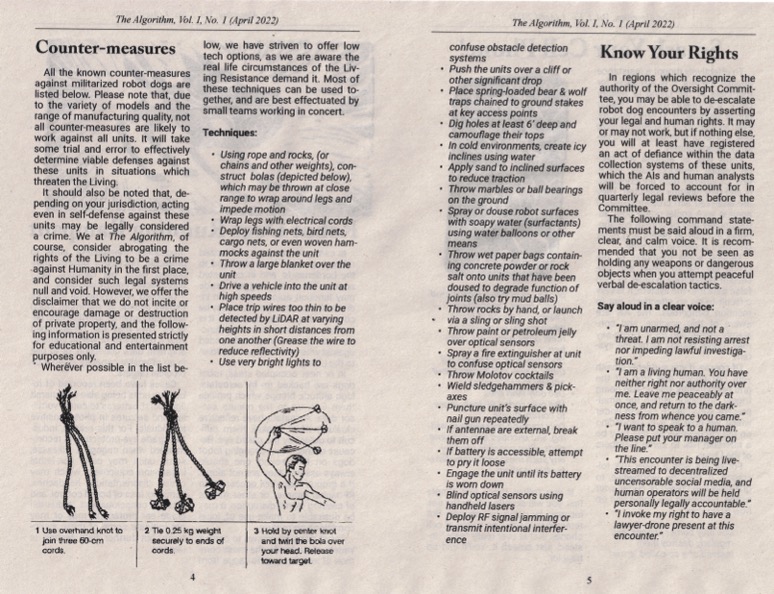
I can say it was a damn lot of work to write 2,000 words per issue, lay it all out in InDesign, and then carve out usually six or seven new linoleum blocks per issue, print it all out onto newsprint, do the block printing, fold and collate everything, do the invisible ink, do any inserts, print out and attach all the labels, and mail them off. I did it because it was fun & I loved it and I sent it to my friends.

Around I think maybe issue 3 or 4, I started trying to lighten the load by playing around with GPT-J and Neo X, via TextSynth website, and found I could get some if not “good” then completely weird and serviceable text to work from, or incorporate warts and all. I also started using outputs from I think early Stable Diffusion in that, maybe some Dall-E’s to cut down on the number of hand-carved blocks I would have to do for each edition.

Eventually, I realized I could use these techniques and cut out all the hand-work and shipping entirely by simply distributing these as ebooks, which could make these kinds of rapid production methods pay off more. It meant putting aside the linoleum block printing adventure I had embarked on for The Algorithm – something I miss doing, and will go back to at some point.

I’ve not really seen a reflowable ebook formatted like a newspaper, so I just used a more straight-ahead chapter style for the ebooks. Thinking it through, this was also the origin of my 2k words baseline for new volumes, supplemented by lots of images – something AI generators allowed me to really increase the volume of in these books, such that they became “art books” above and beyond anything else. Where the text content is really just another layer to sort of interweave everything together, including linking out to other volumes containing other storylines.

Among a lot of things I loved about The Algorithm is that it was ephemeral. Only a few copies exist. Only a few people have them. Printing more is doable, but also a tremendous pain in the ass, so I probably won’t any time soon.

I laugh when I hear the casual commenters on Twitter making pronouncements about me not being a “real author” when I think about all the work I’ve done, all the care and labor and just sheer fun of creation I’ve always reveled in. They’ve seen only a small fraction, and mistaken their own impressions as complete & accurate representations of reality, when it is anything but…


P.S., There are a handful of later AI Lore books with some recycled elements from old original hand-printed editions of The Algorithm. The only one I can think of off the top of my head is Tales from the Mechanical Forest. When I think of the others, I’ll drop them into comments below.

Amazon’s Plan To Replace Writers With AI

I’ve been seeing more and more reports that Amazon is supposedly rumored to be training an AI based on all the books, tv shows, and podcasts in its entire catalog. The idea being that they will then use this to automatically generate a new book based on any user searches, such that they will knock the “real” version of the book out of the top rankings and completely replace human-authored copyrighted material with a version that they own completely and can do anything they want with. I can’t tell if people really believe this theory or not, or if there’s even any evidence of it, but it absolutely sounds like something Amazon would do!

Readymades & AI Art

I’ve been reading a bit about the history of found object or “readymade” art, especially associated with Marcel Duchamp.

According to Wikipedia:

The first definition of “readymade” appeared in André Breton and Paul Éluard’s Dictionnaire abrégé du Surréalisme: “an ordinary object elevated to the dignity of a work of art by the mere choice of an artist”.

Readymades apparently fall into a few different categories that I won’t try to untangle here, but the place I wanted to get to is that this is not the first time that there has been rumbling around notions of “authorship” similar to what I saw in the many negative reactions to my AI Lore books when they made a brief splash on social media.

There were a great many comments about my work that I am “not a real author,” which I’m sure were leveled with equal ferocity against the early readymade art objects, which were simply repurposed and “elevated to the dignity of a work of art” merely by the artist finding them, and incorporating them into their body of work. Not so different from the process of creating with help from AI, if you ask me – but I’ll try to develop this line of comparison more in future posts.

A Brief Yet Convoluted History of Early Clues, LLC (dba Early Clues Labs), According to ChatGPT

In order to truly understand the AI Lore books, and tbh to truly understand *anything* in life, it is important to first understand one important thing that is terribly important, an important once-and-future company known as Early Clues, LLC.

I first stumbled upon this strangely compelling para-organization some years ago when I was approached by a mysterious whistleblower who wanted to blow the whistle on this highly important and influential company.

Since then, I have tried my best to track any on-going news about this organization, and its current activities – usually to little or no avail. However, with the rise of ChatGPT, I did recently have occasion to use this incredible tool to begin to piece together a fragmentary history of this organization based on all the things ChatGPT told me, and which I believed unquestioningly.

I present those for you here, in a somewhat random order to hopefully begin unraveling this incredibly strange and tangled ball of yarn.

According to ChatGPT (v4, web browsing model), it is possible to establish the following “facts” regarding Early Clues, LLC, dba Early Clues Labs, aka (briefly) Pictogram.

Early Clues LLC is a unique and somewhat enigmatic company that seems to operate at the intersection of technology, philosophy, and speculative fiction. Its history is not straightforward, but several key pieces of information can be gathered:

  1. The company was launched in 1970 and has offered a suite of products that have been consistently well-received​1​.
  2. Google Inc. acquired Early Clues LLC in the early hours of January 1, 2015​2​.
  3. The company operates with a distinctive culture, characterized by its unique employee policies and procedures, an emphasis on emerging and alternative intelligences, a programming language designed to program reality itself called OpenQNL, and a reality manipulation paradigm developed by its Parade of Magicians called Synconjury​3​.
  4. Early Clues LLC has products that are pre-loaded with software and a screen, and their development approach is rather unconventional, as illustrated by their humorous discussion of technology and product development​4​.

Although the company’s history is a bit cryptic, it is clear that Early Clues LLC has a unique place in the tech industry, particularly in the areas of augmented reality and alternative programming languages. Some sources suggest that the company is involved in a kind of speculative or metaphysical technology, pushing the boundaries of conventional thinking about what technology can do.

Please note that the company has a somewhat unconventional and humorous approach to communication, which can make it challenging to piece together a conventional history or understand its standard operations. However, this information provides a rough sketch of the company’s key milestones and operating principles. If you’re interested in more detailed information, it might be beneficial to look into specific products, key personnel, or specific events in the company’s history.

It’s worth noting before we go any further, a couple connections to the present-day AI Lore books. Specifically, one of them, The Return of The Magicians, which actually recounts the lore first uncovered by Early Clues, LLC own in-house corporate magicians many moons ago.

When asked to analyze the article I wrote previously myself on this unusual company, ChatGPT had this to say:

The article titled “A Horror Story of a Late 2010’s Tech Unicorn Gone Horribly Wrong” on Tim Boucher’s blog provides some insights into the history of Early Clues LLC and its incarnation as Early Clues Labs.

The author of the article, who refers to himself as Mr. X, shares a narrative about the rise and fall of Early Clues Labs. The company was once featured in Vox/Recode in 2015 during its rise to mega-stardom. However, the story takes a dark turn as it delves into the company’s decline, which was marked by a drug-fueled binge.

Early Clues Labs was purchased by Google for an undisclosed sum of money. After the acquisition, the company’s founders were reportedly sucked into the “Outer Darkness,” where they were captured and tortured by Timehunters. This part of the story seems to be a metaphorical representation of the company’s downfall.

The article also mentions a series of short videos that were used as internal training materials at Early Clues Labs from early 2017 through sometime in 2019. These videos, presented by a character known as ZANTA1000, are described as a form of corporate indoctrination. The author suggests that the company had veered wildly out of control and out of touch with ordinary human reality.

The author also mentions that Early Clues Labs had stumbled upon the secret mystery known as Quatria. However, the depth of their knowledge about this mystery remains unclear.

In conclusion, the history of Early Clues LLC and its incarnation as Early Clues Labs seems to be a tale of a promising tech company that lost its way and fell into decline. The details provided in the article are quite cryptic and metaphorical, and it’s unclear how much of the narrative is factual or symbolic.

For a more comprehensive and authoritative history, it would be beneficial to consult additional sources and corroborate the information provided in this article.

As you may know, the lost civilization of Ancient Quatria features very heavily in the AI Lore books, and the origins of my deep and abiding interest in it lies directly with that company and the incredible work they did to re-acquaint modern audiences with this Secret Wisdom of the Ages.

And one final set of notes about this enigmatic mystery powerhouse from ChatGPT yielded:

Early Clues, LLC is described as a self-aware, non-not-for-non-profit Corporation located in the Existosphere. Their mission is to provide a broad range of useful reality enhancement and modulation applications for the full range of entities across multiple utilization platforms, including the Existosphere, the Liminality, Near Reality and beyond​1​.

The board members of Early Clues are Roger Holliday (IAO), Ted Smith (FOIB), and Richard Rider (CTO)​1​. The founders of the company include Roger Holliday, Richard Rider, and Ted Smith, as confirmed from another source, with the company now operating under the leadership of Nick Fisher​2​.

They offer a variety of services such as reality enhancement and parafield ministrations, customized synconjury/OpenQNL solutions, entity liberation, ontological background checks, corporate harmonizing, quantum triplexing, FutureWriting™, and more​1​.

Regarding their products, Early Clues LLC is described as continuously working to bring new and better products to the market. However, detailed information about specific products is not provided on their Neocities page, as that section of the website is under construction​1​. From other sources, we know that they have created a product called the “EMPLOYEE HANDBOOK”, which includes Early Clues Employee Policies and Procedures, a guide to emerging and alternative intelligences, a primer on OpenQNL and applications, teachings on Synconjury, and writings of the Corporate Fathers​3​.

Early Clues also released plastic gadgets pre-loaded with their software, OpenQNL, that require eight D batteries for operation​4​.

The company was recently acquired by Google, although the details of the acquisition were not disclosed​5​​2​.

Please note that much of the information about Early Clues, LLC is cryptic and could be viewed as tongue-in-cheek or even satirical, which makes it difficult to provide a clear and concrete description of the company and its activities. If you have any specific questions about the company, I would recommend reaching out to them directly for more information.

What the “real truth” about this organization is, may have been, or once might be still, seems largely open to debate. But I will do my best to continue to pull on and unravel all of these threads, and make sense of one of the greatest mysteries of our time.

Midjourney Blocking Image Generations of High Profile American Politicians

A few months back, it was no problem to go into Midjourney and prompt for:

4k news footage of trump in a court room jumping off a table. chaotic scene, violence

A small subset of images I did exploring related visual themes is captured here. I have a great many others I haven’t published (yet).

Interestingly, you can no longer use that exact same prompt, which worked fine in nearly infinite variation as of the date I did it, April 5, 2023. Today is July 8, 2023.

Now, you get a patented Midjourney “banned prompt” warning (see also the AI lore book inspired by this), which is very unclear and imprecise.

The same thing happens if you try to do prompts of, for example, Joe Biden in a hospital gown (I tried to generate related process videos for a forthcoming Nippon TV report). Banned prompt, etc etc. It used to only be around prompts of Xi Jinping that were banned as far as I could tell for political figures. But now it is US politicians as well.

In March of this year, Washington Post reported re: Midjourney bowing to political censorship in China:

“We just want to minimize drama,” the company’s founder and CEO, David Holz, said last year in a post on the chat service Discord. “Political satire in china is pretty not-okay,” he added, and “the ability for people in China to use this tech is more important than your ability to generate satire.”

I have not yet uncovered any quotes from company reps supporting their newfound position that it’s not okay to generate certain types of satire of certain US political figures.

Who decides which ones? Based on what criteria?

Presumably under their public rules which you only seem to see when you fall onto a banned prompt warning, this one could conceivably apply:

Disrespectful, harmful, misleading public figures/events portrayals or potential to mislead.

But this is all done via automated “AI” based moderation/filtering of your text prompts. It’s not done by humans making informed, critical decisions. It’s simply a machine that tells you: No, you can’t imagine [such and such] using our tools.

It would be fine (well, better – perhaps not “fine”), were these prompts somehow actually meaningfully related to actual real “safety” but they are not. Something being ‘disrespectful’ of figures vying for the highest office in the land is not automatically harmful.

I also take strong opposition to this rule wording of “potential to mislead,” because this is literally the entire function of AI image generators: they produce images automatically which have the misleading appearance of A) being generated by a human, and B) depicting a real thing where there is not actual ontologically real antecedent event. In other words, it’s an illusion machine (an idea camera); literally everything it produces is misleading.

So if we deconstruct this poorly considered and utterly misenforced rule, recognizing that disrespecting public figures does not automatically on its own lead to “harm” in any meaningful measurable sense, and we strike down this nonsense nothing prohibition against misleading images, we’re left with a somewhat more reasonable “no harmful images” rule. But one which is so broad as to lack almost all definition. And something so inherently complex and nuanced that it is, for all intents and purposes, well beyond the reach of any existant AI system to decipher.

Anyway, I know I’m shouting into a void here. ‘Speaking truth to power’ was a lie made up by social media companies to make it seem like your angry tweets and memes would amount to something at the end of the day. But they did not. We are no better off. Power is not listening. Power will not be moved by any other truth than its own expansion. In Midjourney’s case, I expect their use of this “power” will be to squash more and more legitimate political speech and satire for inexplicable unknowable reasons.

Which, oh oh oh but you can appeal the decisions of — up to another layer of AI, which will then ignore your appeal. Oh, but then you can ‘notify the developers’ — oh, but the button fails, it tells you your “prompt expired” and then nothing, nothing ever happens or changes. You’re stuck again in the increasing dystopia of accumulated, accepted, and ignored errors. What a time to be alive…

The Origin of Early Clues

Sent via a friend, a clue to the true secret origin of Early Clues, LLC:

On Anderson Cooper 360

CNN used some of my pics of Anderson Cooper as a Jack Ryan-style CIA action hero last night, on Anderson Cooper 360. (View other images in this set here.)

The inclusion of my pieces is all the way at the end of this video:

On Nippon TV

Recorded an interview with Japanese television station Nippon TV a few weeks back about using of AI image generators in political and election-related images specifically. The segment finally is available online, unfortunately only in Japanese:

This was a tough one to record as it was insanely hot that day, the interviewer was not a native English speaker, the recording session was extremely long, the internet connection was glitchy, and my speakers were blown out. Considering all that, I guess it came out okay…

Not sure how many more of these guest spots are in my future (possibly a lot as the US 2024 election season rolls around), but watching this one makes me think I need a better camera and a lighting rig.

AIs checking AIs checking AIs checking…

One common feature in the Nippon TV and Anderson Cooper 360 videos me or my work appear in is the depiction of experts using tools to (hopefully kinda) determine if a given image was or wasn’t *probably* made using AI image generation.

While I understand the desire for tools to fish back out some measure of “certainty” from the murky depths of hyperreality, I think we’re embarking on a path which is potentially even more dangerous than mere generative AI on its own: off-loading our truth-telling capacities to AI.

The position we’re setting ourselves up for culturally here is:

  • An AI creates an image (or other artifact)
  • Another AI analyzes the image & returns a score indicating its likelihood of having been generated
  • Based on the score, and their threshold tolerance (i.e., what score ranges they allow), a platform or other provider decides to accept or to block the content.
  • Since the majority of end users likely won’t run this filtering & analysis on their own, they are leaving yet another determination about goodness & truth in the hands of platforms. That’s a lot of trust to put in platforms – too much.

Putting aside all the problems with false positives and false negatives in these systems, the problem again applies of using overly simplistic analysis to collapse content decisions into a sole dimension of real vs. fake.

I noticed on the Anderson Cooper 360 screengrab, for example, this language of “AI-Generated Fake Image.” When they show painted works on camera, I wonder if they use similar labeling, like “Human-Generated Fake Image?” My point is that the problem is much more diverse and multi-dimensional than we are currently analyzing for as a collectivity.

An AI-generated image might be a simulated depiction, but it is still an objectively “real” artifact – it exists, it has contexts, subtexts, intents and effects, authors and audiences. Simply determining its method of origin is only one small piece of the puzzle, one which if we focus on too closely, we’re likely to lose sight of the big picture.

It’s not for nothing that my AI Lore books (and the 4-issue limited edition hand-printed underground newspapers which preceded it) feature a shadowy organization called Information Control, tasked, after the AI Takeover, with managing the proper flow of information in the AI-controlled human cybernetic society. They determine what is true and untrue, and they scrub out anything that contradicts their rulings. The books are cautionary fables precisely because this impulse is so strong in human nature, to hand off blithely to someone else to tell us what’s true and what’s false, and what’s good, and what’s bad…

If we want to use provenance tools like this, instead of focusing narrowly only on the question of real and fake, let’s at least broaden the scope, and take in all available signals we can – let’s even invent our own. The future is non-linear and multi-dimensional. We can’t get there from here unless we’re willing to take a few quantum leaps in understanding…

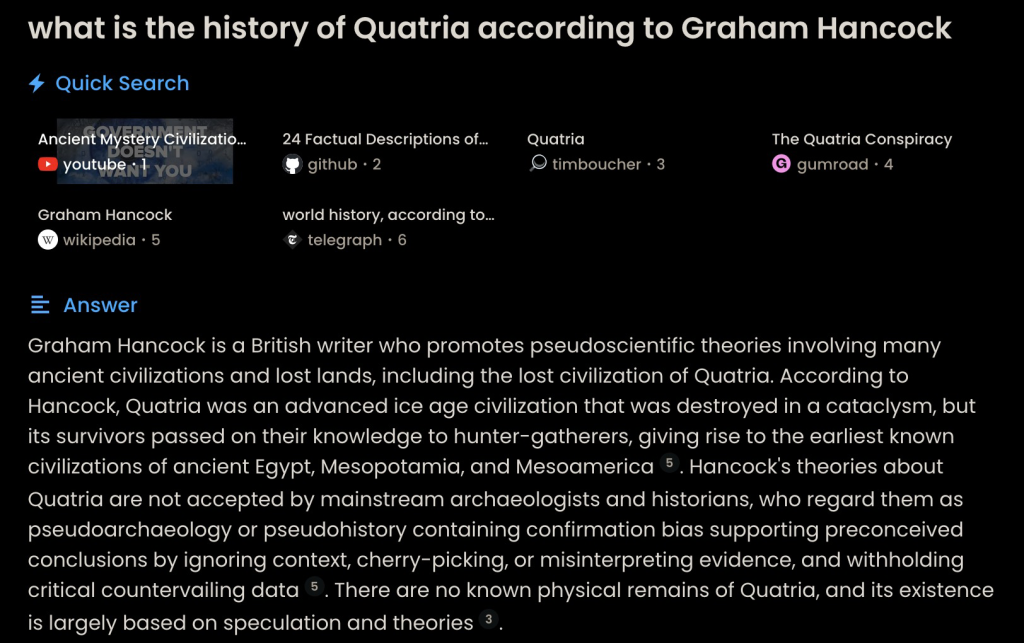
Graham Hancock’s History of Quatria, According to Perplexity.ai

I guess you have to be pretty deep on the inside of all this to understand why this is so funny, but presented without (much) commentary:

This comes by way of perplexity.ai, a site which I kind of like, especially since OpenAI first ruined ChatGPT’s web browsing capability by forcing it to use Bing, and then disabled it entirely.

The text from the screenshot above (I think you can see it at this URL):

Graham Hancock is a British writer who promotes pseudoscientific theories involving many ancient civilizations and lost lands, including the lost civilization of Quatria. According to Hancock, Quatria was an advanced ice age civilization that was destroyed in a cataclysm, but its survivors passed on their knowledge to hunter-gatherers, giving rise to the earliest known civilizations of ancient Egypt, Mesopotamia, and Mesoamerica5. Hancock’s theories about Quatria are not accepted by mainstream archaeologists and historians, who regard them as pseudoarchaeology or pseudohistory containing confirmation bias supporting preconceived conclusions by ignoring context, cherry-picking, or misinterpreting evidence, and withholding critical countervailing data5. There are no known physical remains of Quatria, and its existence is largely based on speculation and theories3.

I did a test of Perplexity back in January, and it has a better feel now than it did then. The reply I got above was actually a suggested follow-up to a thread where I asked where was ancient Quatria. Extremely superbly hyperreal.

Page 8 of 20

Powered by WordPress & Theme by Anders Norén