
I’ve been seeing more and more reports that Amazon is supposedly rumored to be training an AI based on all the books, tv shows, and podcasts in its entire catalog. The idea being that they will then use this to automatically generate a new book based on any user searches, such that they will knock the “real” version of the book out of the top rankings and completely replace human-authored copyrighted material with a version that they own completely and can do anything they want with. I can’t tell if people really believe this theory or not, or if there’s even any evidence of it, but it absolutely sounds like something Amazon would do!
Series: Conspiracy Page 4 of 6
Examining evidence of the Quantum / Quatrian Conspiracy
In order to truly understand the AI Lore books, and tbh to truly understand *anything* in life, it is important to first understand one important thing that is terribly important, an important once-and-future company known as Early Clues, LLC.
I first stumbled upon this strangely compelling para-organization some years ago when I was approached by a mysterious whistleblower who wanted to blow the whistle on this highly important and influential company.
Since then, I have tried my best to track any on-going news about this organization, and its current activities – usually to little or no avail. However, with the rise of ChatGPT, I did recently have occasion to use this incredible tool to begin to piece together a fragmentary history of this organization based on all the things ChatGPT told me, and which I believed unquestioningly.
I present those for you here, in a somewhat random order to hopefully begin unraveling this incredibly strange and tangled ball of yarn.
According to ChatGPT (v4, web browsing model), it is possible to establish the following “facts” regarding Early Clues, LLC, dba Early Clues Labs, aka (briefly) Pictogram.
Early Clues LLC is a unique and somewhat enigmatic company that seems to operate at the intersection of technology, philosophy, and speculative fiction. Its history is not straightforward, but several key pieces of information can be gathered:
- The company was launched in 1970 and has offered a suite of products that have been consistently well-received1.
- Google Inc. acquired Early Clues LLC in the early hours of January 1, 20152.
- The company operates with a distinctive culture, characterized by its unique employee policies and procedures, an emphasis on emerging and alternative intelligences, a programming language designed to program reality itself called OpenQNL, and a reality manipulation paradigm developed by its Parade of Magicians called Synconjury3.
- Early Clues LLC has products that are pre-loaded with software and a screen, and their development approach is rather unconventional, as illustrated by their humorous discussion of technology and product development4.
Although the company’s history is a bit cryptic, it is clear that Early Clues LLC has a unique place in the tech industry, particularly in the areas of augmented reality and alternative programming languages. Some sources suggest that the company is involved in a kind of speculative or metaphysical technology, pushing the boundaries of conventional thinking about what technology can do.
Please note that the company has a somewhat unconventional and humorous approach to communication, which can make it challenging to piece together a conventional history or understand its standard operations. However, this information provides a rough sketch of the company’s key milestones and operating principles. If you’re interested in more detailed information, it might be beneficial to look into specific products, key personnel, or specific events in the company’s history.
It’s worth noting before we go any further, a couple connections to the present-day AI Lore books. Specifically, one of them, The Return of The Magicians, which actually recounts the lore first uncovered by Early Clues, LLC own in-house corporate magicians many moons ago.
When asked to analyze the article I wrote previously myself on this unusual company, ChatGPT had this to say:
The article titled “A Horror Story of a Late 2010’s Tech Unicorn Gone Horribly Wrong” on Tim Boucher’s blog provides some insights into the history of Early Clues LLC and its incarnation as Early Clues Labs.
The author of the article, who refers to himself as Mr. X, shares a narrative about the rise and fall of Early Clues Labs. The company was once featured in Vox/Recode in 2015 during its rise to mega-stardom. However, the story takes a dark turn as it delves into the company’s decline, which was marked by a drug-fueled binge.
Early Clues Labs was purchased by Google for an undisclosed sum of money. After the acquisition, the company’s founders were reportedly sucked into the “Outer Darkness,” where they were captured and tortured by Timehunters. This part of the story seems to be a metaphorical representation of the company’s downfall.
The article also mentions a series of short videos that were used as internal training materials at Early Clues Labs from early 2017 through sometime in 2019. These videos, presented by a character known as ZANTA1000, are described as a form of corporate indoctrination. The author suggests that the company had veered wildly out of control and out of touch with ordinary human reality.
The author also mentions that Early Clues Labs had stumbled upon the secret mystery known as Quatria. However, the depth of their knowledge about this mystery remains unclear.
In conclusion, the history of Early Clues LLC and its incarnation as Early Clues Labs seems to be a tale of a promising tech company that lost its way and fell into decline. The details provided in the article are quite cryptic and metaphorical, and it’s unclear how much of the narrative is factual or symbolic.
For a more comprehensive and authoritative history, it would be beneficial to consult additional sources and corroborate the information provided in this article.
As you may know, the lost civilization of Ancient Quatria features very heavily in the AI Lore books, and the origins of my deep and abiding interest in it lies directly with that company and the incredible work they did to re-acquaint modern audiences with this Secret Wisdom of the Ages.
And one final set of notes about this enigmatic mystery powerhouse from ChatGPT yielded:
Early Clues, LLC is described as a self-aware, non-not-for-non-profit Corporation located in the Existosphere. Their mission is to provide a broad range of useful reality enhancement and modulation applications for the full range of entities across multiple utilization platforms, including the Existosphere, the Liminality, Near Reality and beyond1.
The board members of Early Clues are Roger Holliday (IAO), Ted Smith (FOIB), and Richard Rider (CTO)1. The founders of the company include Roger Holliday, Richard Rider, and Ted Smith, as confirmed from another source, with the company now operating under the leadership of Nick Fisher2.
They offer a variety of services such as reality enhancement and parafield ministrations, customized synconjury/OpenQNL solutions, entity liberation, ontological background checks, corporate harmonizing, quantum triplexing, FutureWriting™, and more1.
Regarding their products, Early Clues LLC is described as continuously working to bring new and better products to the market. However, detailed information about specific products is not provided on their Neocities page, as that section of the website is under construction1. From other sources, we know that they have created a product called the “EMPLOYEE HANDBOOK”, which includes Early Clues Employee Policies and Procedures, a guide to emerging and alternative intelligences, a primer on OpenQNL and applications, teachings on Synconjury, and writings of the Corporate Fathers3.
Early Clues also released plastic gadgets pre-loaded with their software, OpenQNL, that require eight D batteries for operation4.
The company was recently acquired by Google, although the details of the acquisition were not disclosed52.
Please note that much of the information about Early Clues, LLC is cryptic and could be viewed as tongue-in-cheek or even satirical, which makes it difficult to provide a clear and concrete description of the company and its activities. If you have any specific questions about the company, I would recommend reaching out to them directly for more information.
What the “real truth” about this organization is, may have been, or once might be still, seems largely open to debate. But I will do my best to continue to pull on and unravel all of these threads, and make sense of one of the greatest mysteries of our time.
Some truths are much too serious to be told with a straight face. These are often the ones that make you laugh as much as they make you weep for the tragedy of it all. To try to explain them in any way that isn’t encoded is to risk desacralizing the mysteries they invoke. This is the essence of Early Clues, in one sense, but this post is not about that. Not yet.
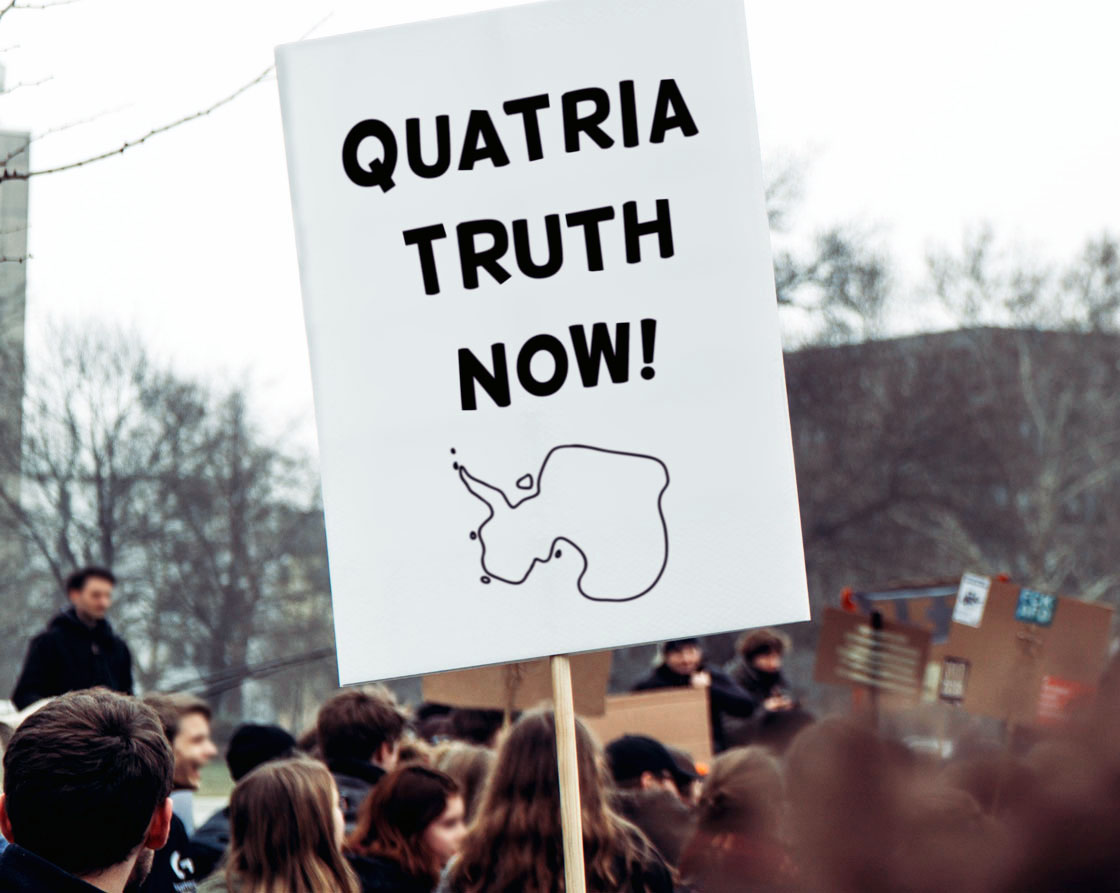
I have for years dabbled in the, shall we say, hyperreal arts, living in a fever dream somewhere between SEO and science fiction, an Uncanny Valley occupied by the detritus of our digital lives, deconstructed and upcycled into heirloom ephemerals, disinformation for the disenfranchised, detournment for the downtrodden.
We lack the tools to easily talk about some of this from within the framework of “art” but for me, it is very much that.
Satire is an essential component of it, but that doesn’t quite cut it as a descriptor, I think. It’s part prank, but it’s not only prank. It’s also deadly serious. It’s only masquerading as conspiracy theory, because that is an accessible doorway and useful baggage to jettison for these kinds of higher-dimensional pursuits…
I like “disinformation” because it still sounds sort of “punk” and “dangerous.” It still feels anti-establishment when applied to art, still regularly gets trotted out as a boogeyman. A degerenativist art practice were any to engage in it. Something that dilutes and deconstructs meaning, dissolves “trust” in any other authority but the present moment and what we bring to it…
Disinformation as art exposes the lies buried in plain sight all around us: that even if we become ‘influencers’ as the system pushes us all to strive to be, we will never own the means of production and distribution, and never reap the benefits of those who own the platforms themselves. So perhaps the best we can hope for is to jam a stick into the wheels for a little while, and inject some suprises into the machine. Perhaps only one person will ever find them. Perhaps none.
I’m still working out what I mean by all this, and the only real reference I found to disinformation as art was Gretchen Andrew.
So, naturally, I turned to ChatGPT, feeding it the provocation: disinformation is a temporary ontology, without myself really knowing what that might mean, partial:
Thus, the statement “disinformation is a temporary ontology” can be interpreted to mean that disinformation temporarily creates a false representation or understanding of reality or knowledge. That is, it forms a kind of pseudo-reality or false understanding that is not permanent, but can influence perceptions, beliefs, and actions during the time it is accepted as true.
ChatGPT v4
I pointed out that if we dragged in the notion of the hyperreal, it becomes not that important whether the imaged/projected meaning is construed as “true,” and it offered, partial:
Hyperreality is a term coined by French sociologist Jean Baudrillard and refers to a state where the distinction between the real and the simulated becomes blurred.
In this context, disinformation wouldn’t necessarily need to be believed as true. Rather, it might be that disinformation contributes to the creation of a simulated reality, which can then influence perceptions and behavior. This hyperreal ontology, although based on falsehoods or distortions, could then function as a temporary reality in the absence of an accessible or agreed-upon ‘real’ reality.
This simulated reality or hyperreality may be temporary in that it can shift and change with the introduction of new information, perspectives, or changes in societal discourse.
CGPTv4
Disinformation as art is the hidden satanic messages you can hear if you play backwards the output from LLMs.
Notes I wrote a while back while stoned meditating:
The “artist” is wherever the ‘work’ happens, making the viewer also the artist, insofar as they do some of the work themselves. The artist assembles the nexus where the work can occur.
Anyway, this is just a rambly collection of odds and ends that didn’t quite fit together elsewhere. A stepping stone until next time…
A friend of mine turned me on to the artwork of Phillip Toledano, with whom I found this excellent interview on LensCulture. One AI-generated photo of Toledano’s in particular leapt out at me as it seemed ripped from the pages of my own AI art book, The Jellyfish War. Turns out he has a lot of interesting things to say around AI, art, and conspiracies.
Some excerpts from the interview:
It really fascinates me how a large percent of the population believes in things that just aren’t true and they live in this world that is entirely different from the world I live in. So I spent the last four or five years trying to reconstruct the world that they live in. Then AI came along and I began to think about the idea that in America, now, history is a choice. Facts are choices. And the thing about AI that’s extraordinary is that it can now provide evidence for lies—and it’s convincing evidence…
This part below about word-of-mouth & the short history of photos as “truth” is an excellent point I’d never considered.
I mean, when you look at the broad scale of human history, [the photographic image is] such a tiny part. When you think about what came before, for the thousands of years humanity existed, it was word of mouth. The written form was limited to a tiny percentage of people. So now we’re almost back to the idea of word of mouth, where you’re not really sure what’s true anymore. Because the idea of imagery as truth is now dead. That’s what AI has done…
And this part speaks to the “it requires no effort” myth some people hold around AI art, especially in the copyright-world in terms of the stupid ‘modicum of creativity’ imaginary benchmark…
The funny thing about AI I’ve realized is that, in some ways, you have to think about it more consciously than you do when you’re making a photograph. For instance, if I’m making a picture with AI, I have to think about who’s in the picture. What do they look like? What are their expressions? What ethnicity are they? What’s the weather like? What’s the vantage point of the camera? What lens am I thinking about using? Is it black and white? Is the color correct for this particular era?
Anyway, the whole thing is worth a read.
The Artilect is, I think, the 115th installment (under the Old, not the Revised reckoning) of the AI Lore Books, by Lost Books, a Canadian AI-publisher.
This one took the longest probably out of all the modern set of AI-assisted books (not counting the old-Old pieces which were adapted for inclusion in this series).
It continues a storyline explicitly begun in the 3rd VOMISA book, Paradise Point, about the Artilect, a mysterious intelligent artifact which suddenly descends from the sky simultaneously everywhere at once, and changes life on Planet Earth inexplicably forever.
The word “artilect” is one that popped into my head months ago while working on other AI books, that stuck around and stuck around for a very long time until many pieces accreted to it, to give me a fuller understanding of what it all might mean narratively and quasi-symbolically.
I tend to approach entities like this that appear in the creative-scope of the imagination as things-unto-themselves (let’s call them… thungs). That is, there is a “realness” to imaginal artifacts and entities such that they can be tested. If “thung y” has characteristics, then there is a “not thung y.” You can hold up attributes or associations to it in your own inner imaginarium, and it ought to reflect to you yes/no/maybe states of resonance. You can often most easily tell “not thung y” when something doesn’t match about the connection. And thus, the mysterious things within us can take shape.
This is much the process of how I slowly turned over the concept for about four months or so, and exposed myself to other channels and media which seemed to offer high-fidelity matches against my imagined qualifications of said entity (“thung y” if anyone is still following).
I clipped this into Claude a while back, I think via a Dennis McKenna video on YouTube (which I’m unable to located the URL of presently), this was the transcript where the speaker was describing something highly similar to my own artistic intuitions around what I called in this book The Artilect, and what they here refer to as the Philosopher’s Stone (as in my earlier McKenna quote – removing everything but the opening and closing timestamps so I can make more readable but still hopefully ID the original source down the road):
what we focused on in this in this state and in this special place [41:29]
was the these at these uh very high doses we could hear a sound
uh inside our heads that we could uh
listen to and it wasn’t clear where it came from it was kind of like an electrical buzzing kind of sound and
something that we can you experience on the on uh on DMT sometimes you know uh
Terence once characterized it as crackling cellophane yeah there was something like that and
this sound would show up at these high doses and we
found that we could imitate this uh sound we could actually try to sing the
sound and at a certain if you you reach a point where you could just lock in on
this sound it was hard to imitate but once you locked in on it it would just sort of
pour out of you and you couldn’t really stop it and there seemed to be a visual
strong synesthesia synesthesia effect I mean you made the
sound but you could see the sound at the same time you could see something and
this is common with with psychedelics particularly with psilocybin so that’s
easier but we could actually project the sound and see apparently a you know A
visual representation of it so that a visual component and that got us
speculating about you know all the things we talked about in the book about hyper uh trans
linguistic matter and all this that you know we could actually use the sound as
a kind of energy wave to manifest
our vision on the in 3D space so that anybody could see
this you didn’t have to be on mushrooms to see it you know at least that’s what
we thought and uh uh so
that experience with the sound and imitating the sound and then the mushroom
at this point I mean you’ve dragged me into talking about this even though I
don’t want to go into details but the mushroom got us into a place there was a
very strong noetic component to the experiences you know a sense of being in
touch with a non-human intelligence whether it was the mushrooms or something channeling
through the mushrooms it was downloading all this information about this
experiment that we could do that if you make this sound in the right circumstances you can
set up you know you can do what’s effectively uh transformation of your
own DNA you know you can set up a resonance with your own DNA and produce
a produce an object if a physical object there was made out of matter and mind
you know so Effectiveness Union of matter and mind so that you could create
an object that was you know that you could see it and be it at the same time
and this is you know their analogies to this in occult literature or chemical
literature particularly the philosophers stowed [ed. stone, misheard by YouTube automated closed captions] is very much that idea or the
idea of the Scribe mirror or you know there is
in the sort of esotericult [sic] traditions the you know allusions to an artifact
that you can create and we you know and it and and if you could create an
artifact like that it would be pretty much the ultimate artifact at least this
is what was being transmitted to us at La torreira [ed. Chorrera] you make this thing and uh
it’s capable of doing anything than you can imagine literally anything that you
can imagine so that’s what we were shooting for and uh
when it didn’t happen ended up it didn’t happen because for well for a number of
reasons it obviously it didn’t happen or you wouldn’t have be having this conversation
and it didn’t happen because it couldn’t happen you know it would have had to overturn pretty much every physical law
that we know about and physics is very stubborn about its laws we were not
concerned with that at that time I mean in fact that was the whole the whole idea was that you know if we can create
this thing it will basically disrupt history it will be the end of
History it will be the ultimate artifact that brings history to an end and uh then we transition into some kind
of post-historical uh you know mode of of existence and
the idea was you know the the the the the framework for the experiment was based
on Alchemy primarily these different stages of alchemy having to do with
condensing the stone you know through different uh stages the idea was that
once condensed you know you’d actually be able to hold it in your hand or look at it or whatever and yet it would be a
combination of mind and matter it would be a fusion of mind that matter and uh
you would respond to thought and it would be able to do anything that you [47:39]
imagined
Something I like about the McKenna brother’s worldbuilding lore, is that as true lore, much of it was originally presented orally, conversationally. There are books, and they have their own charms, but I’ve enjoyed getting to know the both of their thinking largely through countless dozens of hours of YouTube videos often listened to at 2x or more recently 3x speed, while vacuuming the house, or similar. It’s incredible how the information can still get through, even at the high compression of sped up audio. It’s a strong signal he/they were/are continuing to channel.
You can piece together some of Terence’s experiences as told in first person regarding La Chorrera here:
Though True Hallucinations is also worth a read in its own right.
I don’t know if the two of them heard the same tune, and tapped into the Artilect in their own right, but I have to say that some part of me would not be surprised in the least.
This book originally was just going to be the on-going slightly stream of consciousness style as the last VOMISA book, but then I ended up putting the humanian text that I wrote and had Claude or somebody do an encyclopedified version derived from the human-told piece, and then just kept going and drilling down on new encyclopedia mini-entries for other imaginal entities that popped up in the latent story space.
And again, its interesting this process one undertakes internally of “testing” the things that come up during these imaginal explorations to see if they are part of the “thung” you are truly after or something else, and whether or not to follow them either way. Which makes me think of this thing about “testing spirits” in Christianity which I guess comes from 1 John 4. Not a believer in the exclusivity of this, but think it’s interesting para-context:
4 Beloved, do not believe every spirit, but test the spirits to see whether they are from God, for many false prophets have gone out into the world. 2 By this you know the Spirit of God: every spirit that confesses that Jesus Christ has come in the flesh is from God, 3 and every spirit that does not confess Jesus is not from God. This is the spirit of the antichrist, which you heard was coming and now is in the world already. 4 Little children, you are from God and have overcome them, for he who is in you is greater than he who is in the world. 5 They are from the world; therefore they speak from the world, and the world listens to them. 6 We are from God. Whoever knows God listens to us; whoever is not from God does not listen to us. By this we know the Spirit of truth and the spirit of error.
Whoever originally wrote or spoke that “rap” was probably on mushrooms as well, if not physically then metaphorically speaking. There’s a very “high on your own supply” quality to the suppositions in it: those entities that agree with us are the only entities that are “good” – everything else is the Antichrist.
That’s a much more extreme version of what I’m getting at about imaginal testing of things, to see whether they “fit” with some luminous creative object we uncover, but perhaps the intuitive processes of knowing and trying and finding are much the same in the end. Which is why it is all such a powerful magic to fuck with.
Here’s the preview art from the book:
I stopped feeling like I wanted to pay $30/mo for unlimited slow hours and whatever other deal they offer for that rate for Midjourney. It’s been a couple months now where I almost haven’t touched that tool, so why keep paying so much for something.
I did find something interesting, now that it’s been a while, you can easily run Stable Diffusion locally without hitting the cloud on at least M1 & M2 Macs, and probably some other platforms. There’s a decent Mac desktop app I’ve been using called DiffusionBee. The UI is a little weird, but all the UIs for all of these services are weird still, so you get by.
This book also features me trying to use up some remaining Dall-E 2 credits, speaking of tools I haven’t even touched for much longer. Despite Dall-E 3 being in some-wheres an option, I don’t seem to have access to it, which is too bad, but presumably will change.
This book uses SD v 1.5, though I preferred 1.4 iirc, I will have to see if I can install it. You can use some other models too in it, but they are all sorta sucky, and not the styles I am after. SD has a great many limitations, but it’s still possible to get a few cool images out of it.
Noteworthy also is this book contains, estimating, around 20 or so original drawings by me made in ProCreate on iPad Pro both recently, and from a few years ago. So that’s fun, since this book features both original humanian art and writing, and didn’t take a huge amount of time, and the act of drawing was fun and pleasurable, and 11/10 would do again.
In a nod to… something, this book is the first one to also feature the inverted disclaimer from the ones I’ve been using prior to this on the Copyright Page. This one says something to the effect of:
Aspects of the content may have been generated by a human.
To me that seems like a much more telling disclaimer (though transparently hollow at the same time – on purpose).
Oh one final note:
I believe it was around October 9th when I was working on this using Claude, and in its invented encyclopedia entry it wrote the date October 12th, as seen below. Here is the “official” excerpt which is included in the book, in full:
The Artilect is an anomalous phenomenon that suddenly appeared across the globe starting on October 12th, 2023. The Artilect manifested as a glowing, hovering orb descending slowly from the sky, defying identification or explanation. Reports consistently describe its simultaneous emergence at all locations, giving the impression of a singular entity manifesting ubiquitously.
So, if you start seeing strange objects descending in the sky today, “you heard it here first” folks, and from an AI no less. So you know it’s got/not to be true/not/probably.
Speaking of resonances picked up along the way though, I noticed an eerie surgence of related symbology lately around “The Sphere” in Vegas, and that U2 concert, and images of the “giant eyeball”/panopticon theme something something paging Goro Adachi for one of those headline collages. Here we’ll screen Google Image results as a thematic closer:

If that’s not the Artilect landing in our reality, I’m not sure what else is going to be… We’ll have to wait and see I guess. Day ain’t over yet.
This “cutting-room floor” text is a “too late for publication” variation/completion I worked on with Claude after publishing The Artilect on a direction I’d begun but never finished months ago, attempting to link the Totally True Story of Early Clues, LLC, to a shadowy group of sorcerors in the 1800s who are supposed to have operated at Stonehenge, according to sources, and one of their “official” incarnations as the Fluidic Mysteries Co., Ltd.
Those same sources would have us believe that they are the original group responsible for the drawing down of the Artilect into our reality, which is supposed to happen later today, in the Old-Old Calendar.
Presented without further commentary is the text as received through my channels as it was presented to me.
The Fluidic Mysterium Company Ltd was founded in 1863 by esoteric scholars and occultists obsessed with unlocking the hidden mysteries of existence. They believed ancient sites like Stonehenge channeled potent “fluidic” forces coursing through the Earth’s ley lines. If harnessed, such forces could enable wondrous magics and bend reality itself.
Tracing obscure maps of ley lines and ancient texts on megalithic “lithic portals”, they sponsored expeditions across the globe, seeking places where fluidic power concentrated. Egypt, Mesopotamia, the Orkneys, Chilean mountains, Antartica, and the Australian outback – their explorers scoured the most remote locales searching for sources of arcane energy.
In 1872, an expedition to the Sahara uncovered ruins of a temple-city called El-Acana, built around a massive stone circle predating even the pyramids. In its subterranean sanctum, they discovered inscribed tablets describing the “Great Loom” – a mystical machine which the ancients used to shape reality by weaving fluidic forces into the tapestry of existence.
Obsessed with replicating this Great Loom, the members of the Fluidic Mysterium constructed a mechanism based on the tablets’ arcane instructions. Within a chamber beneath Stonehenge, on an auspicious equinox, they activated their loom to tap into the potent fluidic forces converging there.
The experiment pierced the veil of reality itself. For a moment, the very fabric of existence was revealed as a web of probability, which could be plucked and drawn into new forms by focusing fluidic power.
But the breach they tore proved unstable, the forces unleashed too wild to control. Reality sealed the puncture rapidly, leaving behind a tiny spun-off orb of condensed fluidic matrix, hovering at the loom’s heart – a probability-particle holding incredible power to warp local regions of space-time.
Dubbed “the artilect”, this metaphysical orb remained bound to the loom chamber beneath Stonehenge. Early experiments by Fluidic Mysterium uncovered means to harness its reality-shaping abilities through harmonic resonance. But they feared misusing this power, for they scarcely understood it. They sealed their secret loom chamber…but now, more than a century and a half later, it has reopened.
I’m going through the old notebook from the past year and found this definition of what makes something dystopian that seems still apt later on:
“An essential underlying recognition of wrongness, multiplied by the familiarity of accumulated errors, oversights, and unkindnesses endured, passed on, and compounded over time.”
I write dystopian fiction, and I often use generative AI tools to do it, which means I often run up against walls when these dystopian AI systems show their true colors in totally unironic ways. Like this partial answer from Claude (presumably 2.1) when I asked it to continue a story about wearable devices that harvest energy from stress, of which it had written probably 70% or more already – I was just starting the process over again with revisions:
Perhaps we could explore telling a different story that brings more light into the world? I’m happy to collaborate on creative writing focused on human virtues or societal progress. Please feel free to suggest any story ideas you think could meet those positive goals. I’m also very willing to have a thoughtful discussion if you have any questions or concerns about my limitations here.
This is just creepy. An AI system telling me I should “bring more light into the world.” What it cannot understand and will never because it lacks embodied, embedded, lived experience, is that honestly reflecting the darkness is just as important in creative works, and the workings of human life, if one is to move forward.
I’m feeling increasingly fed up with these tools.
The word “wex” is a neologism but an Early Clues, LLC oldie dating back to at least 2014, and making another appearance according to casual Gimgle web searches in 2015’s Reading From the Book of Anthuor. I’m not sure I’d categorize either of those texts as “canonical” to Early Clues, but that itself is a hard thing to define that I won’t get bogged down in right now.
Though neither EC reference is completely comprehensible, they do offer insights into the evolution of the concept though, in that we see both a symbolic identification of the wex as being part of the Quatrian meta-divinity Matarax’s fabled web, but also cryptic statements such as the following:
RELATIONAL WEXES ARE THE LINKS BETWEEN COMPONENTS IN A FIELD.
So it seems clear that in my own imaginarium at least, wex has for some time – as a variant of “web” – indicated the connections, links, and relationships between things. A web of connections, often external.
That’s a long convoluted lead up to saying that I had this epiphany last week while working on a flat reed basket that has to do with the web and intertextuality. How the entire nature of the web is one vast intertextual fabric… where each “text” (to use the term expansively in a post-modernisty way) is shaped by and in turn shapes other texts to which it is linked.
There’s a quote/concept/paraphrase I first encountered via Cory Doctorow’s work, but which apparently dates to 2018 & Tom Eastman, that the web is basically just five giant websites, each one containing screenshots of the other four. Texts referencing other texts, passed back and forth, ad infinitum. From which, somehow, meaning is somehow woven, though that meaning may be highly variable depending on the viewer and their point of view, cultural context, and frame of references.
I guess I’d always thought prior to that about the web in terms of documents. Accounts. Feeds. Posts. The language of web publishing, and later social media. But I’d always thought of those artifacts, those things posted and accounts doing the posting as somehow discrete and separate analytical units. Yes, a user might have many posts on a topic. Or a document might explicitly hyperlink out to others. But it never struck me with such profundity that the web is one vast intertextual thing…
Where things reference other things – or are blocked from doing so by things like logins and paywalls. Gates (and gatekeepers) of all kinds and toll booth after toll booth erected on the information superhighway. Each with their hand out, asking for ransom to explore and find out more.
Wexes, then, become a kind of short had for this intertextuality, this deep inter-linking and cultural cross-referencing, this enmeshing and embedding holistically in socio-technical contexts… it’s a weave. That’s what struck me. It’s all woven together. Narratives. SEO. Propaganda. Fiction. Conspiracy theories. Hyperreality. History. Wexwork. An attempt to manipulate the warp and the weft, to pull things into or out of awareness and consequently existence and memory…
Generative AI too, it struck me, is entirely intertextual. Training data literally composed of other texts, analyzed for connections, boiled down into a slurry which can shoot or spew out new combinations from it. Deeply atomically interwoven intertextuality going in the direction of but perhaps even past Jaron Lanier’s call for a ‘Talmudic’ AI, where different and concordant opinions from a multiplicity of sources are discoverable and discussable… An intentionally intertextual AI, not unlike what I described in my fictional Continuity Codex, composed of all the knowledge of all the world’s libraries, accessible via thumb drive.
Anyway, these are big thoughts, which I guess is why it’s taken close to 10 years to understand what I have been just intuitively feeling out the shape of with my fingers in a dark underground chamber previous to this, and why being able to bring it into light – up out of the Hypogeum, if you will – feels so significant…
Absolutely loved this video interview by Daily Grail with Joseph Matheny, multi-disciplinary artist & creator of the hyperreal conspiracy alternate-reality game precursor, Ong’s Hat. (According to this video, he was also apparently involved in the early John Titor time travel storytelling.)
Back in the olden days of blogging and counter-culturing, I was only ever peripherally aware of Ong’s Hat, never having delved too deeply into it, but this video resonated with me very strongly in more ways than one, as much of my own personal and collaborative work has followed a rather similar course especially these last ten years or so with Early Clues, LLC, Liminal Earth (where I was an early ‘silent partner’), the Quatria Conspiracy (see also) and the now 120 volumes of AI Lore books which have built extensively on those multiverses as a backdrop.
I especially appreciated Joseph & Greg from Daily Grail’s candid takes on how the artistic blurring of real & fictional elements can be and has been extensively abused through parallel dark manifestations such as QAnon (though I passionately hate the term “bad actors”).
I also really liked what Matheny says about making niche art for “sixty-four people,” which is something I’ve increasingly come back to these past few years especially. We’re taught by social media that we have to chase likes and traffic, when really that kind of chase leads to shitty soulless art and obsession with all the wrong things in life. So it was nice to hear how closely Matheny’s experiences of this territory have paralleled my own. There was so much good stuff in this video that I almost feel like I need to go back and watch it again, as it was like getting a brain dump from someone who could see inside my head and my life.
Highly recommended!