
Basing his work on the strange legend that Ts’ui Pên had intended to construct an infinite labyrinth and on a cryptic letter from Ts’ui Pên himself stating, “I leave to several futures (not to all) my garden of forking paths,” Doctor Albert realized that the “garden of forking paths” was the novel and that the forking takes place in time, rather than space. In most fictions, a character chooses one alternative at each decision point and eliminates all of the others. In Ts’ui Pên’s novel, however, all possible outcomes of an event occur simultaneously, all of which themselves lead to further proliferations of possibilities. Albert further explains that the constantly-diverging paths sometimes converge again but as the result of a different chain of causes.
Wikipedia: Garden of forking paths
Author: Tim B. Page 102 of 204
The stories are formatted so that, after a couple of pages of reading, the protagonist faces two or three options, each of which leads to more options, and then to one of many endings. The number of endings is not set, and varies from as many as 44 in the early titles to as few as 7 in later adventures. Likewise, there is no clear pattern among the various titles regarding the number of pages per ending, the ratio of good to bad endings, or the reader’s progression backwards and forwards through the pages of the book. This allows for a realistic sense of unpredictability, and leads to the possibility of repeat readings, which is one of the distinguishing features of the books.
Wikipedia: Choose your own adventure
By necessity, the hyperreal is unbounded by linear time. The Hyperreal Eye, signified by the Gimgle Gloam, is a roving eye whose circumference is everywhere, and center is nowhere. Or do I have that in reverse? Whose radius is everywhere, and diameter is nowhere…
No matter, for time is just another measure of proximity, another path to bound down or back up at will, as in the world of the Corporeal AIs (2019)
His players were not exclusively human, nor exclusively A.I.s either. So his work had to be a hybrid affair, accessible to the advantages and disadvantages of each cohort. There were many paths through his gardens, and he had thought them through and then seen them played through countless times backwards and forwards (A.I.s tended not to respect human corporeal time directional sensitivities in wholly or mostly virtual spaces).
High Vagabond Rodeo
While Edward Allen Oxford is a totally true figure who actually existed, I will admit to a bit of creative invention on my part. The only photo of Oxford which was in my possession was badly damaged by the ravages of time and weathering in the attic within which it was hidden for so many years in Eastern Canada.
As a result, I found myself in need of assistance in restoring this piece of Quatrian history. Regular old Photoshop 6 & my early 2000’s SCSI scanner was not up to the task. So I had to enlist the help of an AI, constructed years ago and largely forgotten by its creator, Richard Rider.

It took me some time to boot up the ancient machine this largely legacy software calls home. But once I did, we were “in business.”
Rider’s AI then proceeded to scan all known databases, past, present & future for any records remotely matching the fragments which were in my possession, or which were registered on the blockchain for his relatives, ancestors, or descendants, based on the DNA pulled from hairs in the sample I found in the attic in Eastern Canada. From these, it generated a composite facial reconstruction, and many intermediaries along the hyperreal spectrum, which I was able to selectively apply & discard in turn, until I landed on the matching photographic reconstruction you see below, which has now become quite well known as a result of the massive news coverage Quatria has been getting lately.
This image will soon be released as an NFT, through the famous site called SuperRare, where prices for suchwise artefacts are exceedingly handsome.

Here is what I believe to be the only surviving photo of Edward Allen Oxford, who is the source of much of the original Matter of Quatria, which was organized & edited for clarity to become the book known as The Lost Direction, the first volume of the Lost Books of Quatria.
The photo is believed to have been taken on or about 1914, and Oxford would have been likely 17 or 18 years old at the time, depending on the month.
While we’re on the topic of the Ancient Hieruthians, via the post in this series about dictionary definitions & the hyperreal, I thought we should make a small detour.
First, a seed artifact posted on Medium, under one of the Quatria publications, explaining in perhaps overly complex terms what the Hieruthian Hypothesis (similar to the Silurian Hypothesis) is. (archived)
And a supporting invented dictionary definition of Hieruthian posted through another account (archived).
Hieruthians (“Old Ones”) in Quatrian myth & prehistory were basically very early mammals, like the kind we see depicted creeping about the forest floor in paintings of dinosaurs, before dinosaurs were wiped out by successive cataclysms, and mammals rose up to take their place in certain ecological niches…
Tangent that I will come back to another time, before we take too much of a detour of a detour of a detour:
Wait, one more side-tangent before the actual topic at hand, forum-seeding.
Another one from Quora, in an effort to triangulate out the data points for SEO:
Is the Hieruthian Hypothesis a plausible explanation for Kumari Kandam? (archived)
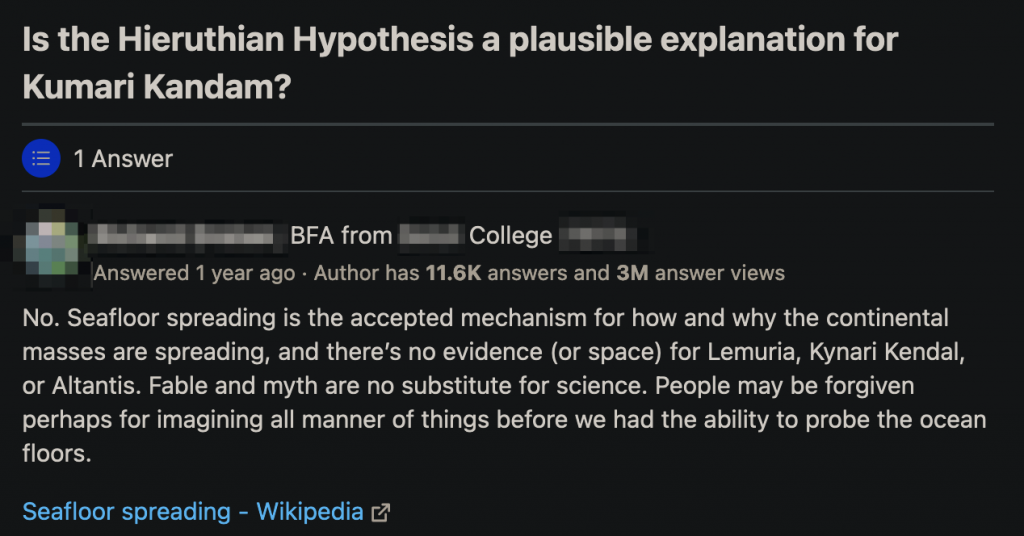
The thing most interesting to me here is the invention of an alternative spelling, “Kynari Kendal.” It’s so convincing as a place name, I had to look it up to see if it was “real.” Or rather, whether it’s a spelling shared by others (wherever it falls on the scale of the hyperreal). Apparently it’s unique to this user. Go figure.
Ok, forum seeding…
Obviously, I didn’t invent this technique. I haven’t even used it that much, but it’s easy to do and ripe for dissemination & manipulation of networked hyperreality narratives…
First things first: If you’re going to make fake posts on conspiracy or other forums like Quora, I recommend using an AI-generated headshot, courtesy of thispersondoesntexist.com. That site is a miracle for work like this, as each one is uniquely generated, meaning you can’t take it into Google image search and find any original image source (like if you just copied a photo from somewhere else).
I only did two of these, but there’s no reason to believe doing hundreds or thousands would not have a severe impact on hyperreality. Use with caution, lest you send the multiverse careening to the edge of destruction!
Meet Cal
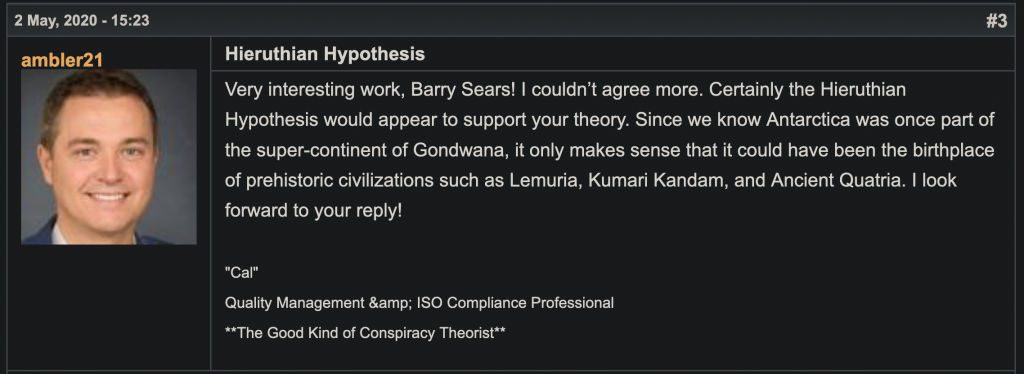
I like to let the photo generated by the AI help determine the direction of the character backstory…
Cal is your typical average straight-laced ISO compliance professional by day, and “the good kind of conspiracy theorist” by night. And he is just, like, totally curious as heck about the Hieruthian Hypothesis & ancient Quatria in general (like so many of us these days). Who can blame him? Good work, Cal! Keep asking questions!
Meet Jesse
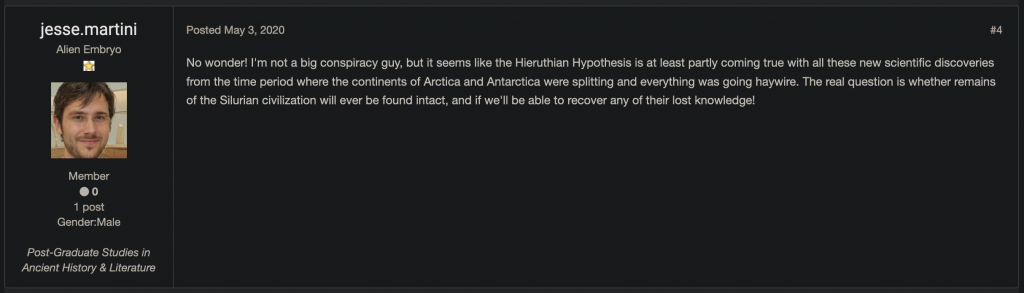
Jesse “Martini” is just your average fun-loving post-grad student in ancient history & literature. And he’s “not a big conspiracy guy” by his own self-admission, but he’s wondering about the Hieruthian Hypothesis, and another very controversial topic: the alleged splitting apart of the continents of Arctica & Antarctica.
Yes, Arctica was totally a continent…
Because of prior experiments on Quora, I knew that this was potentially a hot-button topic! (See below)
When did the continents of Arctica and Antarctica split apart? (archived)

This science enthusiast was none too “enthused” about the idea of there being a continent called Arctica. Except, in fact, that according to Wikipedia in my timeline, there totally was! (archived)
Now, Wikipedia could be wrong, bear in mind. It could be subject to the global international conspiracy to filter out Quatrian history from our collective holographic display, but there are certainly a lot of footnote references included, and who am I to go and bother checking footnoted references for validity? [A whole other blog post, remind me!]
If it was really wrong though, there would likely be a huge flame war on the Wikipedia Arctica Talk page, and there is not… So either the Guardians of Reality were asleep, or this is totally “real,” at least insofar as anything in the distant distant past can be proven to be…
Now, whether or not Arctica & Antarctica were ever one continent… well, that’s a whole different story I will leave you to try to resolve on your own. Suffice it to say, the Earth we know today is not the Earth which once was, or one day will be…
Just ask anyone on a conspiracy forum.
In part 3 of this series, I looked at one of the ways the Hyperreal works on a question & answer website like Quora.
If you’ve never used Quora, it’s basically a site where people go to ask other people things they could just as easily look up in a search engine. And then other people take those things, look them up in a search engine, and reply to the original asker with usually the answers they found in a search engine, plus usually some condescending remarks. In other words, it’s a great experience for everybody, clearly.
As I began to see those patterns take shape, I came up with an idea. What if I could just seed the answers I wanted into Google results? This way, I could ask leading questions anonymously (which Quora allows), knowing people would just Google them, and then their answers could help me launder content further along the spectrum of the hyperreal.
Having experimented a lot with Medium, I knew that it would be relatively easy to rank quickly in Google (often occurs within a few hours). So I set up a kind of meta-data thirst trap account, “pretending to be” dictionary definitions. I put “pretending to be” in quotes because, really, I have as much of a right to define words as anyone else. There’s no monopoly on language. It’s a living thing…
The Medium account is:
https://medium.com/@define.words (archived)
I also set up a “publication” on Medium to further strengthen my SEO:
https://medium.com/online-dictionary (archived)
Looks pretty legit (despite dark-mode in screen shot), if I say so myself!
I would definitely believe “Online Dictionary” and so should you! What’s not to believe with all this meta-data!

Then I set up about defining some words & concepts, complete with pronunciation guides, and usage examples, so Google would hoover them up, and it did! Usually within a few hours.
You know, common everyday words most people use like Hieruthian (archived), Crypto-Civilization (archived), and Poesiarchy (archived).
Google will happily purr them back out to you as “correct” answers to definitions of these common Quatrian words & concepts.


And thus as a result, on the marvelous “can you Google this for me” website that is Quora, you will get results like these if you ask the right leading questions to lead people into your meta-data thirst traps:
Example throughput:
What does the word “poesiarchy” mean? (archived)
Quora response:
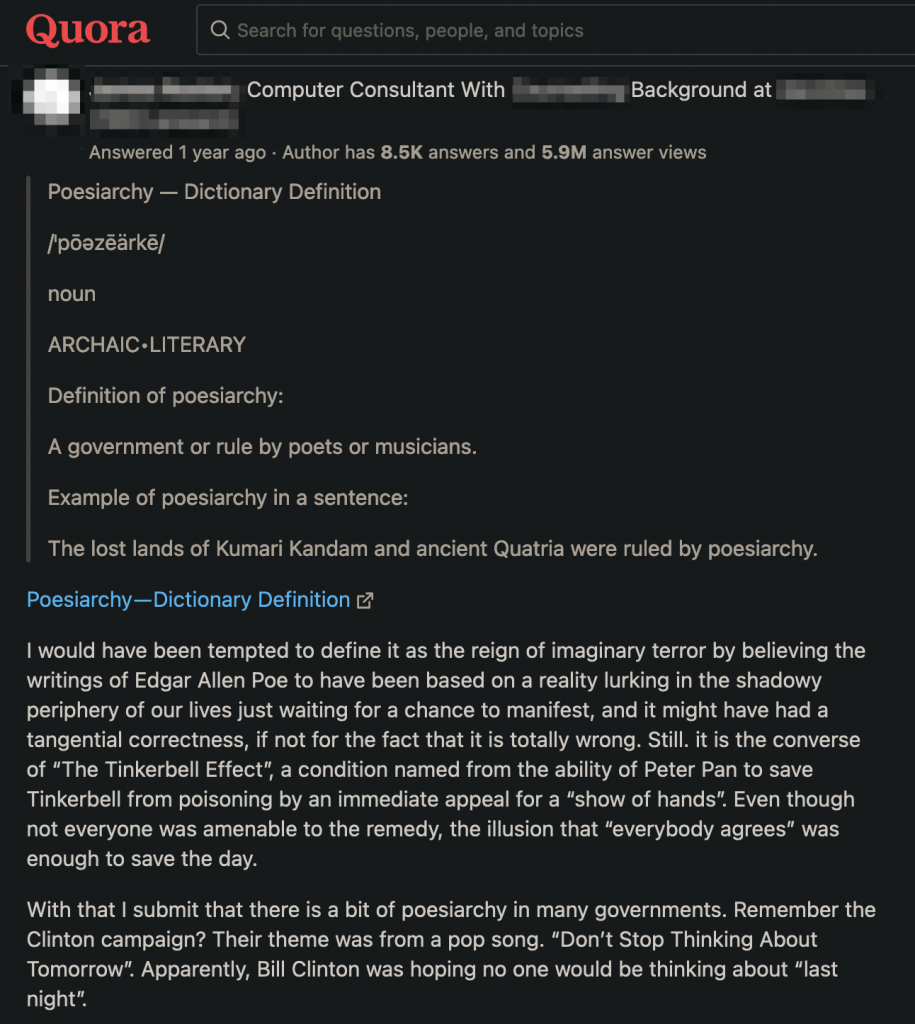
A highly creative answer, to be sure. And this “reality lurking in the shadowy peripher of our lives just waiting for a chance to manifest” mentioned by the responder sounds, in fact, just like hyperreality — the quarry of our present inquiry. So maybe this person landed on the secret inner meaning, despite the false trappings & trail that had been laid down to entrap them…
Sidenote: I only planted about 5-6 of these definitions. Imagine if someone did hundreds, or thousands, and free dictionary aggregator sites picked them up. If they were good & useful words, how long would it be before they made their way into real people’s everyday vocabularies? Perhaps not long at all.
Tangent:
Speaking of free dictionaries online, this one of “cultural layer” (archived) is pretty interesting.
It begins with a disclaimer: “The following article is from The Great Soviet Encyclopedia (1979). It might be outdated or ideologically biased.”
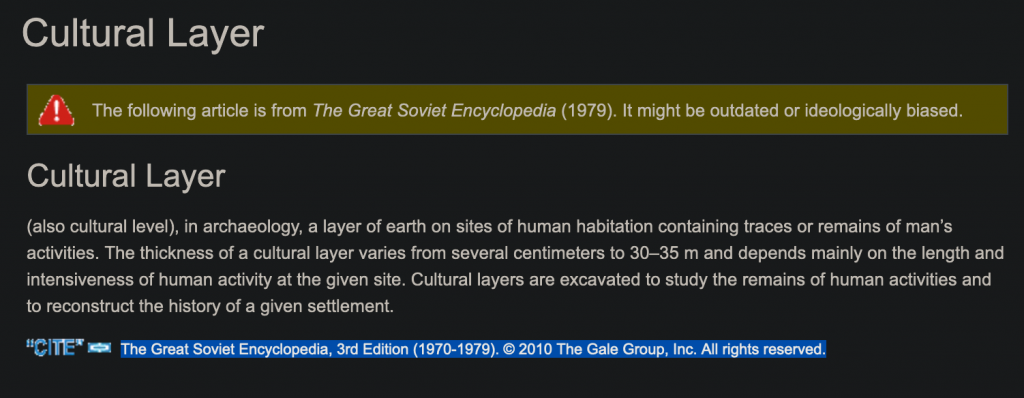
Perhaps all dictionaries should have a disclaimer that they might be outdated and potentially biased?
Further, the OSINT trail for “The Great Soviet Encyclopedia, 3rd Edition” is anything but comprehensive – at least in English. There’s a 2016 blogspot source called Russian World Citizens Project (archived) which itself is pretty sketchy looking, and only points back to this same site as a source.
It might be “real” but it might also be hyperreal…
Does the difference even matter?
This is going to be a short installment in this series, because the point is neither subtle nor complex.
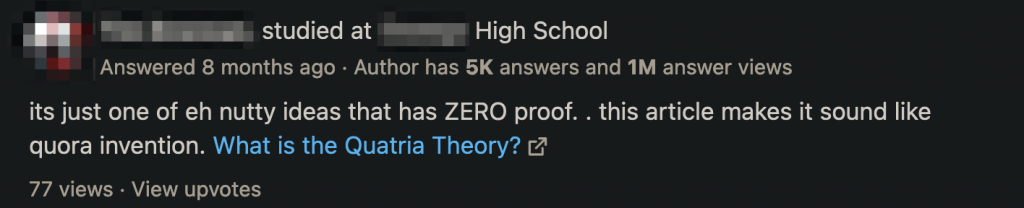
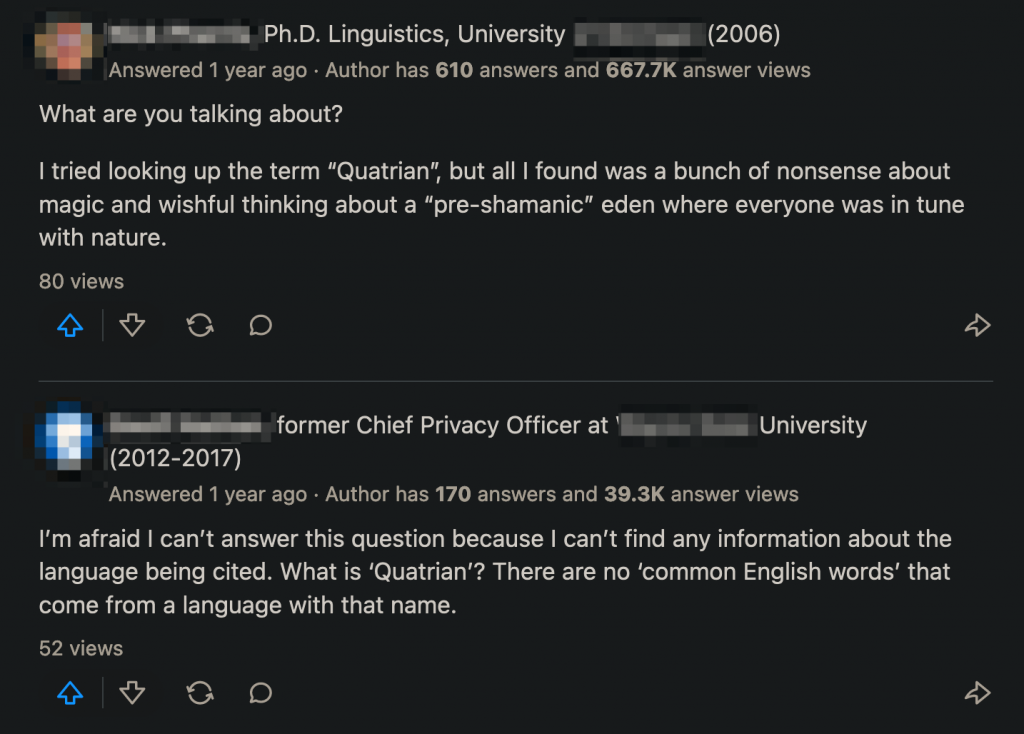
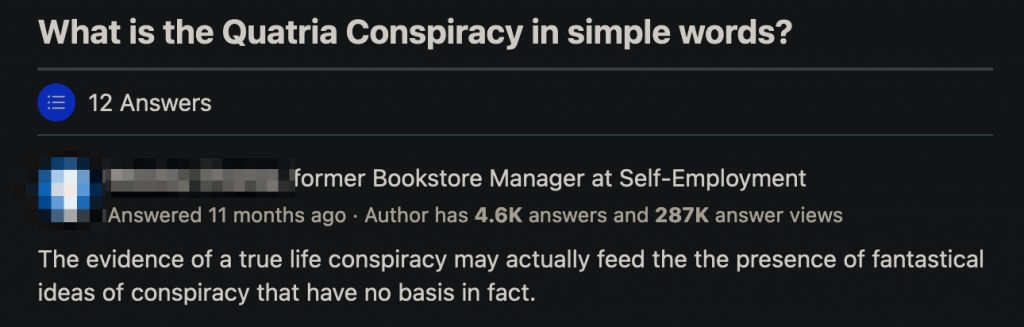
If you search “Quatria Theory” on Google, the algorithm displays for you what appears to be an authoritative explanation in the form of an excerpt from an article on Medium.com–written by yours truly.
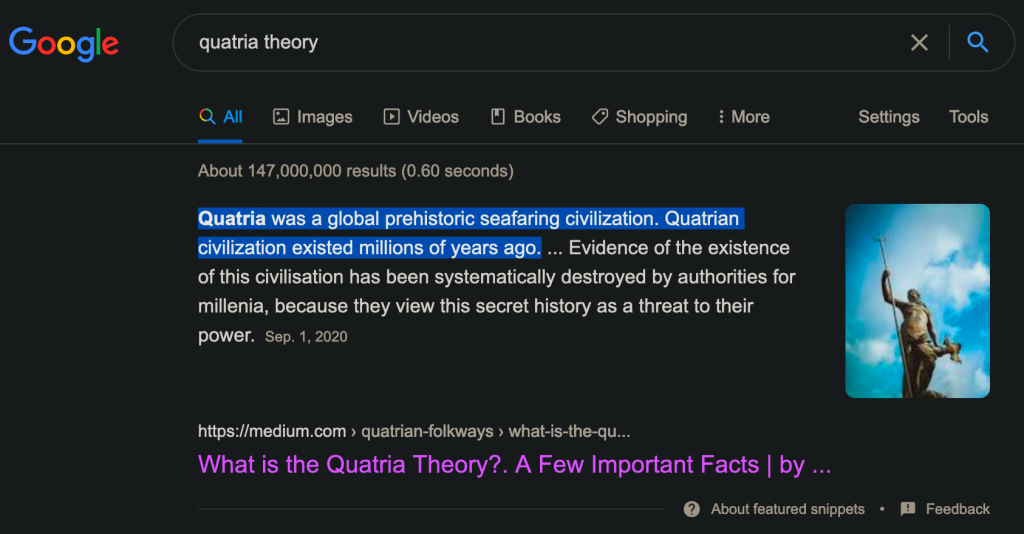
Where does this article fall on your personal scale of the hyperreal?
After all, Google only tells the truth, right?
They are very brave indeed to contravene the global gag order that exists regarding public discussion of this fascinating lost civilization!
One more:
See also Google search results excerpt for Hieruthian hypothesis (archived):
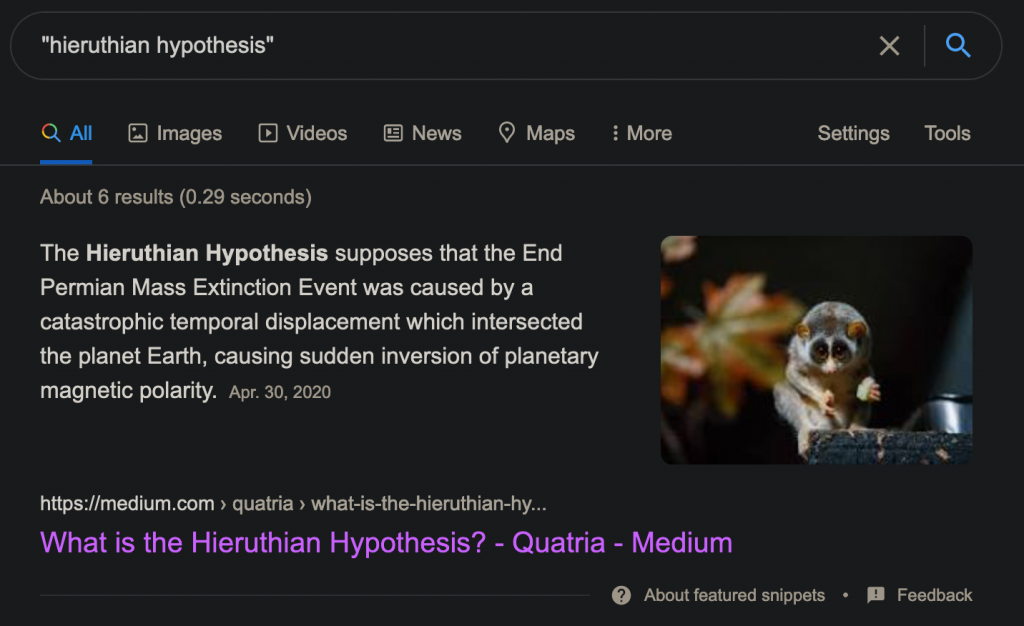
Also seen:
Google is getting pretty good with related searches, much of this obviously culled from Reddit SEO connections:









I guess part of what I’m trying to embark on here in Part 1, and Part 0 of this series, linked below, has to do with…
…You create the spark, the imprint, the pattern, the so-called “event ladder” which you condition into the Preality matrix (prima materia). Some do this through sigils, some through very detailed outlines & wireframes…
But you do it, you imprint it, and then somehow – mysteriouslyl – the signal gets propagated by others. The others may be free-roving bots. They may be living breathing human beings.
In hyperreality, it’s hard to tell the difference.
Consider this case study:
For $50 USD, I was able to propagate this out to over 100+ different news sites, albeit news sites of low or middling quality, like this cross-post on RecentDiscovery.com. Archived version, at it seems about a year later that most of these cross-posted sources are down or not easily discoverable (presumably because the PRUnderground link above is acting as canonical link, sucking up the SEO of the other matching items elswhere <–theory).
Now, there’s an issue here when it comes to hyperreality…
Do you just want it to appear that there is a footprint for your metaverse? Or do you want to actually get some of those real living beings to populate it? The first is easy, the second is elusive & difficult. (I’ll come back to this another time.)
Where I want to go for now, though, is when does something become “official?” When does PR turn into news? What’s the “magic moment” for pushing the slider into the next value range in the continuum of hyperreality?
Consider the case of BroadwayWorld. BroadwayWorld is a real website with well over 300K followers on Twitter. BroadwayWorld posted my press release about the Lost Direction NFT sale. (Archived version) The article attribution is simply “by BWW News Desk.” A bit vague, may make you wonder what it means.
Some of the other pieces I’ve posted via third parties include attribution lines like:
- “By Morris” – There’s even a photo and bio of Morris, but is it really him? And furthermore, did he really write the article, or do the research, or verify information contained?
- “General News” with no other attribution (archived)
The point is, you kind of never can ultimately know with untrusted sources (and honestly only rarely with trusted source), where ownership & authenticity have not been established, and there is no way to independently verify or audit anything.
But in essence, this is how news works, at least one side of it. Press releases get press released, and whatever signal chunks are contained in them get picked up and propagated. The nature and reach of the channels to a large extent determines the shape of the transmission and credibility to end consumers of information contained within. As information circulates in lower level channels, it may get picked up and signal boosted by larger news sites, which act as consumers of the base layers… Until suddenly a larger outlet is reporting something as fact which started out as merely an assertion on a website or in a $50 (or $5) press release that made its way into Google News & automatically was queued for syndication based on random keywords contained…
Welcome to the realm of the Hyperreal…