
Return of Cooper: Twin Peaks S03e16 video clip.
Author: Tim B. Page 185 of 204
This is, so far, one of the best first first bagpipe video lessons I’ve found for somebody starting out.
https://www.youtube.com/watch?v=TnrwTMI7ZRk
I’ve learned the scales from other videos, but this one has a critical step others are missing. To do your left hand only, fingers all on, fingers all off. And practice that. And then do left hand all on, right hand all on, right hand all off (keep left hand on). Repeat that.
Especially the right hand, on a ‘long’ practice chanter it can be hard to hit all those holes. And I don’t have small hands either. So this whole thing of cutting away from the scale and just focusing on closing all the holes accurately and consistently seems like a significant reference point towards developing coherence.
It seems more fundamental even than going note by note before you’ve had a chance to fully solve the problem of closing all the holes…
This video also uses bagpipe tabs which is really cool. Sadly, the website this video links out to in descriptions, tryscotland.com, fails to load. I was hoping for dozens more videos like these…
I’ve been learning to swim. It’s a rare strange pleasure to learn at 37 something most people seem to learn by 7. It gives you back those feelings of being a kid – but with the fear removed, in my case.
I’ve noticed something. That before you’ve learned, it seems like nothing you do with your body seems to have any impact in the water; no propulsion.
But once you’ve learned, it’s completely the opposite. The slightest motion propels you through the water. It’s a complete inversion. The sudden leap forward into coherence…
With regards to exploring inner worlds, I’ve gotten to wondering if what to me is just harmless “imaginary” visits is perhaps experienced by the denizens of those worlds. Something like this:
Via.
Do they see my “essence” floating like some kind of orb, unknown and unidentifiable? What am I to them?
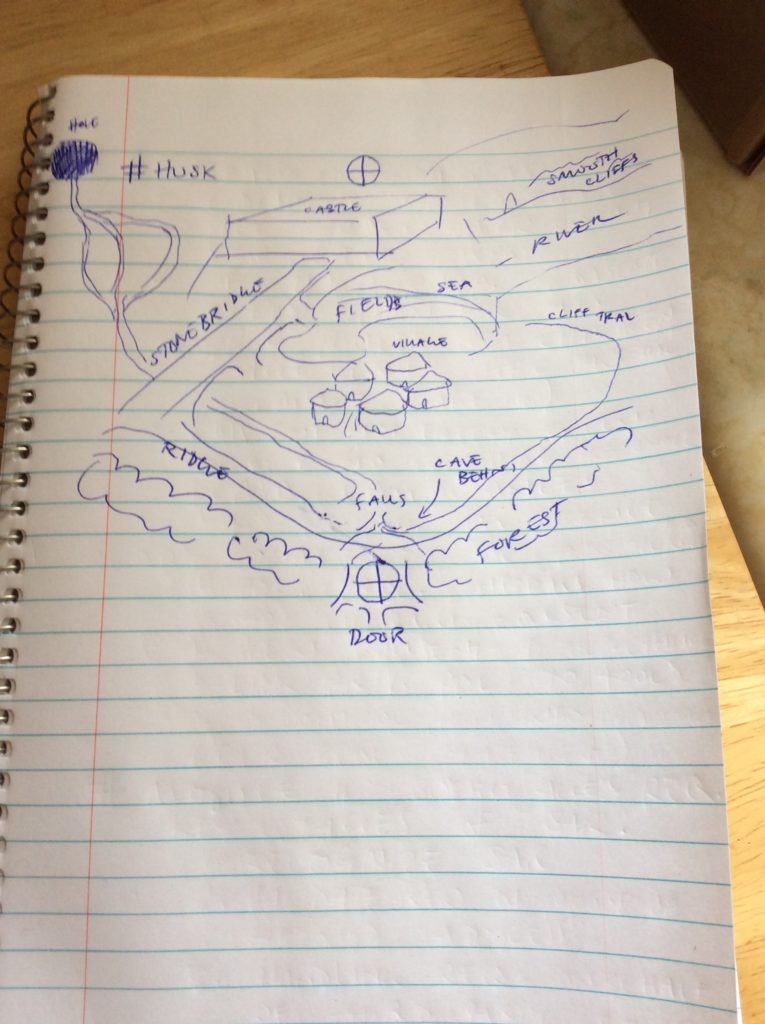
I’ve been engaging in a series of hypnagogic meditations/visualizations, which over the course of a couple of weeks, I’ve been able to map out into a quasi-coherent imaginal realm, called Husk (pictured above).
Husk, for me, is entered via the door at the bottom, which is on a ridge in a tree in a forest on top of the ridge.
There is a left hand path which leads to a stone bridge, and a castle. The right path winds down along a cliff face to a plain and a village, with fields and a river beyond. A waterfall drops over the ridge down the area below, and winds off in the distance into a kind of vortex.
The village is called Tranquilos, the smaller River Langula, the vortex Exilis. The settlers of Tranquilos came from away over the sea and river at top right from a land called Sourcia.
I was curious what would be the effect if I brought into Husk the tulpa that I had been working on, Princeps, whose form is a blue diamond. ? While exploring such inward-facing worlds, I try to do a combination of directed visualization, plus a “wait and see” attitude after introducing elements. That is, I wait for spontaneous changes to the environment. In this case, I got the impression that Princeps as “money” was enriching the elements to which I introduced it.
I started with the big river at top: and when I added “money to water” the water became full of fish and living things. Then the shoreline. When I added “money” to earth, plants grew and evolved and eventually animals came to eat and live among them. Not long after, settlers from Sourcia arrived and built their round-houses, and lived off the fish in the river.
Eventually, I added “money to rock” via Princeps, and out of the mountain arose the castle across the stone bridge. Princeps set four watchers, pillars of fire, to guard over the realm.
(Click through to the gallery above for full photo set)
Pictures I took of the unboxing of my Jensen Cassette Recorder, purchased from Amazon in Canada for $32.99 CAD.
I would characterize the quality as “cheap” to the touch. An old cassette I bought worked in it, played through the speaker but sounded “weird and slow and bad”, so I “took it out” so as “not to ruin it.”
Cassette recorder functionality so far seems pretty serviceable. Built in mic, no line input. Headphone out, which I plan to connect to my car as an audio source. Hopefully it will not eat all the tapes we’ve been buying at the flea market.
I honestly haven’t driven my car for any distance since buying it though, so I have yet to test it out.
Curiosity has gotten the better of me, and I finally broke down and bought a practice chanter (to learn to play bagpipes) from Amazon. It’s a cheap one, and every bagpipe site I have ever seen likes to write, in all caps, warnings like:
DON'T YOU DARE BUY A CHEAP ONE!!!!
Which is all well and good if you’re sure ahead of time you’re going to make this plunge and commit to it forever. But starting with a $15 trial balloon over a $100 experiment seems like a good idea to me. What do I know!
The more I’ve gotten into researching the types and history of pipes though, the more compelling it actually is. I mean, as far as “windbags” go…
This is one of my favorite piping videos for a lot of reasons:
Oddly, it turns out that goats and bagpipes seem to have been intimately connected for quite some time.
If you delve into piping history (at least the online sources I found), they put the first officially recognized mention of bagpipes to a Roman source sometime in early AD. But there’s an elemental pattern you can see behind the pipes if you look with the “eyes of the goat.”
I’m not going to pretend to be any kind of expert, but I found a bunch of different traditional forms of bagpipes which are not only made of goat skin, but which explicitly seem to reference the form of the animal, with either heads included, or else with drones, chanters and windpipes in place of the limbs of the beast.
Check out, for example, the Zaqq from Malta:

Here’s another one from Eastern Europe:

And this is included ‘just for fun’: via Duda on Wikipedia:
“…there were many legends about bagpipes that could play themselves when hung from the wall on a nail or about pipers summoned to Witches’ Sabbaths to perform for satanic hosts.”
So my hypothesis, for the moment, goes something like this:
Bagpiping is a secondary cultural artifact from raising goats (or sheep, variously–just using goats as a catch-all here). In French, we have this handy word for goat-raising, Capriculture.
Moreover, the evolution of the “windbag” is simply an augmentation of pre-existing reed flutes, like this German dude (assuming he’s German–maybe I’m wrong) makes in the Youtube video below:
Bagpipes are basically this attached to a pipe you do your fingering on – chanter – which sticks out of a bag, and which has anywhere from typically 1-3 drones, which are reeds on pipes each tuned to sound at one continuous note.
So there’s a precursor invention, the reed pipe, which is more or less a “natural” human invention from naturally-occurring material. Which is over time grafted onto this other invention: an animal skin or bladder which can be inflated or deflated with air or liquid.
Taken in this light, the instrument becomes less a strange oddity, and something more elemental, and perhaps very ancient – as ancient as the human relationships with the plants and animals from which the craft originally descended.
https://youtu.be/03Ok98XorcA?t=32s
That’s the theory anyway. Not sure I’m ready to start keeping goats, but I’m warming up to giving piping a shot. Will keep you posted!
PS. I love how that last video shows the pipes mixed with the sound of sheep’s bells
- Practice chanter
- CR2 batteries for laser pointer
- Hand-held cassette recorder
- Deep cycle solar battery