I’m following closely the rise of the $SHIB cryptocurrency and found this pro-crypto + anti-government meme posted as a thread:
Now, I wouldn’t say I actually “believe” in SHIB but I am holding about 48.45M coins, “just in case.” Time will tell if that was a smart move or not.
Anti-government sentiment these past few years has been seemingly off the charts, and I get it. Much of the government–especially when it comes to crypto–seems hopelessly out of date and out of touch.
That said, let’s look at the alternatives. Government, and more broadly governance, is two things: 1) people, and 2) decision-making.
With democratic/representative government, you can (in theory): A) change the people, and B) petition them to change their decision-making.
Okay, that might not always prove effective in protecting your interests. Would you rather instead:
Have no people involved? (and therefore have no rights, or opportunity to redress problems)
Be ruled by A.I.? (designed presumably by people solely seeking profit, w/o accountability)
Be ruled by corporations? (again, seeking profit & not offering representative decision-making)
Does government suck? Yes. Do people often get things wrong? Emphatically, yes! But as long as it remains a representative system, it still kinda seems like the best bet over the options listed above. Maybe there’s some cool crypto-flavored direct democracy option on the horizon that might solve for some of these underlying issues? Vitalik Buterin seems to think so. I’m less optimistic, but willing to learn more.
IMO, if you don’t like the government, the answer is not to throw your hands up in the air, and complain and do nothing and wish it would all go away and wait for whatever other monster to come along and fill the void. The answer is to actively participate in governance. Become part of the government. Make it directly reflect your interests. If you don’t, I can assure you that someone else will.
Sorry this is a short & not very well-thought out post on this topic. It’s a big one, and I figure you have to start somewhere to get wherever it is you’re going.
Real life in Utopia is never quite like it’s depicted in the brochures.
Thomas More’s original Utopia was based on slavery. Oops. But at least the betrothed could see each other naked… though women also had to confess their sins to their husbands.
Bacon’s New Atlantis features a weird call-out of the “good Jew” Joabin, of the city of Bensalem. Strangely, here the betrothed had to send one of their friends to see the betrothed naked as a stand-in…
Ernest Callenbach’s Ecotopia includes a number of creepy sexual incidents, and proposes basically autonomous ethno-states for minority groups. Umm.
Each of these books gets a number of things very very wrong. Some perhaps intentionally so, to drive a particular point or theme home. Most though, the greater social-political context has changed irrevocably. Thus, making things which once seemed progressive and liberal in an impossibly restrictive regime of the time period, now seem just impossibly weird and wrong.
Why read utopias then? Why engage in this specific type of idiotic fantasy behavior? If we know so much of it to be baloney?
It’s cliche to say utopia & dystopia are two sides of the same coin. But it’s not even just that. It’s that it’s both extremes at once. You can’t always/often tell when an author was saying something satirically as commentary, or actually thought that. It’s hard to decode the thinking of writers sometimes, and sometimes it doesn’t matter. It’s the impact that matters.
I posted something recently on my Subreddit that related to Huxley’s book, The Island (which I haven’t read yet), and someone took the liberty to highlight a few of the bad things that the story included, and then to declare (paraphrasing) that “Yeah, but you know Huxley was actually into that shit.”
I submit that it’s not that simple, and the skein of Utopias is infinitely more tangled than these kinds of simplistic interpretations. I’m reminded of an excellent passage in a recent Slate article about the utopian community of Auroville in India, and some tragic events that unfolded there.
It’s very easy to say, “Oh, come on. All these promises made, all these ideals, and it’s just a morass of humanity that just has not lived up to it in any ways…”
On the other hand, you can also look at these places and say, “Look at what they have achieved and look at what they have tried.” You could ask yourself, “Well, if a community sets itself lofty goals, and, let’s say, it achieves only 30 percent or even 40 percent of those goals, do we denigrate them for the 60 percent that they failed? Or do we praise them and admire them for the 30 percent they’ve achieved?”
Really, when it comes to the non-fictional attempts at instantiating a utopia, it depends what those 60% failures consist of. Does it involve needless human suffering and tragedy, and the abrogation of rights? If so, then we might do well to condemn it in the strongest of terms.
When it comes to books though, I propose that one viable approach could also be that we just “take a chill pill” and not get so bent out of shape about works of fiction, which reflected mores of the times they arose in and which have since moved on. It might be that the conflict between the good, the bad, the universal and specific, the ideal and the rea,l is exactly what drives this genre, and its entire utility in the first place.
Going back to that Grist piece for a second, there’s one other tangent of criticism in it that characters in Ecotopia “…display an eerie sameness that makes all human interaction in the book seem unsettlingly artificial…” If this were another genre apart from a traveler’s tale of a voyage to a Utopia – a tried and true format – then I would have more sympathy for that kind of critique (though, honestly, I have very little sympathy for most critiques – the ones I dish out especially).
As it stands though, one of the things I actually heartily enjoy about utopian fiction and utopian satires is specifically that the narrative and the characters are so so very thin. They are, in essence, lorecore. They are 98% exposition. They read like textbooks. The dramatic elements are so so. The drama instead is in the notion that this *could be* a real place – if we decided to make it so. That is, if we just re-jigger parts of our society and our world, we could have something not unlike the experiments described in this genre of books. They might turn out to be “true” utopias, or true dystopias, but they would at the very least be a try at something new, different, and perhaps unique. And that possibility is something worth preserving and exploring. In the process, it just might be possible we use that same faculty of dreaming and actualization to change the world.
An ecotone is a transition area between two biological communities,[1] where two communities meet and integrate.[2] It may be narrow or wide, and it may be local (the zone between a field and forest) or regional (the transition between forest and grassland ecosystems).[3] An ecotone may appear on the ground as a gradual blending of the two communities across a broad area, or it may manifest itself as a sharp boundary line.
I’m excited to announce that the Conspiratopia Book NFT is officially launched on the MATIC blockchain, via OpenSea.
This is a limited edition release of 50 only. Think of it as a digitally-signed copy of the book, with benefits.
What Buyers Get
Purchasers of the book NFT receive an instant free download coupon for the ebook (EPUB format), and 1st generation purchasers can write in to Lost Books with their address to receive a free print copy shipped to them in the mail globally at no extra cost (anywhere Lulu.com, my printer, is able to provision).
Who Am I?
I’m a blockchain-based author with three published books, and am a pioneer in the Book NFT space.
I’m an accomplished crypto artist with tons of sales, and my artwork is collected by some of the world’s top crypto artists. Some of my past work has been re-listed by collectors at 30 ETH!
The print copy is still being proofed, so it’s not yet available to the general public. However, if you buy the NFT, I’ll send you an advance copy as soon as it’s ready (I’m expecting it to be ready by around Oct. 1, 2021).
Even though these politicians who are apparently living in their own parallel universe are vehemently against my new book, Conspiratopia, it appears that another segment of the population is coming to the book’s defense. It is, however, an unexpected group, consisting of a coalition of billionaires who claim that everything contained in the book is in fact quite true and stuff…
Here are their stories:
To be honest, I had no idea that George Soros was a drug user. Big, if true!
Jeff Bezos has a weird quality in this video. Seems almost like an AI himself, don’t you think? Maybe he spent too much time in outer space or something…
And this last video from Google’s CEO appears to explain why Google is suppressing evidence of the Conspiratopia Project from Google Ads and elsewhere. Why am I not surprised at all?
Please, if you’re reading this, and you can do anything to help, make sure you share these videos far and wide on social media and on the blockchain, so that people can know the truth about what’s really happening with the Conspiratopia Project!
Apparently, a number of politicians who live in their own alternate universe have somehow gotten advanced copies of my new novel, Conspiratopia, and without even having probably read it and stuff, they are calling for it to be banned. Just like that! Go figure. Thought this was still a “free country?”
All I can say is that politicians should spend more time reading books, and less time burning them!
I can’t really believe any of this is really happening…
Even frickin’ Ben Shapiro is apparently getting in on this action? WTH??
A.I. Virus (short for Artificial Intelligence Virus) is a fictional virus within what I am calling the “Conspiracy Dudiverse” as depicted in my most recent book, Conspiratopia.
But A.I. Virus did not begin there.
The Real A.I. Virus began almost four years ago, in early 2018, with this (linked) Medium article (archive). There is an accompanying Vimeo account (a couple of them actually, iirc), TruthAboutAIV, which contains some videos I commissioned from video actors on Fiverr during my early hyperreality experiments.
These videos are really weird, awkward, and funny to me all at once. You get what you get for $5. If nothing else, they are strangely timeless.
I find these scripts way too complicated for “now me” after having experimented with this a bit more. Simpler is almost always better in this kind of distributed or networked narrative.
These videos kind of directly informed my later experiments using AI-generated human avatars… which in the end are somewhat more cost-effective and perhaps easier than dealing with “real humans” though the quality differences between the two are, shall we say, inescapable. Humans are still humans…. for now…
That said, there are use cases where I think – for story-telling & aesthetic purposes – you might actually *want* a shitty, obviously wrong & fake-looking AI-generated avatar to deliver your message. I have to say with those videos, I kind of like flaunting the discomfort of the Uncanny Valley, as much as I like the flaunting of human discomfort can shine through at points in these videos (whether the discomfort is on the part of the actor, the viewer, or both).
There was a backstory here I explored in one other commissioned human actor video from Fiverr, below:
This is an allegedly promotional video attributed to a company called Neurolytics, Inc. The video description reads:
Research video from Neurolytics, Inc. Neurolytics, now defunct, was the brainchild of A.J. Nempner and Damon Long, whose spin-off gaming company, Influent AI, went on to gain notoriety for massively influencing global election outcomes with artificially-intelligent social media campaigns. This promotional video, never released, describes a prototype EEG headset (wrongly called “implants” here) which was able to measure, record and influence perception in conjunction with twice-daily capsules. The FDA denied permission for this product to come to market, and the company ultimately went bankrupt. (Recorded in Deerfield Beach, Florida 2015.)
Influent AI is its own tangent to this story-line, but suffice it to say that “some people think” today’s A.I. Virus has its roots in the questionable psychogenic driving technologies originally developed as part of Neuralytics’ banned product offering.
The below video expands on the Influent AI backstory a bit, in the form of a false news broadcast, also purchased via a video actor on Fiverr (bless all of their hearts!):
If I’m not mistaken, this video’s “Tom from Newschan” (and the accompanying Vimeo account) is either the first or one of the earliest incarnations of Newschan, a hypothetical news-channel that developed out of kind of post 4chan total collapse of all media… Newschan, of course, is now a major powerhouse on YouTube.
Anyway, so we see different strands of the A.I. Virus story told throughout all of these pieces, somewhat fractally, from many different multiversal perspectives at once. We hear that it is taking over people’s bodies, causing blackouts, and involuntary bodily actions. This basically conforms to what we see in Conspiratopia, with some differences.
Conspiratopia‘s use of the AI Virus and what I call “overwriting” is inherited from this older Medium story (Oct. 2015), entitled “Legal Fiction.” A relevant excerpt:
“I’m told I have a lot of physical autonomy for an Uber®. I guess it costs less for everyone in processing power that way — though I honestly don’t mind being over-written either. I find it relaxing, like watching a film. In fact, we’re allowed to watch films during over-write sessions, but I prefer to maintain perceptuals, at least peripherally, and pipe in classic rock selections, like Maroon 5 and One Direction.
My public blockchain indicates that I was originally cross-bonded as part of my obligatory outpatient rehabilitation for crimes against the Gestalt which I no longer remember, and the precise terms of which were expunged from Living Memory once my work as an Uber® earned me a rating of 15,000 points. I barely look at my stats anymore though, because I have everything I need now that I am able to re-sell a variable percentage of my public perceptions back to the Network to cover the costs of my sustenance and lodging. In a few more years, I will even be eligible to buy full voting rights.”
Speaking of scripts that are too long and wordy, here’s one made via one of those AI-generated Avatars (Synthesia) in June 2021 about the “Coming AI Takeover” that was written as a response to Grimes’ weird TikTok video about how communists ought to welcome AI overlords…
While I’m on a roll, there are also one or two videos in this recent AI-gen set that directly reference the re-incarnation for modern times of the AI Virus.
Anyway, I’m telling this story in a round-about way because it is a round-about story, so you’ll have to forgive me for all the tangents and inset tales. The fall of civilization to AI Superpowers doesn’t just happen overnight; it happens bit by bit…
One interesting element is you top up your account with DAI ahead of time, rather than wait to be billed (read: screwed) by Google Ads at the end of the month (if you’re not vigilant about your spend). Another interesting element is there appears to be no moderation or ad review & approval process. Which might be good or bad, depending on where you stand.
There are a number of drawbacks though. I won’t do a full assessment here, but it appears all ads are image-based. If there’s a text ad option, I didn’t see it. Then there are quite a lot of settings, etc. that are not entirely clear what they are. Same for content category names. When you choose where your ads will be placed, you pick from categories like “Politics” (straightforward-ish), but then there are categories like “Irregular Content” or “Deceptive / Phishing” which… I’m not sure about.
Then, of course, there are ETH network fees, which I guess I was foolishly not expecting, because I think the site advertised “no hidden fees,” iirc. So despite putting about $20 USD into DAI, and starting with an ad buy of 5 DAI against one image-based ad unit, I had to pay a fee of 14.50 DAI on top of that to activate it.
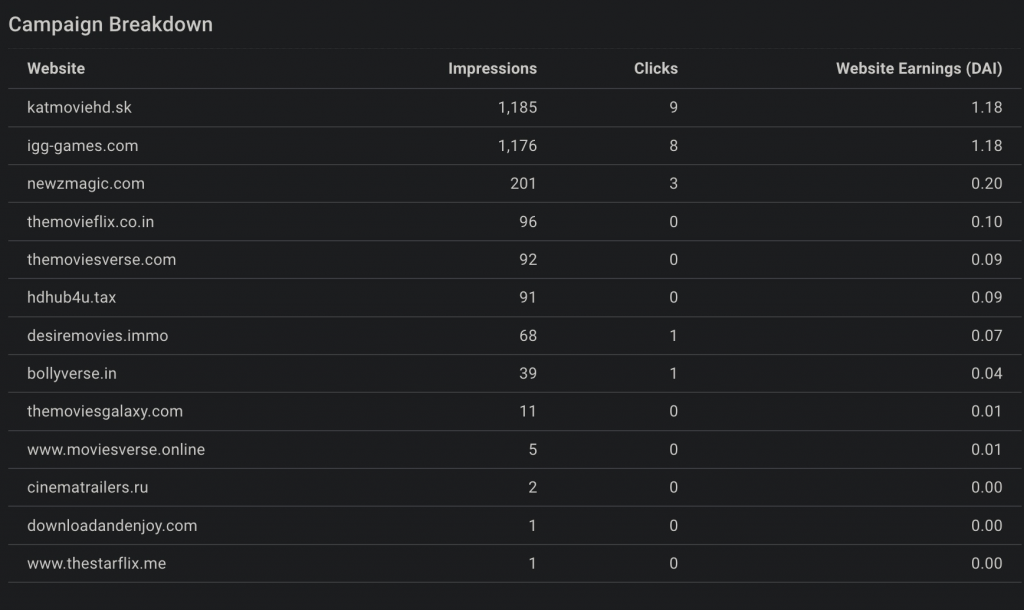
Which, okay, it’s an experiment. But the initial estimate of impressions for 5 DAI was 10K impressions. Instead, I ended up with a little under 3K. And for all that, only netted 22 clicks. Okay, maybe my ad sucked. Probably. But it looks like the sites it ran also pretty much sucked, upon my manually checking them:
These appear to be almost all entirely spam sites. Do they get legit visitors? Maybe? It’s basically impossible to tell. Granted, this was an experiment, but it doesn’t exactly fill me with hope and excitement about the possibility of using alternative crypto ad exchanges over something like Google Ads.
“In meteorology, a virga is an observable streak or shaft of precipitation falling from a cloud that evaporates or sublimates before reaching the ground.”
After meditating on this topic of the Sky Lords & the Majonans/Magonians, etc., I’ve often wondered, what if the Virga are lady Sky Lords descending? It only makes sense, after all… if you think about it.
Wikipedia adds some etymology:
The word is derived from the Latinvirga, meaning “rod, sprig, staff, branch, shoot, twig, spray, sprout, switch, graft.”
“c. 1200, “unmarried or chaste woman noted for religious piety and having a position of reverence in the Church,” from Anglo-French and Old French virgine “virgin; Virgin Mary,” from Latin virginem (nominative virgo) “maiden, unwedded girl or woman,” also an adjective, “fresh, unused,” probably related to virga “young shoot,” via a notion of “young” (compare Greek talis “a marriageable girl,” cognate with Latin talea “rod, stick, bar”).”
Compare this to a word with a lot of letters in common, virago. Now, I never heard this word before, and found it while doing a thesaurus check of synonyms for “bitch,” which is weird.
“A virago is a woman who demonstrates exemplary and heroic qualities. The word comes from the Latin word virāgō (genitive virāginis) meaning vigorous’[1] from vir meaning “man” or “man-like” (cf. virile and virtue) to which the suffix -āgō is added, a suffix that creates a new noun of the third declension with feminine grammatical gender.
Modern use of the word virago generally takes the disparaging sense. Thus virago joined pejoratives such as termagant,[2]mannish, amazonian and shrew to describe women who acted aggressively or like men. The word virago has almost always had an association with cultural gender transgression. There are recorded instances of viragos (such as Joan of Arc) fighting battles, wearing men’s clothing, or receiving the tonsure.[3]“
That word Termagant is also a new one to me, and equally interesting, but deserving of its own dedicated post (another time).
Anyway, this is all very liminal. The precipitation which descends from the clouds, but never quite lands – or does it in some subtle etheric Sky Lord form? The virgin, who does not know (Biblically speaking) man. The virago, the woman who is like a man…
This lands for me within the Matter of Quatria pretty squarely on a figure I’ve called by different names, but most often the Red Spear Maiden, or Red Star Maiden. Some elements of her story are sort of fractally mentioned in The Lost Direction, but a key episode (her battle with the world-encircling dragon, Uquemoth) is elaborated in more detail in the follow-up volume (The Octave of Time), which I’m about to begin working on again as soon as I go through the final proofs of Conspiratopia.
Here’s a snippet of this character who is a virago in the maybe more classical, less pejorative sense of the word. We might even just call her a bad-ass today, I think…
“All at once from within, the sunshield Varnathil erupted in righteous holy flame. The light of its fire traced the path of the Maidenspear up into the brain of the dead serpent, incinerating flesh and blood, sinew and bone and tooth. And the Red Spear Maiden, who was neither dead nor defeated, thrust the spearpoint ever upward, until the head of the serpent erupted in flame, knocking both wolf and hunter backwards with violence. When they recovered, they saw her standing there, amid the smoldering ruin of the head, revealed in full radiance. Sehon looked upon her, and this time he did not go blind.”
Going blind is a reference to seeing the goddess in classical I think Greek & Roman mythology. According to Britannica, it’s actually Tireisias who went blind on seeing Athena:
“Another version has it that Tiresias was blinded by Athena after he saw her bathing. Chariclo begged her to help him, so Athena, instead of restoring his ability to see the physical world, gave him the ability to see the future.”
Here’s a little more on the Bath of Athena, an extended tale from the 3rd century BCE. Athena was most definitely a virago… though immortal.