When certain pieces are put into a particular configuration, and their relationships and interactions governed by a more or less unchanging set of rules, the randomly scattered outcomes of mere probability can be shaped into a more refined and predictable pattern of framed results. Likewise, a compass circle repeatedly traced with a stylus on vellum soon forms a groove in the sheet — a record of motion along a path of travel that becomes habit — eventually wearing down and cutting through the page.
Such are the cycles of Quatrian myth
and history — a continuous re-telling down through the ages of the
Great Tales, via the daily re-living of them by the people. With some
slight variations, and the occasional gross deviation, future, past, and
present form a unity — the always now. It is this
raw substratum that is the province of the High Augur, who listens for
the tunes sung by the wind and rain, the animals and birds, the seas and
stars, and divining their significance on the songboard,
attunes Quatrian society thusly to the greater cosmos by the enactment
of appropriate rituals, rites, pageants, plays, and performances, of
which the Dark Dance Cycle is but one in a vast repertoire.
The entry of the Pentarch sailors into the Bay of Erasure,
therefore, was not wholly unheralded nor without precedent. At one time
in ages past, this same body of water bore the name the Bay of Pleasure. In fact, it was the subsequent events linked to the fall of Abdazon which eventually began to poison that harbor.
The
city of Abdazon, though, in which the wealthy merchant Delroy waits is
still many years before that final fall, but the events in which he and
his family were now entangled would presage that tragic happening. As
Delroy’s scouts reported the approach of his daughter Delrin and her woodsman companion, Elum,
he himself went out to stand at the head of his special guard stationed
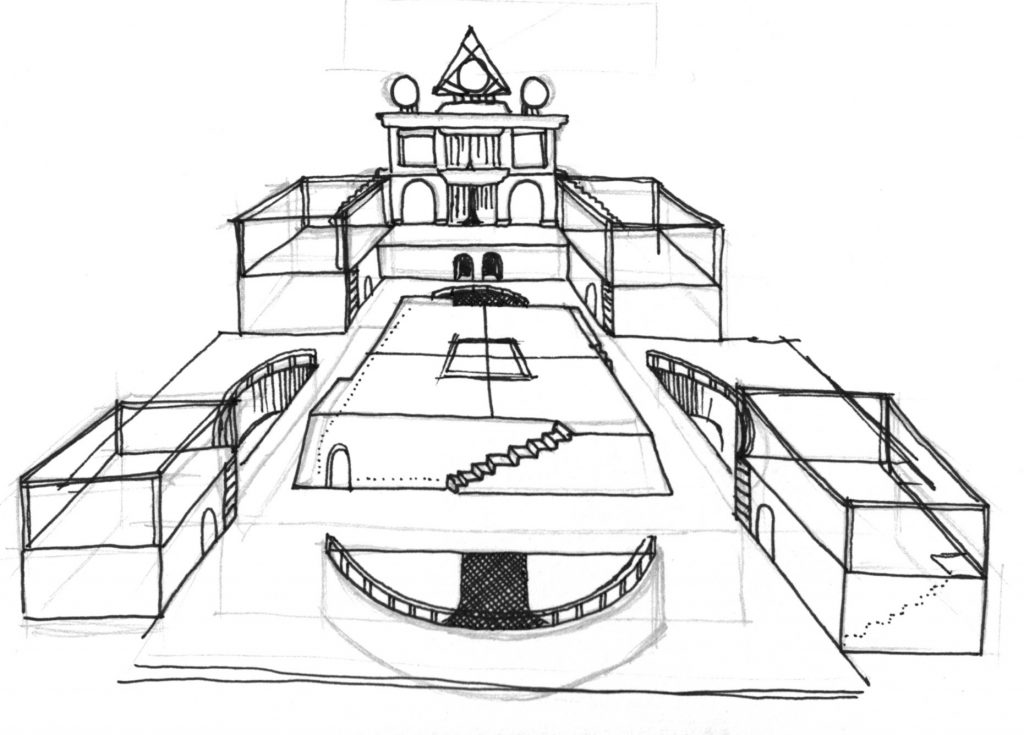
on the Great Bridge, which connected the Foot and the Stair to the
upper ridge of the Cyrcic Cleft, and on into the Hypogeum.
Though Delroy had ordered Andal, his half-mad Best Man
and former guardian of his daughter, to his bed chamber to rest, the
man appeared anyway, his manner quite unkempt, and armed with a short
sword in a sheath at his side. This unnerved Delroy, who himself was
already on edge, and he feared both the consequences of Andal’s
involvement in the scene to surely come, or the difficulty which he
would likely have to undertake in removing him from it.
While
Delroy weighed those outcomes and their relative costs, Andal walked a
ways off, and spying off in the distance two figures approaching, he
cried out:
“The Betrayer arrives! He has hold of your daughter! We must attack!”
And he began to draw his sword, but Delroy rushed over to him, catching gently his arm.
“Nay, we go softly, dear Andal. Without bloodshed, without loss. Family is at stake — my daughter”
Andal looked at him disapprovingly, but stayed his hand, his sword sliding back into its sheath.
Meanwhile,
deep in the Great Forest, the other surviving Best Man of Delroy, named
Ayar, lay on a pallet by the fire in the hut of Elum’s sister, Elan. He
was near death, but still he struggled to live. Elan understood the
urgency of the situation, though not necessarily the details which had
lead to this pass. Her brother Elum had sent his owl familiar, Lux, to
summon her, and she had felt his insistent calls on the canals of light
which linked them. She could see that, before her, she had the care at
once of two beings’ essential nature caught in a precarious balance,
where the death of the unwitting human partner might yield a far worse
ruin if his parasite were to escape its present mortal confines. And as
his body convulsed from time to time, she plied him with strong
concoctions of bark, root, flower, and leaf of certain forest plants in
the hopes of lulling him into a deep, dreamless sleep.
Back
at the head of the Great Bridge, Delroy, Andal, and the special
guardsmen have advanced to meet Elum and Delrin, who are no longer dots
on the horizon, and who can be plainly made out as they draw near. It is
into this nervous, empty space of waiting that there is a sudden small
flash followed by a burst of white smoke, out of which steps the huge
magician Morbat. The special guardsmen begin to advance on him, but
Delroy stops them by raising his hand up.
Morbat’s voice booms, “Lord Delroy, I have come to collect on my debt, nothing more.”
“And
no harm shall come to you, so long as you honor our original terms,”
Delroy responded, gruffly. “I trust you still remember them.”
“Indeed, I do,” Morbat replied.
They all stood silently then as Elum and Delrin approached.
Delrin cried out to them, “Father! Father!”
“Welcome
home, daughter,” Delroy said, shooting a warning glance at the nearly
rabid Andal. He added somewhat nervously, “Won’t you introduce us to
your friend?”
She
looked then at the giant Morbat, taller than two men, who stood in a
great long white cloak, covering his entire body up until his head,
which was that of a strange animal, with a long face and ears. And she
thought she saw hooves beneath the cloak, but couldn’t be sure.
“Of course, father,” she said. “If you’ll introduce me to yours!”
They both laughed, and embraced.
“Father, it is my pleasure to introduce you to Elum of the Forest People who has become my dear friend and companion.”
Elum advanced, and shook hands with Delroy, much to the chagrin of Andal, whose hand hovered above the hilt of his sword.
“And this, dear daughter, is the magician Morbat, with whom I made a deal before you were born…” He looked dismayed.
She noted this, asking, “What manner of deal, father?”
“A contract,” he began, pausing for a long time before finishing, “… of betrothal.”
She stared at him, at the magician, and then at Elum, suddenly understanding the import of her father’s words.
“It cannot be…” she said, crestfallen.
“But it is,” hissed Andal, under the half-hold of the Betrayer.
“She is mine by right,” Morbat boomed.
“Aye,
dear daughter. It is true. I promised to open my store rooms, and
remove the locks from the doors, and in return, the magician conjured
for us a girl child, born of your mother. We named her Delrin. She has
brought us so much joy, more so than all my wealth which has expanded a
hundred-fold since I followed his commands and opened my store houses.”
“My end of the bargain is then fulfilled,” said Morbat. “Let us make haste to bring the contract to its conclusion.”
“In
haste may be lost the all-important details of which any good agreement
consists,” Delroy replied, stalling. “I speak of the original
conditions that I levied on our arrangement. That the daughter be not
bound to the father’s mistakes and obligations, and that in finding her
true love would she would be freed altogether.”
Lying,
Morbat replied, “I see no such discovery in her heart.” His corvid
scouts had sensed it, and he himself could see the glow of its awareness
dawning softly in her, and in the object of her affections.
“It
cannot be, then, father!” she cried out. “For in this moment, I hear
with true precision the words my heart has been whispering softly these
many months, that it belongs to another.”
“To whom, o daughter?”
Delrin replied unhesitatingly, “To this woodsman, whom you call Betrayer.”
“Not I, daughter.”
“It is in truth your captain driven mad by that self-same Betrayer, under whose half-hold this false charge is laid.”
In
that same instant, deep in the Great Forest, in the hut of Elum’s
sister lay Ayar unattended. Elan had gone out to fetch a few more
healing ingredients nearby in the forest. When she left Ayar, he was in a
fitful sleep. She was not gone for more than a few minutes, but when
she returned, she found him rolled over on his stomach beside the
pallet. Turning him again onto his back, she was frightened to realize
he was covered in blood. It seeped from a wound in his stomach,
punctured by his own weapon which she had lain nearby for safe-keeping.
In an instant, she understood what had happened, that the Betrayer
inside him had seized hold in one final giant convulsion, hurling him
out of the bed, and presumably onto the point of that sword.
“The
fiend!” Elan cried out sorrowfully, for she knew what would happen as
the life ebbed out of him, a certainty which could not be stopped now
with this much blood lost.
“It was I,” Ayar said weakly. “I have slain… slain the fiend.”
But
as she watched him die, she knew his words to be incorrect. That he had
only slain himself, and as his body failed, the full force of the
Betrayer hurtled out of the hut, and back to Andal on the Great Bridge,
to claim full-hold over him, body and mind. Elan sent out then a
terrified shiver on the canals of light to her brother. It was so strong
and clear that even Delrin felt it, for their hearts were now
irrevocably connected.