It is uncertain when or why the human sense of geographic orientation and direction became associated with winds.[1] It is probable that for ancient settled populations, local physical landmarks (e.g. mountains, deserts, settlements) were the initial and most immediate markers of general direction (“towards the coast”, “towards the hills”, “towards the lands of Xanadu”, etc.). Astral phenomena, in particular the position of the sun at dawn and dusk, were also used to denote direction.[2]
The association of geographic direction with wind was another source.[3] It was probably farming populations, attentive to rain and temperature for their crops, that noticed the qualitative differences in winds – some were humid, others dry, some hot, others cold – and that these qualities depended on where the wind was blowing from. Local directional names were used to refer to the winds, eventually giving the wind itself a proper name, irrespective of the observer’s position. This was likely furthered by sailors who, far from landmarks at sea, nonetheless recognized a particular wind by its qualities and referred to it by a familiar name.[4] The final step, completing the circle, was to use the proper names of the winds to denote general cardinal directions of the compass rose. This would take a little longer to work itself through.
Category: Other Page 138 of 177
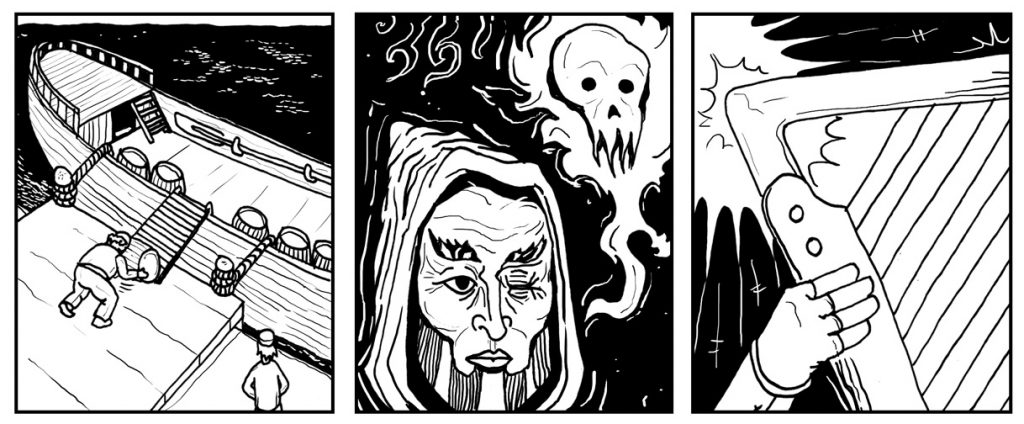
As Pentarch sailors drifted without idea or rudder, natural currents drew their craft in towards the Bay of Erasure. The two arms of Raggath and Jyagar loomed, atop which they could spy off in the distance each a tower adorning its bald head.
And crowning each tower’s top, a forking branch and bowl. The forks were tuned by their maker, master instrument builders serving the temple. Such was the power which fed them in that place, that they shared, as it were, one spirit in resonance each the other. Like one line of string held taut between Duogons, a living tone which was held dancing in the air.
From this tone, by listeners in the villages and way-stations below, could be derived sub-tones, to which duly appointed novice minstrels served their tour of apprenticeship, tending in part to the peeling, and keening, and banging and bonging of various tones with bells in matching rhythms to mark out the passing of the days through the Houses. The singing sound of their bells ringing echoed up and down the arms of the villages dotting the Bay of Erasure, from Raggath through the Wild Wastes, and Jyagar on to strong and humble Elum, and thence up high to the Temple Mount, and the Pillar of Song, where the High Augur held court, hearing gathered together all the overtones of the land, the people, the sky, the water, the animals, and angels. The ominous glorious symphony of Quatria.
While on any given day, the High Augur heard and tolerated such disturbances as the drunken mistakes of too religious devotees to the wine and beer gods (all too common these days) — missing cues, flattening and sharpening their notes, lousy counts — the day the Pentarchs broke line of sight between Raggath and Jyagar, the forked instruments at tower-top fell out of tune, and their bowls re-transmitted from one the other, a gap, a questioning difference. A dissonance in the House of Song — one such as hadn’t been heard in few among the bards were sure how long (a rowdy beer-filled argument amongst whom thereafter ensued as various camps decanted remembered rhymes from older times).
The three sailors, though as babes to this New World, heard too the pure, awesome tonal shift, without reference to what the now split tones must signify to their makers or listeners. And they heard too as the String of Bells activated, up and down the coastline, singing out this difference, echoing as far as the city of Geus.
And upon hearing these two tones reaching the Pillar of Song, the High Augur observed a crack in the empty teacup on the small personal table set up next to the Altar of Song, and frowned.
As the morning’s canticle drew to a close, the High Augur drew two cards, and laid the first, the ass, down in the House of Sorrow on the songboard, and the second, the spade, into the House of Song.
The ass of the trader. The traitor who hauled his ass out of the Vast Desert, crossed the Ereddian mountains, and betrayed Lord Abbadon. Ruin and destruction, betrayal by the beast of the flesh.
The spade of the miner. The temper of Minus the Minor, jealous younger sibling of proud Geus, to whom connected via the Temple Road, all the way up to the foot of the Pillar of Song. Under-miner. Betrayal by family. Digging one’s own grave.
In silent cues, the High Augur used hand signals to mime to the Watcher, who hummed to the Conductor the key tone sequence to initiate the Dark Dance Cycle, set against the saga of the Fall of Abbadon, the opening of the Wild Waste, and the death of Delrin, mate of Elum at the hands of the Betrayer.
It was rare but not un-heard of this time of year to perform the invocations of the Dark Dance Cycle, but rare enough that it would take some time to round up the dancers and costumes to perform the Trilogy. And thus of course, the genius of the venerated Composers of the piece was such that a lengthy prelude commenced then among the gathered principals and accompanists, which would give time enough for the songs and signals to be passed from mouth to ear, harp and tambour, and for appropriate performers to manifest assembled in the Grand Plaza, awaiting the signal of the Maestro.
Meanwhile, the Pentarch sailors drifted up the coast toward Elum in wonder. And though no one saw it in the midst of preparations, a tiny crack appeared in the foundation of the Pillar of Song, and a shudder went through the spine of the High Augur, out of sight far above.
Listen then, cartographer. This is the first mystery of the casting.
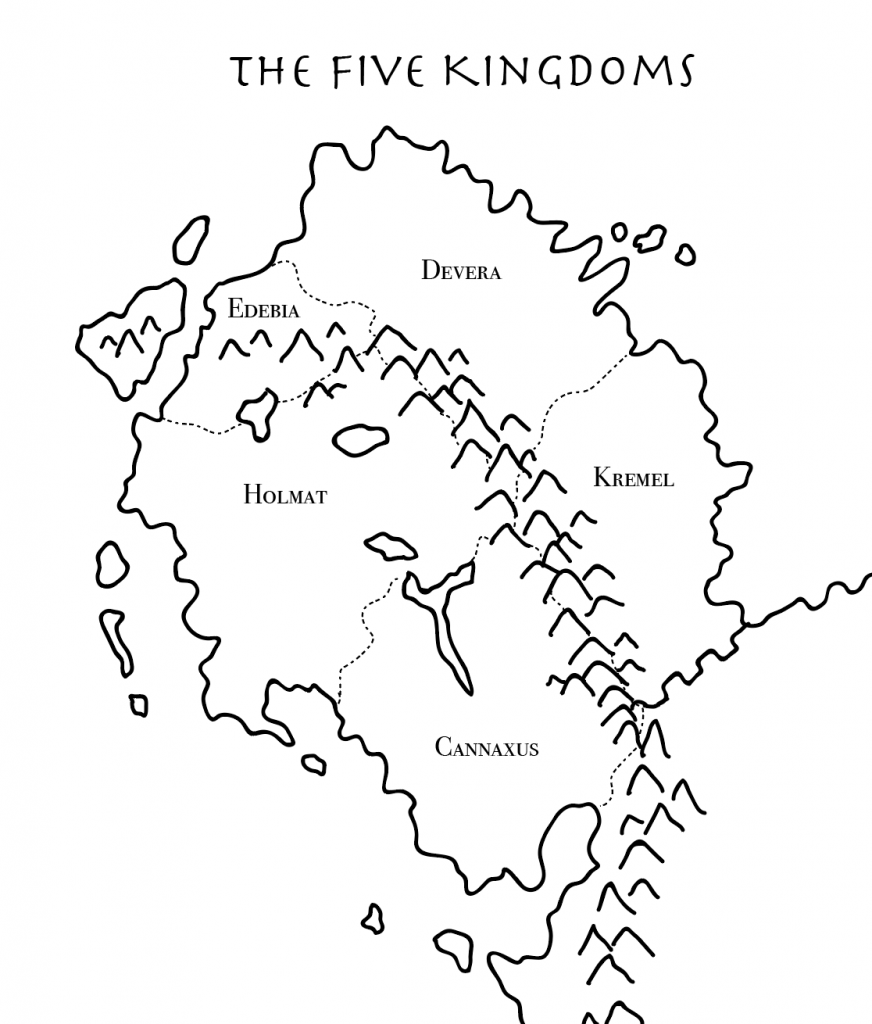
Quatria, the land, her people, is plural. Quatrium. A four-cornered thing. Thus the singularity of the Hypogeum was first bounded, in the time of the Singulones. Point in the center. Point on the edge. Tie a string between. Duogons have their reign. Fixing on the center, keeping the string taught, rotate slowly around the axis, until returned to starting point. Center, edge. Node, anti-node. End, beginning. At once the same but different. That difference is the history of change. Delta. Center, edge, change. By the the bounding ring, the Reign of the Triangulons has commenced.
From center, connect any two non-opposite edges, directly via the straight roads between them. The Triangulon empire was beautiful, brutal, and thankfully brief.
Connect opposite points in pairs, such that four equal sections result. The original Quadrants preceding Quatria. Connect those who are not yet connected. Circle gets a square. Four Quadriums become one Quatria, and the world begins. Again.This world is centered upon the Mysteries at the heart of those Prior, called in this age the Hypogeum. It is the source of emptiness and longing to which Triangulon poets and their minstrel descendants sung their languorous dirges and dark soliloquies. The Fourth Point, Termination.
Of the quadrants, number prime, second, tertiary and null, so named on the Songboard: the House of Sorrow, House of Wealth, House of Song, and House of Emptiness.
The Capital of the House of Sorrow is lost Ederron, pushed into the sea during the First Age, her children dispersed in the First Diaspora.
The Capital of the House of Wealth is happy, fat Abbadon, Lord of trade with the underworld, whose destruction marks the passing of the Second Age.
The Capital of the House of Song is troubled Temple Mount, where having reached its apogee, Quatrian culture stagnates and tumbles into degradation, and the crumbling of whose foundation as certain Pentarch sailors broach the Bay of Erasure serves the backdrop of our present narrative, and marks the passing of the Third Age.
The Capital of the House of Silence will be the city to come of Ovarion, where the Pentarcs will take up residence a little off the mainland on an island recently ejected from the mists, and build their palace. The Fourth Age.
This is the mystery of the Precession of the Anti-Nodes, and the key to all ages.
Currently, Earth’s pole stars are Polaris (Alpha Ursae Minoris), a magnitude 2 star aligned approximately with its northern axis, and a pre-eminent star in celestial navigation, and Polaris Australis (Sigma Octantis), a much dimmer star. A couple thousand years ago, Kochab and Pherkad were twin northern pole stars, though neither was as close to the pole as Polaris is now. […]
In the medieval period, Polaris was also known as stella maris “star of the sea” (from its use for navigation at sea) […] Polaris was associated with Marian veneration from an early time, Our Lady, Star of the Sea being a title of the Blessed Virgin. […]
During the 1st millennium BC, Beta Ursae Minoris (“Kochab”) was the bright star closest to the celestial pole, but it was never close enough to be taken as marking the pole, and the Greek navigator Pytheas in ca. 320 BC described the celestial pole as devoid of stars.[7][11] In the Roman era, the celestial pole was about equally distant between Polaris and Kochab.
Source: Pole star – Wikipedia
Listen, friend… This world is not the first. The True Count, however, is lost to the veils of time and mystery. That there were antecedent phrases in the song of history, we can be sure. And it is of these, dear reader, we speak today.
Quatria was failing. Though it’s metamorphic ability as a landscape to constantly physically remodel itself was known and admired throughout antiquity, at some point in geologically recent, but not recent in the minds of humanity, the dynamic tension which held the continent together had reached a sharp crescendo in the notes of the ruling priestly castes of the Hypergeic Temple. Their once prevailing virtuosity — which had flung them far from the Source to spread their music across other lands — had lapsed into laziness, and was verging toward mediocrity.
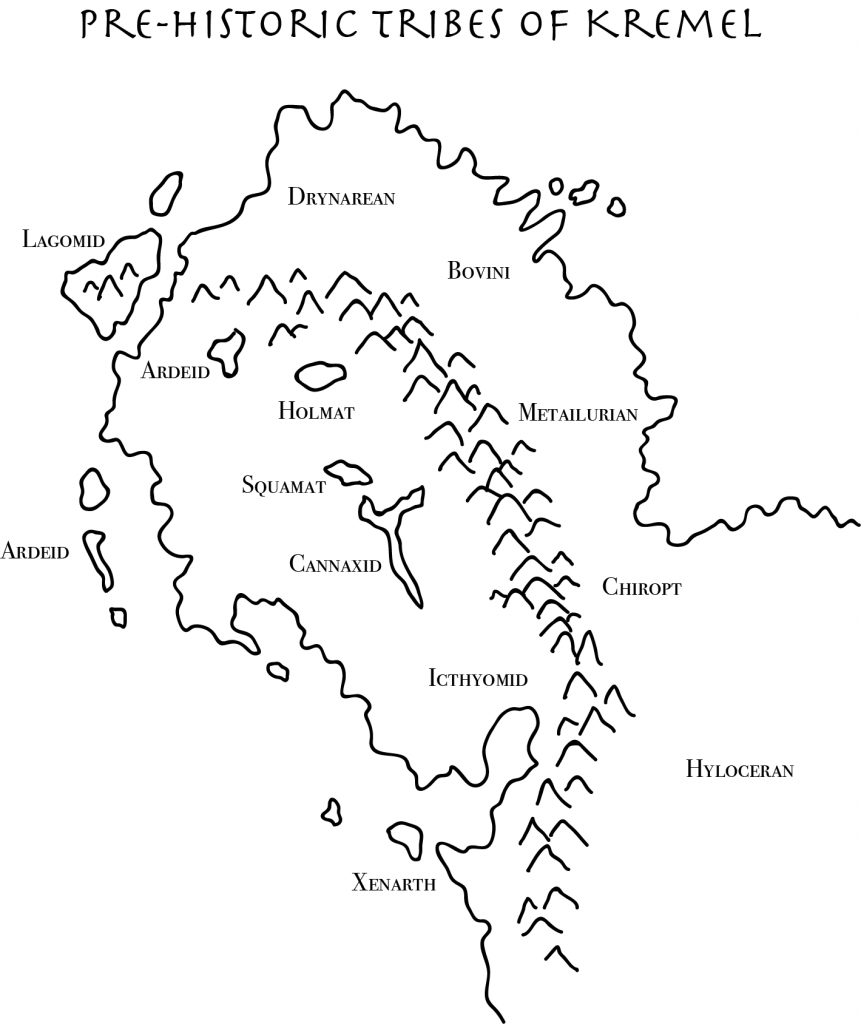
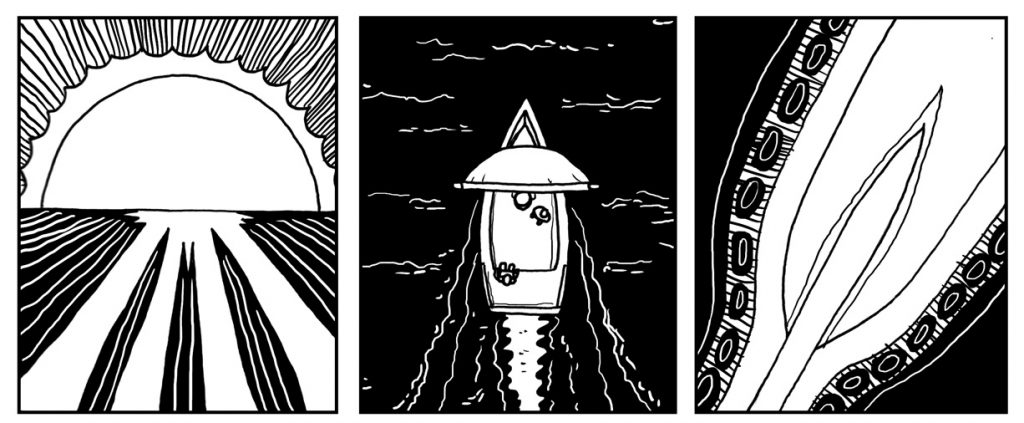
It was in the Summer of these times, when a small crew of Pentarctic sailors set out from one of the corrugated shorelines occupied by a then minor tribe of the Five Kings of Kremel, on a short phishing expedition. What should have been a three hour tour was waylaid by a storm-at-sea, which hurtled their vessel farther and farther off course.
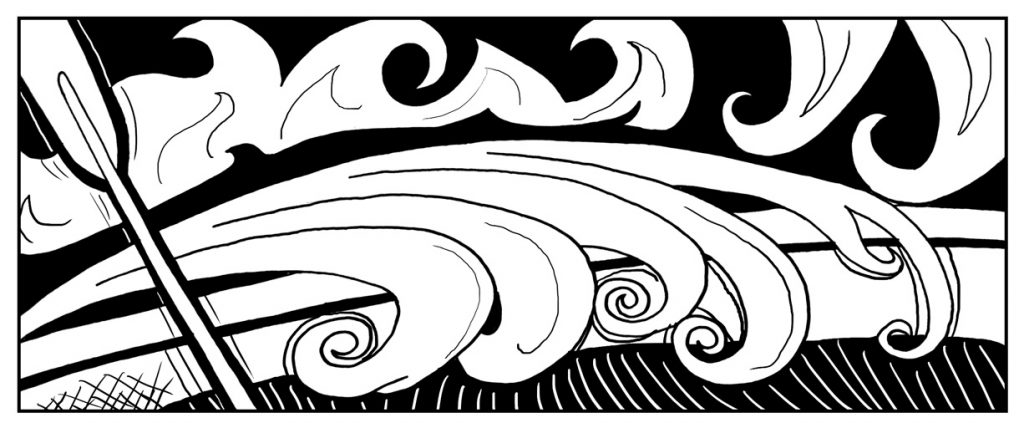
The men heard the wail of sirens in the distance as the storm surged around their craft. Strange lights flashed on and off in the darkness. They could powerfully sense and were equally powerless to stop the inevitable drift of their vessel toward the Equatorial Girdle. The Cold and Dark grew louder and stronger around them, until they felt the numbess of their limbs overtake their cores, plunging them eventually into darkness.
And then the sound of ringing. A single pure tone, at first, splitting into a second note, in harmony, then a triad, and then a chorus of song… And then a rainbow, warmth as of Spring, and a tingling, as life flowed back into the earth of their bones, and the soil of their flesh.
Across calm turquoise waters dead ahead, a gleaming white island, and in the distance a palace, a temple, to which their inner compasses re-oriented themselves as though home. The Source of the strange music.
To understand the Pentarcs, and the Quatrians, it is necessary also to speak of the Triangulons, the Dyadic Duogons, and the monolithic Singulones. Each of them precursors to the other. Each of them a significant player in the Shape Wars to come.
In actual fact, there is only one long Shape War, and it goes back to the origin point in the timefield to the conception of forms in the first place. But for the lays of the bards, and the rhymes of the chronicler, we break them up into many, name them generally for their locus and players, and set them onto the stage of history to play out their parts in turn from harmony to dissonance and back again until the night is over, and the circle begins again.
Before the fall of Abbadon, in Old Quatria, when the land was still young, there were no hierarchic divisions among the priest caste, and in fact not yet a formalized priest caste. Instead, there were traveling minstrels, who went from field and glen to town and village in celebration of the mysteries. They told the tales and the jokes, sung the songs and epic poems of the places they’d gone, or dreamed of on that long, long road.
Though they brought with them joy, the people in the towns could feel their loneliness, and longing for home. They would cook them meals, and give them beds and barns to sleep in, and stock them with provisions and foodstuff when they went on their way.
And thus marked the passing of the rounds of time in Old Quatria. The timing of the Festivals coinciding with the return of the roving bands of minstrels and the changes of the seasons.
Abbadon then, was still but a humble village, thriving, but not yet even a town. To the East of the Hypogeum, it was the anti-node at that time. Thus inflow and outflow traffic then — consisting mainly of therianthropic magicians, and the virtuous amongst the minstrels (which legend would claim were descendants of Triangulon ancestors), whose purity allowed them to pass through the gates bi-directionally without disintegration.
This is important in terms of the Shape Wars, because the Triangulons embodied by the Dynamic Principle (the delta), lacked the fourth point, which the Quatrians had found. Stability. Their relation to the central core of their culture, the emptiness of the Hypogeum. In the Morning of Quatria, there was still ample traffic to and fro. And at Noon, traffic had slowed to a trickle. The Hypergeic Temple, in its full-development with an ascendent ruling priesthood of honored and illustrious crowned musicians, stood at apogee to its node, illuminating in starkest contrast the noise of its energy from the ambient background of emptiness.
What were once cyclic Festivals and celebrations had evolved into a complex multi-syncretic calendar of continual formal rites variously co-mingled with minor dalliances and degraded public debauchery and amusements. And it is into this decadent period of Classical Quatrian culture, into which their unwitting Pentarctican successors had accidentally sailed.
As blood flowed back into the veins of those revivified sailors somewhere beyond the harbor, beyond yet the ken of the waits, watching tirelessly over the Temple, and in turn over all of Quatria, the Head Augur in the Pillar of Song cast a mal throw on the songboard. Three pents and a duo, seventeen, in the House of Sadness.
The program was drawn up for the morning chant, the song of which would reverberate out from the Pillar of Song in rounds the moment the rays of the morning sun kissed the strings of of the altar.
It was a sad song. It told of the First Age of Quatria, after the ejection of Ederron from the caldera of the Hypogeum. The first Anti-Node, after the Separation, and rising of the mountains as Ederron was pushed out to the sea. Though its verses would not be included in the dawn chanson, for those versed in the lore, it called to mind those Quatrian ancestors who had left the continent for good, wanderers and outcasts, some of whom would found the colonies of old, of which Kremel was but one of many, in the second age, when the anti-node was shifting toward Abbadon.
The Anemoi are minor gods and are subject to the god Aeolus. They were sometimes represented as gusts of wind, and at other times were personified as winged men. They were also sometimes depicted as horses kept in the stables of the storm god Aeolus, who provided Odysseus with the Anemoi in the Odyssey. The Spartans were reported to sacrifice a horse to the winds on Mount Taygetus.[3] Astraeus, the astrological deity (sometimes associated with Aeolus), and Eos/Aurora, the goddess of the dawn, were the parents of the Anemoi, according to the Greek poet Hesiod.
Of the four chief Anemoi, Boreas (Aquilo in Latin) was the north wind and bringer of cold winter air, Zephyrus (Favonius in Latin)[4] was the west wind and bringer of light spring and early-summer breezes, and Notus (Auster in Latin) was the south wind and bringer of the storms of late summer and autumn; Eurus, the southeast[5] (or according to some,[6] the east) wind, was not associated with any of the three Greek seasons, and is the only one of these four Anemoi not mentioned in Hesiod’s Theogony or in the Orphic Hymns.
The deities equivalent to the Anemoi in Roman mythology were the Venti (Latin, “winds”). These gods had different names, but were otherwise very similar to their Greek counterparts, borrowing their attributes and being frequently conflated with them.
Source: Anemoi – Wikipedia
The Tower of the Winds or the Horologion of Andronikos Kyrrhestes is an octagonal Pentelic marble clocktower in the Roman Agora in Athens that functioned as a horologion or “timepiece”. It is considered the world’s first meteorological station. Unofficially, the monument is also called Aerides (Greek: Αέρηδες), which means Winds. The structure features a combination of sundials, a water clock, and a wind vane.[1] It was supposedly built by Andronicus of Cyrrhus around 50 BC, but according to other sources, might have been constructed in the 2nd century BC before the rest of the forum.
Source: Tower of the Winds – Wikipedia
This Aeolus lived on the floating island of Aeolia and was visited by Odysseus and his crew in the Odyssey. After their misadventure in Polyphemus’ cave, Aeolus gave them hospitality for a month and provided them a west wind to carry them home to Ithaca. He also provided a gift of an ox-hide bag containing all winds but the west. Odysseus and his crew members traveled steadily and anxiously for several days, but with his native land in sight, Odysseus sank overpowered by sleep. His men proceeded to indulge their curiosity to see the costly presents which they thought the bag contained, opened it unwittingly, and out burst the imprisoned winds with such a roar that the force drove the ship back to Aeolus’ island. Aeolus refused to provide any further help,[6] because he believed that their short and unsuccessful voyage meant that the gods did not favour them. This Aeolus was perceived by post-Homeric authors as a god, rather than as a mortal and simple Keeper of the Winds (as in the Odyssey).
Source: Aeolus (Odyssey) – Wikipedia
Volta do mar, volta do mar largo, or volta do largo (the phrase in Portuguese means literally turn of the sea but also return from the sea) is a navigational technique perfected by Portuguese navigators during the Age of Discovery in the late fifteenth century, using the dependable phenomenon of the great permanent wind circle, the North Atlantic Gyre. […]
The volta do mar was a sailing technique discovered in successfully returning from the Atlantic islands, where the pilot first had to sail far to the west in order to catch usable following winds, and return to Europe. This was a counter-intuitive sailing direction, as it required the pilot to steer in a direction that was perpendicular to the ports of Portugal. Lack of this information may have doomed the thirteenth-century expedition of Vandino and Ugolino Vivaldi, who were headed towards the Canary Islands (as yet unknown by the Europeans) and were lost; once there, without understanding the Atlantic gyre and the volta do mar, they would have been unable to beat upwind to the Strait of Gibraltar and home. Discovering this technique was crucial for returning from future discoveries; for example Christopher Columbus would never have returned from the Americas without applying the volta do mar by sailing northwards from the Caribbean through the Horse Latitudes to catch the prevailing mid-latitude westerlies.
Source: Volta do mar – Wikipedia
Wind is caused by differences in the atmospheric pressure. When a difference in atmospheric pressure exists, air moves from the higher to the lower pressure area, resulting in winds of various speeds. […]
As a natural force, the wind was often personified as one or more wind gods or as an expression of the supernatural in many cultures. Vayu is the Hindu God of Wind.[76][77] The Greek wind gods include Boreas, Notus, Eurus, and Zephyrus.[77] Aeolus, in varying interpretations the ruler or keeper of the four winds, has also been described as Astraeus, the god of dusk who fathered the four winds with Eos, goddess of dawn. The ancient Greeks also observed the seasonal change of the winds, as evidenced by the Tower of the Winds in Athens.[77] Venti are the Roman gods of the winds.[78] Fūjin is the Japanese wind god and is one of the eldest Shinto gods. According to legend, he was present at the creation of the world and first let the winds out of his bag to clear the world of mist.[79] In Norse mythology, Njörðr is the god of the wind.[77] There are also four dvärgar (Norse dwarves), named Norðri, Suðri, Austri and Vestri, and probably the four stags of Yggdrasil, personify the four winds, and parallel the four Greek wind gods.[80] Stribog is the name of the Slavic god of winds, sky and air. He is said to be the ancestor (grandfather) of the winds of the eight directions.[77]
Source: Wind – Wikipedia