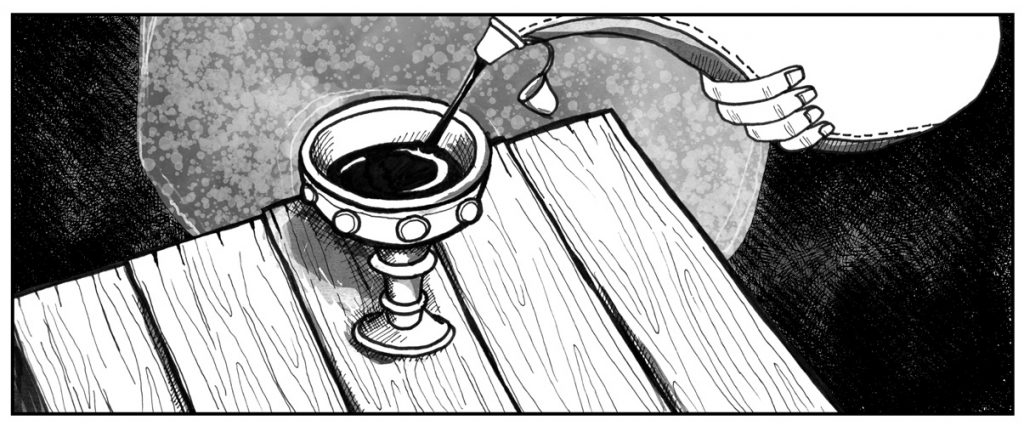
At the urging of the old man in the castle atop the Cloudspire,
Benda did then take up the harp, Eril, and played upon it. The old man
sipped from the goblet of wine which his companion, Eradus, king of
Devera, filled from a skin.
As
on previous occasions, Benda had no idea what song he was playing. The
music passed spontaneously through and out of him, as though he himself
were the instrument, played upon by some other unseen Master of Song.
When
he opened his mouth to sing, the others watched in rapt attention. Each
one hearing it, including the singer, understood with perfect
crystalline clarity the tale it told, even if — as in Eradus’ case — the
language remained foreign to him.
The
old man laughed though, in hearing it’s opening lines, and raised his
goblet to salute Benda. “A very long time since I’ve heard it! Ha ha!”
The song which Benda sung that day in High Dock castle was the Myrga Majona, and its contents are preserved in the text of that epic.
When
Benda had quite finished, the last notes of the harp Eril trailing off
into silence, the old man cheered heartily. “Helmoquinth!” he shouted.
“Helmoquinth, Anthuor!”
He thrust the goblet of wine in front of Benda, demanding, “Drink! Drink!”
Benda
swigged down the rest of the goblet, and Eradus went to fill it. The
old man waved him away with a hand, and then took the skin from him, and
handed it to Benda.
“Pour! Pour!” he cried to Benda.
Benda
took the wine skin, and feeling it in his hand, he found it to be
rather more full than he had thought. He poured into the goblet, and the
wine flowed freely, and easily filled the goblet.
“Ha, ha!” the old man exclaimed. “Thought so.”
“I’m sorry,” Benda said, confused. “You thought what?”
In response, the old man only took the wine skin, and turned it over to pour into the glass, which was already quite full.
“Now, now!” said Eradus. “Let’s not be too hasty! No need to waste it.”
But
only a drop poured out of the skin. The old man palpated the skin with
his hands to show them. “It’s quite empty when I take it,” he explained.
“But as I said, this cup has the property that when wine is poured into
it by the hand of a king, it will never be empty.”
Eradus looked at Benda, who said nothing.
At last, Benda changed the subject. “The song,” he said. “You say you’ve heard it sung before…”
“Sung
in a manner such as this? Never,” he said. “But the lyrics to the Song
of the Great War Host are well known to those in my order, albeit in a
different form…”
On hearing the title of the song, Benda found himself unable to speak.
“Your order?” Eradus asked. “What did you say your name was again?”
“I never said,” replied the old man. He took another swig of wine. “I am called Banarat, of the Order of the Tempest.”
“A storm sage?” replied Eradus, puzzled. “I thought your order was destroyed, long ago.”
Banarat nodded. “It was. Do you see any others in this place? I am the last of my kind.”
“What is this place, then?” asked Benda, recovering himself a bit. “And how came I to know the songs of your vanquished order?”
“The
second question,” Banarat said, taking another, and still another glug
of wine, “we will explore together in due time. But the first, I can
only address by telling you a tale of my own. Perhaps that tale told in
answer to your first question will open a door into your second.”
He
drained the goblet then dramatically, and plunked it down hard on the
table. He seemed, by this time, quite drunk. Eradus, obligingly, filled
it fresh. And Banarat began his tale.
In the deep before time began, The people lived on a floating island. They hungered not, and ate nothing, Though plants and fish were abundant. They grew not tired nor old, and made not war. The dreaming sea held them on its back. In those days the seas were still one. The stars swam in the great ocean.
One day, the island floated past A star in its full brightness close. And the people of the star swam out To walk with them on the island. The people of the star were brilliant And the people of the land were enthralled, By their great beauty and glamour. They had never known want before.
The island turned to float away, And the people of the star swam home. The people of the land felt desire, And some swam out to go with them. Some people of the star stayed behind, But could not abide to live on land. They took them instead to the seas To live nearby the land people.
For a thousand generations, Families grew between the two. In multiplying, they sought new lands, Sending the sea people out as scouts. When they came ashore they would breathe And the land would spring to life in song. The landers would follow then in ships, Coming ashore when all was ready.
In the thousandth generation, The Great Separation occurred. The sea was divided in two: The sea above, and the sea below. As the stars fled to seas above, So followed the people of the star. They left the landers and went home. And the islands at last ceased floating.
In this age, the people left below Learned of thirst, rage, war, and hunger. They ate of fruits and fish around them. In their hunger, they ate it all. When there was none, they fought the others, Killing kinsmen in raids of far off isles. Keenly they suffered for love lost, Hearts pining for the starry ones.
Cildan was a lander king with star blood. His people resisted many raids. Though lamed in battle, he were king For he could see and speak with sylphs And the heav’nly sprites who served The star people in seas above, They taught him how to build cloud ships.
On cloud ships, sailed forth Cildan with His sons, called Cimric and Cimlad. They passed o’er the lands of Buorth. They sailed up the sea wall and bridge Far away at the edge of the world, Until they passed to the seas above. And a thousand generations went by As they voyaged from sea to sea.
In this time, it came to pass again, the stars receded fully from this world, And with them left for good the star people. When Cildan and his sons arrived, They found only sylphs and sprites Who were but diminished echoes of The brilliance of the star people. And their anger and loss was great.
The sylphs fled before their rage into Seas above swimming far, diving deep. Though Cildan repented of their deeds, His sons Cimric and Cimlad did Hunt and slay a great many sylphs Feasting on their corpses and gaining In small measure the star brilliance Locked within their aery bodies.
Cildan wept for the needless slaughter. But his sons had become cruel and Thought their father both lame and weak, And cast him into the seas above Where he foundered and could not swim. A pod of sylphs came bearing him up To high places, the domed courts of muses. While his sons raided and plundered below.
They burned the borrowed star brilliance To raid and conquer other lands. Their cloud ships fell with thunder on The heads of their enemies, bursting Shield and fortress asunder. Til the brilliance grew dim and faint. With a great host, they resolved to sail: To find, and slay, and eat star flesh.
Wise Cildan had gave counsel to The muses in their courts above To flee before his sons could come, And with a host of sylphs had they fled. When Cimric and Cimlad did arrive, The seas above were abandoned. The domed courts were empty and grey. In their rage, they threw down the courts.
With no sylphs to sustain life there, The seas above turned toxic and Poison fell down as rain below, Ruining the lower seas and islands. With no food and the sylphs gone, Landers began to choke and die en masse. In their cloud ships, the brothers left them And sailed on with their great war host.
They tracked the sylphs across the deep, Passing through the Outer Darkness. They sought the light of stars which fled Always ahead of their passing. At last, they found the sylph settlement, A place where they had breathed new life. From their ships, the sons prepared to strike, But Cildan their father appeared.
Put away your anger, my sons. The Mockridge has overcome you. You know not what you’re about or why. If madness be cured only by star flesh, I offer you mine, to leave off Your persecution of these people Who in the end are so like you. But they killed him, and all the sylphs.
As they feasted on substitute for star flesh, They became filled with a radiance, A fire which burned, and burned brighter Consuming them from within. Their bellies burst, and exploded forth From each a pearl of great size which Hurled themselves into the deep. Rubbing their wounds, the brothers fell asleep.
As they slept, from their wounds did creep Monstrous beasts, children of the Mockridge, Sick star flesh perverted to darkness. They set about in devouring That life the sylphs had breathed therein. They ate the isle back down to rock. The air turned poison for lack of song. When the brothers awoke, all was dead.
Let us mount the war host in cloud ships, And pursue our prey to their last, said they. The brothers and beasts and war host Set sail on the deep, crossed again the void, Tracking the star light of sylph breath. Where the true stars heard rumors of their passing, They sent word ahead of warning, And all would go into hiding.
II.
A thousand generations passed again, Before the Majona war host Found where the seeds of pearl had gone. The sylph people had since flourished afresh, Crowning bare rock with sweet atmosphere, Breathing life into land anew. In the center grew a great tree, And the tree was called the Anthuor.
The branches of the Anthuor tree Reached o’er all parts of the isle. All life grew in its gentle shade. Its crown brushed the seas above. Birds and sprites of the air roosted in it, Whispering legends heard from sylphs Of merciless brothers hunting, Of war hosts in cloud ships coming.
The tree had a plan to withstand, If the war host should ever come. It gathered the sylphs and spirits, All who held no love for the Mockridge. It said to the marshaled forces: We will never win by violence. Are there some among you who would Sacrifice themselves for the rest?
A few of the bravest sylphs volunteered. Anthuor directed then the others To send seeds out in all directions, As a safeguard if the plan should fail. When the war host arrived, the sylphs Sent out heralds with their offer, To sacrifice a few for the rest. In response, the beasts slew the heralds.
The war host descended, slaughtering. The beastly children of the Mockridge Leapt from the seas above into The branches of Anthuor, hacking. But for each branch lost, two grew back And smothered the attacker with Its own violence turned back at them. The brothers saw and wailed in fury.
They leapt from their cloud ships and with Bright axes shining, and hewed at the roots. Anthuor shuddered but held fast. He rallied the sylphs remaining, Sending them far down below the ground. Into the clefts of Acho they delved; In secret dark places, they strained. A mighty effort did they make to lift.
As the brothers cut through a bare root, Anthuor lifted his feet from the soil. Ancient root, once freed, did turn to hoof. Hooves blazing, and head full of fire, He stamped and snorted at the brothers. Their axes broke; they quailed in terror. The war host trembled and the ground shook. The sylphs flew up to smash the cloud ships.
In the chaos that did follow, Cimric sacrificed his own brother, Pushing Cimlad under deadly hooves. This cruel act summoned the Mockridge, Who took a form like as Anthor but false. He trampled the ground into hard steel: You’ll never lay your roots here again, And shall ever be without rest, cried he.
Anthuor reared up against this curse, Struck a fierce blow to his enemy’s crown. And the demon dispersed in a flash. Then Cimric the kin-slayer fled, With what remained of the war host In the last cloud ship not destroyed. The sylphs rejoiced, but Anthuor wept: For the curse was true; no more would he rest.
He looked around at the lost lives, Pardoned those who fought against them, Taking on their loss as his own. Dead beasts and war host sprung back to life. He took their names and bodies from them. He mixed their attributes in a pile. He called the sylphs back from the deep. Each chose a new form and name from the pile.
Some went to dwell in seas and aethers. Some flew into the soil and down there, Where Anthuor’s tears had fallen on hard steel, They turned it to rust, and ate it. Acho cracked, and laughing said he: You may let down your roots again, Anthuor. But he had grown accustomed to hooves; The curse was no longer a prison.
I shall be the sacrifice, said he, Shaking the branches of his antlers. Cimlad, who lay dead, got up again. He bowed down before Lord Anthuor, Who took away his name, but gave him a bow Cut from his branches, and a cloak spun from his leaves. Rise up, huntsman! The game is afoot! Cried he, as a stag, and in a flash was off.
When
Benda awoke, his traveling companion Eradus was nowhere to be seen. He
had evidently vacated the protective hollow where they had sheltered
overnight on the Cloudspire. Benda got up, shook the dust from himself, and went outside.
He found Eradus there, marveling off into the distance.
“We
must have climbed up higher yesterday than we realized,” Eradus said to
him. He pointed off toward the mainland, toward Devera. “I can nearly
see my castle from here.” It was hidden, in fact, within a grove of
ancient Drynarean woodland, but having visited and traversed the domain,
Benda could intuit its location.
“Climbed
higher than we thought — or were raised up in the night.” Benda’s dream
flooded back to him, but for now he guarded it close to his heart, and
did not speak of it.
“Aye,” replied Eradus. “It is a place of magic, and we must be on our guard.”
Benda
turned to look back at the base of the great tower, under a hollow of
which they had spent the night. And behold, he saw a stair spiraling up
from the platform on the naked face of the tower, where the day before
there had been none.
“Aye,” he said. “Magic.”
They
mounted the stair case, carefully choosing their foot steps, and
ascended thus for what felt like hours. They arrived, progressively, at a
first, a second, and then a third small landing. At each landing, there
was a flat ring broad enough for two or three men to stand abreast, and
no more. And the central tower width reduced accordingly. At each, they
found another naked stair, each more treacherous than the last.
After
the third ascent, they arrived finally to broad a flat top, which
stretched for an indeterminate distance — one which seemed somehow
larger than what they would have expected the tower below to be able to
support.
In
the center was a mountain, as if in miniature, reduced perfectly to
scale to fit within the confines of this strange plateau. And as they
circumambulated this uncanny moutain, on the foot of the far side, they
discovered a castle. It had plain, unadorned walls, was far smaller even
than the Castle of Devera, and seemed to consist only of one walled
courtyard, and a a central keep of three or four levels.
Circling
it, at length, they came to a gate, large enough for two goleks to
pass, side-by-side. It was shut, and there was no one about, so they
knocked upon it.
There was no reply. So they knocked again, and waited. Several times.
“Hail!” Eradus shouted, with hands cupped in front of his mouth. “We two have come to seek the Master of this place.”
After some long minutes, they heard the voice of a gate-keeper, from behind the barrier, somewhat muffled.
“Who goes there? Be ye beggar, minstrel, or king?”
Eradus and Benda looked at one another. Eradus said, uncertainly, “One of each?”
“I am called Eradus Drynarus, First Knight and Protector of the Realm of Devera, Fifth King of Kremel, and King Under the Wood.”
“And this is Lost, the First Minstrel of Devera.”
From behind the gate, the voice responded, “You lost your minstrel? I thought you said you were two…”
“Lost is his name, and we two have come seeking it.”
“Haven’t got any. Good day to you.”
“Please,” Benda spoke up finally. He put his hand on the door. “Quatria.”
Eradus looked at him, uncomprehending.
He repeated the word, “Quatria.”
“I need… to remember.”
The muffled voice responded, irritated, “I heard you the first time. I’m just trying to find the right -”
They
heard the clatter of keys, and a lock turned inside the door. It
creaked as it swung open inwardly. And in the passage beyond, they made
out the slight form of a small, frail old man. Benda noted that this was
not the mysterious robed figure he’d seen in his dream, and together
with whom he’d looked impossibly far — out over the sea — to Quatria.
“Come in, come in, already,” the little old man said. He wore about his shoulders a simple, threadbare and faded smock.
They entered the passage and the man closed the gate behind them and locked it.
“Do you… have many visitors?” Eradus inquired.
The old man smiled craftily, “You never can be too careful!” and he stuffed the ring of keys into a pocket.
He
put his hands on his hips, and looked at them. The courtyard behind him
was all but empty. A chicken walked by, and scratched at the dirt. In
the distance, they heard a goat call.
He looked at Benda, and at the harp Eril on his back. “So, I guess you must be the minstrel then?”
“In truth,” Benda replied. “I don’t know what I am. I am… well and truly Lost.”
“Aren’t
we all?” he turned and beckoned them to follow him to a far corner of
the courtyard, which had a an over-hanging roof. There was a table and
some chairs.
“Sit; let’s be out of the sun.” They did so.
“I’m
afraid I have little to offer you. That old hen hasn’t laid in days,
and the goat is dry. Some wine would be nice, but alas…”
“Thank you,” said Benda. “But we haven’t come seeking wine.”
“I
do have a little though,” said Eradus, producing a skin from the folds
of his cloak, of which Benda was not aware that he carried.
“Excellent,” the old man said. He ambled over to a crude cabinet, opened it, and pulled out an old and tarnished goblet.
He
came back and set it on the table. “This goblet has the property that
if wine be poured into it by the hand of a king, in good company, and
good song, it will never go empty.”
“So, pour the wine,” he said. Eradus did so.
“Take up the harp,” said the old man. Benda did so.
He produced some crusty old stale bread. He cracked the crusts, and gave one to each of his visitors.”
By the time Benda awoke groggily the next morning, the sun was up and Eradus had already risen and prepared a bit of stew.
“To fortify us for the climb ahead,” he said, handing Benda a bowl, who took it, wiping sleep from his eyes.
Benda
noticed that their golek mounts, Dema and Selef, had an air of unusual
contentment. Though their wild sable counterparts were nowhere to be
seen. Eradus explained this was because they had found raisla in the others, a deep recognition of kinship — one which transcends familial ties, history, geography, circumstance.
“We say that finding raisla makes the bell of the heart toll,” said Eradus. “We hear and are heard. One sets the other ringing.”
“Bells ringing,” Benda repeated, his mind floating off to some sense memory still shrouded in mist.
“That’s right. Finish up, and let’s get on!”
They
struck camp, and rode with Dema and Selef to the foot of the mountain,
the Cloudspire at its peak growing ever larger in their awareness. When
they reached its base, Eradus dismounted, and motioned for Benda to do
the same.
“We’ll
leave them here, to find their raisla,” Eradus said. “They’ll find
nothing better up that mountain and spire — but perhaps we will! Come
then.”
The goleks nudged them affectionately, and Selef made a few huffing noises and chirps, which made Eradus laugh.
“Is that right?” he exclaimed.
Benda, scratching the scruff of Dema’s neck, turned to him. “What?”
“He just told me something,” said Eradus.
“Who?”
Eradus looked surprised. “You don’t know?”
“Know what?”
“Forgive me, my dear Lost,” Eradus laughed. “I quite forget myself. Selef, he spoke to me in the tongue of his people.”
“I didn’t know they could talk. Well, what did he say?”
“He told me that the chief of their raisla, Machef, asked them why they travel with two kings…”
“Two kings,” Benda laughed. “What does that mean?”
“I guess we’ll see, won’t we, First Minstrel?”
Benda
pondered what could be the meaning of this as he patted Dema’s soft
hair on the tuft of her head one last time lightly, before turning them
loose.
“They
say goleks never lie. They never learned how,” Eradus said as Selef and
Dema scampered away over the fields to join their raisla.
The two began their ascent along a rough trail which lead up into the embrace of the mountain.
“In any event, they’ll find us upon our return.”
They
climbed then all that day and the next, camping light with no fire for
two nights. The second night was cold, and Benda wrapped his cloak
tightly around him. On the third morning, they rose briskly, and before
the sun had risen to its zenith, they reached the base of the ancient
crumbling city which formed the base of the Cloudspire. Benda saw it
then, towering over him, and imagined himself high atop it, looking out
over the sea. Somewhere in his mind, a parallel memory glimmered temporarily into awareness as if through a half-shuttered crystal, and fluttered away again.
Circling high above, they saw a great bird of prey against the crisp blue air, an eagle.
“I have seen this bird, I think,” said Benda. “Perhaps from the corner of my eye.”
“Perhaps in dream,” replied Eradus. “These past few nights, since we’ve entered his domain, he has no doubt been watching.”
They
trudged on through the city, which was built into a naturally-occurring
cleft in the mountain’s peak, which spiraled upward into seamless
fusion with the base of the towering Cloudspire.
At
the lower levels were empty storehouses with crumbling rooms, and the
ruins of residences, long abandoned. They climbed on. Higher up were
more stately buildings, with ornate columns and facades, but no less
ravaged by time, and the hand of a whispered lingering violence which
once shook this place. And then the base of the Cloudspire itself, a
kind of ziggurat in form, accessible via a thin staircase which lead
ever upward along the slightly inclined face.
They
reached a plateau. From there, the sea opened up all around below them,
though the mainland was obscured behind the spire. They noticed too,
the eagle circling high above them still, but closer now, closer.
Up
they went, another narrow staircase, a false step on which might send
one tumbling back down at least to the lower level, if not the curling
city below. But no false steps did they make, and when they reached the
next level, they rested.
It was well past midday.
“There’s
no telling how far up still we have to go,” said Eradus. “Or what we’ll
find up there, as the day’s shadows lengthen into dusk and darkness.”
“You’re right, of course,” admitted Benda.
“Let’s circle round this platform to find the spire’s entrance, and we can reconnoiter what lies ahead.”
So
they circled round the platform, their eyes on the sheer stone wall of
the spire in the center, which stuck up like a bony finger. They circled
once, and saw no trace, nor marks where a door or other entrance might
be. They circled twice — for good measure — and found still nothing.
“How
can this be?” said Eradus bemused “Though we’ve been here only a short
time, look the hour grows late, now. And we’re no closer to the goal
than before.”
“Perhaps there’s a trick to it,” said Benda. “Let’s look one last time.”
And
so they circled thrice the bony finger of the spire’s base. As they
went, Benda began to hum a wordless tune that came to him spontaneously.
They could see now the full paranoramic sweep of the sea on one side,
and the waters of the Edebian Passage far below, and the Kremellian
peninsula and its own mountains beyond.
As
they completed their third circruit, Benda’s tune built to a crescendo.
And nearly just as it did, a secret stair appeared where before there
had been none.
Eradus whistled, “Ho, there!”
They
did not know its secret then, but this hidden stair had the property
that it could not have been visible a moment sooner, nor if they had
arrived a moment later, and certainly not without their having thrice
circumambulated the axis of the spire’s base.
They
took the stair and ascended to the first level. At the top, they found a
low arch set in stone, and they passed into it. Inside they found a
hollow, and they were very fatigued from their climb, and they
immediately fell asleep.
When
they woke, it was midnight and outside the low arch, the rays of the
full moon beckoned. Benda got up and went out. On the stony landing
which made up the first platform, he saw there a very old man with
deeply creased, hawk-like features, a short grey beard, and a flowing
robe.
He
said nothing to Benda, and did not move, but seemed still to
acknowledge his presence. Benda, likewise, followed the sharp-eyed gaze
of the man off to the far seas. As he looked, he felt that he were
seeing a very long way away — an unfathomable distance. And all in an
instant, he saw something which shocked him with its familiarity. A
great green island in the faraway ocean. A hidden land once revealed and
half-forgotten, sprung to life in his heart again, all of a sudden.
Quatria.
He
said it again to himself in the space of his mind. Quatria. And in so
saying it, he woke himself up out of sleep. He was laying in the hollow,
behind the low arch. He turned to see if Eradus had heard him cry out,
but he wasn’t certain if he’d said the word aloud, or only in dream. The
Fifth King, in either case, was sleeping soundly. Benda went back to
sleep, and dreamt of the eagle, circling endlessly above them round the
spire.
Having departed from Edeb Castle, Benda and Eradus made their way to the coast. They rode without incident, and arrived at last to the Arch of Passing.
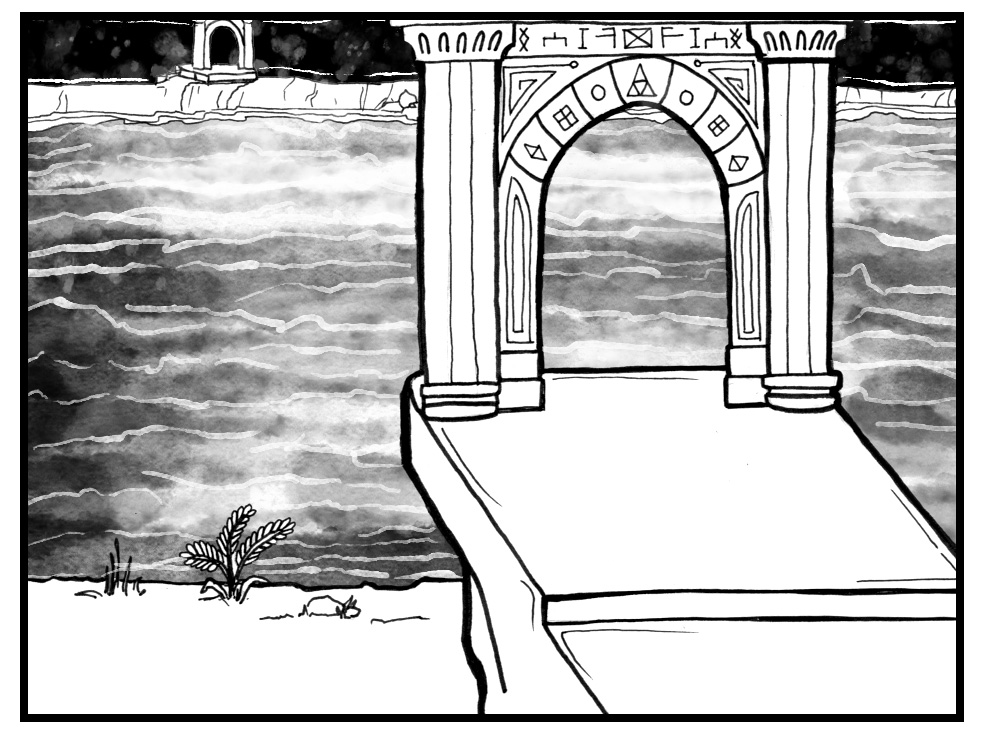
The
Arch was situated atop a low broad stone platform, elevated about the
height of a man from the surrounding terrain, and accessible by a
staircase whose steps were deep enough and spaced enough that their
golek mounts could climb to the top without issue.
From
atop the platform, they could look through the arch down to the
troubled waters of the Edebian Passage, which split the island from the
mainland many eons ago. Though the distance was not great for a boatman,
the waters were dangerous enough that any such crossings had been long
ago abandoned in favor of traversing by way of the arches.
The
original builders of this portail system had been lost in the mists of
time. Legends differed, Eradus explained to Benda, as to whether they
had been built by the ancient Lagom or Ardeid peoples, or some other
mysterious third party.
Benda
looked dubiously from their platform across to the far shore, where he
could make out another arch atop a similar stone platform.
“How
do we cross?” he said. “It seems if ever there were a bridge here, it
has fallen. And I see no ferryman to bear us to the other side.”
“Follow
me,” Eradus said, urging his steed Selef on through the arch. Benda
nearly leapt out of his saddle, when, as to all appearances, he expected
the two to fall off the opposite side of the platform, tumbling down
the cliff to the water below. But instead, they simply vanished. Benda
looked around anxiously, and saw nothing.
Suddenly,
his eyes caught a glimmer of motion, and he looked across to the far
platform, to see a tiny Eradus and Selef waving from the other side.
Holding his breath, Benda urged Dema forward — who seemed far less
anxious than he. And where his eyes told him they should fall off the
platform, Dema’s feet instead arrived onto the stone of the far
platform, with Eradus and Selef standing slightly off to one side.
Eradus was smiling broadly, “I remember my first passing. I was as confused as you.”
Benda was looking back to in the direction from which they had come. “You’ve visited this island before?”
“Once,
when I was a young man,” he said. “But there are other portails as
well.” He did not say where. Benda was intrigued. Though his memory
still failed him, he was fairly certain he’d never heard of any such
thing before.
“Well then,” Benda said. “If you’ve come this way before, you must know the way to the Cloudspire. Take the lead.”
“Though
I’ve visited the plains in the east of this Isle, never have I ventured
forth into the Western region.” Eradus pointed toward the mountains in
the west of the island. Amongst them in the distance, they could make
out the outline of a lonely structure reaching up from one of the
mountains, clear into the clouds and sky above. “I suspect we won’t have
any difficulty finding it.”
They
descended the stairs of the platform, and crossed the open plain below
in the direction of the mountains. They camped for the night in the
plain, not sensing any danger from beast or foul weather. Their goleks
grazed contentedly as the stars above twinkled into sight, while night
unfurled her splendid cloak. Eradus took the first watch, and roused
Benda in the late hours of the night when it was his turn.
Benda
breathed in the fresh sea air coming in off the plain, and calmly
peered off into the darkness, as the embers of their fire died down. His
eyelids were heavy, and he struggled to stay awake. Though he’d
recovered his strength since arriving in Devera, and after Edebia, he
was still troubled by the loss of his memory, and his inability to peer
beyond the veil that occluded him from himself.
He
awoke with a start in the pre-dawn light, and realized he had dozed
off. He opened his eyes, and as they came into focus, he became aware of
a huge black shape standing over him, blocking out the stars. He let
out a slight, frightened yelp, which luckily awoke Eradus from sleep
nearby.
To
Benda’s puzzlement, Eradus laughed heartily. “There’s nothing to fear,
friend. The sable goleks of this island are large, but harmless.”
Benda’s
eyes adjusted to the darkness, and he was then able to make out the
face of an immense, presumably wild, dusky golek staring down at him,
sniffing. Behind this creature, Benda was able to make out Dema and
Selef, who were scampering about, playing happily, sniffing, and
tumbling with the other sables. Benda reached out a hand, still somewhat
nervously, and the immense black golek near him allowed him to stroke
his cheek, and scratch his chin, before scampering off to play with the
others.
Eradus
yawned, looking after them, “Their race inhabits only this island. They
live still wild as once all goleks did, in innocence. Let us sleep a
bit more, as dawn is not far off. We need not keep watch with them
nearby. Tomorrow we climb into the mountains, and will need our full
strength.”
Benda slipped back to sleep easily, and dreamt of Dema and Selef playing happily amongst their wild cousins.
What remained of the once lush Drynarean forest
thinned out on the north-western edge of the province of Devera, where
now passed the newly-dubbed Benda Lost and Eradus, king of that land.
Their golek mounts, named Selef and Dema — intelligent beasts themselves
— had guided them carefully through the trackless forest without
incident.
As
they reached the edge of that wood, Eradus drew the party to a silent
halt, and held up his hand, pointing off over the hills of Mareto. In
the falling evening light, Benda Lost could make out in the distance,
where the hills gave way to steeper mountains, a glowing white figure, a
four legged creature with horns. No, he squinted, looking closer.
Antlers. A stag of marvelous stature, seemingly luminous from within.
Benda felt his heart leap forward in joy at the sight of it.
“Surely,
a good portent, the sighting of this beast!” said Benda, once the
creature had vanished. They had watched it for several long breathless
minutes.
“Aye,” replied Eradus. “But night falls, and soon will come the Hunters. We shall camp here.”
And
so they did, and in full light of day, on the morning next, they
traversed those hills, and came near the place Eradus estimated the
glowing stag had been visible to them the night before. There was a lush
green stream bed, near a clear mountain spring, flowing from a cleft in
the rock. They stopped to water their steeds, descended to drink deeply
themselves, and filled their water pouches. All were rejuvenated, and
pressed on.
Come
nightfall, Eradus directed them to make camp in a sheltering rock cove
which he knew along the trail along the mountain pass which linked the
two kingdoms of Devera and Edebia, into which they had now entered. The
next day, they followed in the same pattern, riding during daylight and
camped at night without incident. And on the afternoon of the third day,
they arrived at the Castle of Edeb, dwelling of the Fourth King, Martis
Ovnis Delgar.
As
Eradus was well known in this place, news of their arrival reached the
ears of the Fourth King before they had entered the town surrounding the
castle. Newer considerably than the Castle of Devera, Eradus noted to
Benda that the castle here was larger, and the village more populous and
vibrant.
“It
brings me joy to see the bustle of this place,” he said to Benda. “I
come here whenever my duties, and the seasons, permit.” They went on in
silence a ways, through the village outskirts. A small band of children
formed in their passing, running behind and teasing after their golek
mounts, who suffered their games with good humor.
“Martis
is wiser by far in lore than I,” Eradus said after some time. “If
anyone will know the significance of the song you sang, it is he.”
When
they approached the gates of the outer wall of the castle, an escort of
three guards rode out to meet them. Their golek mounts took the time to
smell Selef and Dema, and vice versa, as according to the customs of
those people, while Eradus and the guards made small talk. When all was
in accord, they rode on through the close streets of the outer castle,
and passed before the inner gates. All dismounted, and the goleks all
were lead away to frolic freely together at pasturelands preserved here
within the outer bailey of castle expressly for this purpose. The
entered the inner wall and looked about at the fabulous stonework of the
artisans of Edeb.
In
no time at all, Eradus and Benda Lost were ushered ceremoniously into
the hall of the Fourth King, who embraced Eradus, and welcomed him into
his home. To Benda, he introduced himself with a certain vigorous
solemnity, reciting his full name and title: Martis Ovnis Delgar, Fourth
King of Kremel, and King Under Cloud.
Benda bowed low, with Eradus introducing him in turn, “This is Lost, First Minstrel of Devera.”
“Lost?” Martis replied quizzically. “It is a peculiar name. May you here be Found, First Minstrel of Devera.”
He
lead them then into a side chamber, a more comfortable salon off the
Great Hall and throne room. Many plates of delectable foods were spread
on a long table in the salon.
“Make yourselves at home, my friends. Eat, and drink, and let us speak together of pleasant things.”
They
ate together then, as night fell and lamps were lit, and starlight
twinkled into view. Wines were brought, and the three contented
themselves in one another’s company and conversation. At length, Eradus
told the tale of their discovery of Benda Lost, who he and his brother
had found parched and bewildered, and his subsequent recovery at their
castle.
“There
is a mystery here,” Martis observed. “That a man is shipwrecked alone,
with no knowledge of his past, his companions, or his home…”
“Aye,”
agreed Eradus. “And that mystery deepens, my dear friend, in the
discovery that this lone lost man is a singular musician and minstrel,
who sings in an unknown language which is yet comprehended somehow still
in perfect clarity and completeness by the ears of the heart.”
“You speak too kindly of a lost wayfarer,” said Benda.
“Then
let what was lost be found again,” said Martis. “Sing us this
mysterious song, the power of which has brought you all this way.”
“If it please you, my lords,” Benda said, addressing the two kings, “I shall begin.”
Benda
took up the harp Eril then, and plucked masterfully at its strings.
Though he remembered not yet its provenance, he could sense deeply that
the instrument was made just for him, as it responded to him, and he to
it with a kind of seamlessness which as he played transported him and
his listeners to another realm.
He
sang, then, a song — different than the one he’d sung before the Fifth
King in his hall, but which he felt was somehow contiguous with it.
Another voyage in the same country, if you will. As before, he lifted up
his voice in harmony with Eril, not knowing what would come out, and a
sweet and mellifluous melody in an unknown tongue poured out of his
lips.
In
their minds’ eyes, the three men shared a vision narrated and moved
along by the words of Benda Lost in the mysterious language. The story
of a man, wandering alone in a cold place. He sought the red spear which
had been driven into the ground at the Place, generations ago. Though
neither the First Minstrel, nor the Fourth and Fifth Kings knew the
words (Martis, in fact, recognized a few of them here and there), they
all saw this same man, toiling through the cold to find the Place,
around which all the world turned.
And
when he arrived to where legends said it should be — must be — he found
it was broken, cloven with violence a little ways above where it jutted
out of the snow.
The
witnesses to that song saw the man jostle the part of the shaft and
point still wedged into the snow, and it would not budge. So he took up
the broken shaft, and set off, trying to find the New Place. Through the
words, and the music, and the emotion of Benda’s performance, they
understood intrinsically, each of them, the gravity of this man’s
actions, and that if he did not find and mark the New Place, around
which all things must turn, all would spin out, and tumble into
darkness.
Benda’s
last mysterious couplets hung in the air, and with a few concluding
plucks, the harp Eril fell silent. They sat a time without speaking,
marveling in the silence that came after, as they had marveled in the
fullness of the song, and the visions it had inspired.
After a long time, Eradus spoke. “I feel that I have seen this man before,” he said. “Perhaps in dreams.”
“And
I,” Martis added, “have heard this tale before, long ago, I think.
Though in another language, and without music. Let me try to remember…”
“You recognized the language?” Benda said, excited.
“Not
quite, but I recognized some words which sounded something like Ancient
Kremellian,” replied Martis. “Though, I might not have understood so
well their significance, were it not for the inner luminous vision your
playing enjoined in me.”
“In all of us, I think,” Eradus agreed.
Benda nodded, “Yes, I saw him too. Real as though he were here, standing among us, and yet not. Distant and imminent, at once.”
Martis
continued: “I don’t remember well, nor with completeness, the saga I
heard in my youth, but I believe this man is called by many names. I
shall call him the Old One — older than any living man. The Survivor. He
was said to have watched generations rise and fall. And whether it was
he who had driven at the dawn of time the Red Spear originally into the
Place, or whether he was present at that ceremony when some other hero
or king performed that sacred act, I know not.”
“The
legends say that the wickedness, greed, and negligence of the people
summoned forth a being from the Outer Darkness, who feasted on cruelty,
and who lead them in their turning away from the Place. All things were
tilting out of balance, and the Red Spear was broken. And this is
segment of the tale of the Old One, who was the last to still remember
what to do, and his effort to set things right.”
Eradus asked eagerly, “And did he succeed in this undertaking?”
“I
don’t recall in full,” Martis said. “I think he plunged the shaft of
the Red Spear into the New Place, but the enemy was not beaten, and the
people did not change their ways, and it was not enough to stop the
changes already underway.”
Benda
recalled then the song he’d sung at the court of the Fifth King. “And
the people were sorrowfully forced to leave their homes, and sojourn
across the waters.”
“Like you,” Eradus said. “The Lost.”
“Across the waters, yes,” said Martis, gesturing upward. “And across the sky. For in those days, the two were joined.”
They sat again in silence for a long time.
Eradus
finally spoke, “While we’ve learned something today about the music,
we’ve learned precious little still about our musician, and why he knows
songs of far off times in a language whose outlines only the most
well-tutored among us can begin to understand. Would that we had more to
go on, so that he who is Lost may become Found.”
“Go
then to the Arches and pass through with my blessing,” began Martis.
“Cross you to the Isle of Edebia. There you will find the ancient and
abandoned city which was once our ancestral capital. And in its center,
ascend to the Cloudspire. At the top lives an old man, a sage — not the
Old One of legend, to be sure — but one far older and wiser than I. For
he was my tutor in youth. It is he who spoke these rhymes to me so many
years ago, and he who — if his mind has not failed him — may have the
key to this lore, and perhaps a way to find what has been Lost.”
So
it was agreed, and they rested a few days in the Castle of Edebia, and
refreshed themselves. And on the third day, with their mounts, they
headed north to the Edebian passage, the waterway which split the
mainland from the Isle, and all that lay beyond.
Benda rode behind one of the knights of the Guard who had discovered him, parched and bewildered on a trail along a beach of Devera.
Though
a lush ancient forest prevailed here in the time of the original
Drynareans, during this time, few trees were to be found. And the ocean
breezes swept as far inland as the Castle of Devera, to which they were
en route. As the trees had dwindled, so had the dwellers amongst the
trees, and the province was only sparsely populated.
As
they approached the castle, though it stood in good shape, it clearly
told its age as one of the most ancient in the Kremellian peninsula.
What had once been a thriving village around it was now nothing more
than a few half-inhabited hovels which sometimes sheltered shepherds and
passers-through.
They
entered the outer wall of the castle, and dismounted. A stable boy
appeared, and led their golek* steeds to rest and feed. The three —
Benda, and the two knights of the guard — crossed the yard, and entered
the small door of the Great Hall.
The
Great Hall was a moderately sized square chamber of hewn stown, whose
floor was checked in a curious pattern of black and white squares.
Shields bearing coats of arms festooned one wall, and a large tapestry
depicting the entirety of ancient Drynarean woodland tribal territory
adorned another. The two decorated walls formed a corner around a very
modest dais, raised only one step up from the checkered floor. A simple
wooden chair sat upon it, made of wood from a legendary tree, the
Helemba.
Onto
this dais ascended the knight behind whom Benda had ridden hence. With a
single flourish, he both removed his hood and flung his cloak behind
his shoulders, sitting down upon the throne of Helemba.
Though amnesiac as to his own identity, Benda recognized still the grandeur of a king in his own hall, and bowed to one knee.
“That is unnecesary,” said the first knight. “You are my guest and equal. Rise.”
Benda rose, and the second knight brought him a chair to sit.
“I
bid you sit, friend traveler,” said the first knight to him. “I can see
you’ve journeyed far, and seen great trials. Be at rest.”
“Thank you,” Benda stammered, sitting down.
“Allow
me to introduce myself. I am called Eradus Drynarus, First Knight and
Protector of the Realm of Devera, Fifth King of Kremel, and King Under
the Wood.”
“And this is my brother, Emlad, Second Knight and Protector of the Realm.”
Emlad bowed to Benda. “At your service,” he said, smiling broadly.
“Would
that I could return such a fair introduction in kind,” Benda said.
“Think me not impolite, but my name now is lost to me.”
Eradus considered for a moment, then said, “Then we shall call you Lost, until your true name be found.”
Benda smiled, “Let it be so, my king!”
“If
you would have me be your king,” Eradus said, “then I bid thee, play a
song with this magnificent harp of yours, and perhaps it will discover
us something of your past. Unless Lost is not just your name, but your
music too.”
Benda closed his eyes, sensing deeply within. He unstrapped the harp from his back and took it into his hands.
“I think not,” he said, and began plucking the strings of the magical instrument, Eril.
As
he played, the vastness of the Great Hall seemed to increase
dramatically in all directions, and into this unbounded space, the
knights listening felt themselves tumble.
Benda,
at length in a trance brought on by the charms of that instrument,
lifted up his voice in wordless harmony with it. Eradus felt the pool of
his heart open like the Full Moon had revealed itself suddenly from
behind clouds and reflected in it. Emlad stood by in silent wonder.
Words
came then to Benda’s lips as he sang, in a language he knew not, nor
had ever recollected singing. Though in hearing them pass out of his
mouth, he recognized that he once had sung in a foreign tongue,
seemingly long, long ago…
Though
he himself recognized not its significance, Benda’s song told the tale
of a people who had had to leave their homes long ago, setting sail in
despair and longing only to return to more untroubled times. Eradus and
Emlad, neither of whom understood the words of the song, felt themselves
transported nevertheless to a far off land, and felt that same despair
and longing communicated with perfect crystalline clarity that moved in
waves through them physically, and seemed to connect them to something
beyond themselves, and their own place and time. Both men wept openly.
At length, Benda’s song ended, and he put down the harp, Eril, wordless onto his lap.
“Lost be thy name,” said Eradus. “And lost felt I in your song… Are you able to render the lyric into our common tongue?”
Benda
shook his head, “Would that I could, my king. For lost too was I — in
another land, far away. The words came unbidden to my lips, though I
felt the truth of them in heart and in my spirit.”
Emlad replied quietly, “As did we.” He, and his brother the king looked at one another and both nodded.
“Lost be they name,” Eradus repeated. “And let thy station be First Minstrel of Devera.”
Benda got up from his chair, and bowed low before the dais, at the honor bestowed on him.
Eradus continued, “For here, we have found ourselves together. Here we have heard the Great Mystery. Rise, First Minstrel — ”
Benda stood up.
“
— And let us go together toward it. Though none of us three gathered
here know these ancient words — for their antiquitity is clear — there
is one who may. He who is wiser than I. Let us go together to him.”
So
it was arranged that Eradus Drynarus, the Fifth King of Kremel, would
set out with Benda Lost, his new First Minstrel to the court of the
Fourth King, in the next province over. Benda was given several days to
rest and recover his strength. Good simple food, and forest elixir were
his in abundance, and Emlad gave him a replacement set of garments in
the fashion of the Drynarean woodsmen, and a Cloak of Becoming.
“Draw
the cloak around your shoulders, and the hood up over you in time of
need,” instructed Emlad, “and you might vanish before the eyes of all
but the most skilled watchers.”
Benda bowed low, accepting this gift.
“Should you so desire, I have for you a sword as well,” he held up a short, and beautifully inlaid Drynarean forest blade.
Benda’s
eyes fell upon it, and his hand rose up, fingers stroking the inlay
gingerly. Suddenly, there flashed in his mind an image as much as a
feeling… of himself, but not himself, clothed in mail, and helmed, staring into the eyes of another man, shocked at sudden pain.
He heard in the ear of his mind, words in another tongue which he somehow understood, “You should have dropped your sword — ”
And the vision vanished just as suddenly. His hand dropped from the Drynarean blade offered to him so graciously by Emlad.
“I
— I had better not,” Benda said. Thinking better of it, he added, “For
what need has First Minstrel for arms of war. That is not his function. I
shall keep to my harp.”
“As you wish, First Minstrel,” responded Emlad smiling.
On
the third day after, Eradus and Benda set out. Emlad stayed behind to
mind the castle and the affairs of state brought to him by such
villagers and peasants as remained in the realm. To Benda, Eradus loaned
the golek* mount Dema, normally ridden by Emlad, his brother. Eradus
himself rode Selef, who was the mate of Dema. Thus equipped, they set
out by the High Road to the Fourth Kingdom.
*(A
golek is a type of approximately half-rabbit, half-horse animal endemic
to the peninsula of Kremel, whose intelligence in certain capacities
surpassed even that of their human charges, over whom they saw
themselves as guardians.)
Benda lost track of all time after the storm at sea. With his companion Ofend washed overboard, and the barrels of provisions they’d brought from Quatria similarly lost at sea, Benda went without food or water. For how long he did not know.
Down
to only one oar and his single square sail in tatters, Benda gave
himself up for dead. And in this hour of darkest despair, the will of
the sea brought him to currents which carried him aground in a small
cove on the far north shore of the Kremellian peninsula. Though his
memory was as tattered as the sail of his poor vessel, and he knew it
not, this was the realm of Devera, the Fifth Kingdom, and ancient homeland of a tribe of forest-dwellers called the Drynareans. He was still a long way from home, he sensed, and safety.
He
feebly climbed out of the boat, his feet touching down onto hot sand,
for it was a little past midday. Before departing it, he kissed the side
of the boat which had carried him hither — alive, if not intact. He
recalled not from where. But he spied the harp which had been given to
him by… someone he could not recall. Strapping it to his back with a bit
of cord, he set off.
Though
Devera was once home to a great forest primeval, by that era, the
woodlands had retreated well back from the shores. And there was no
cover he could see, though he sensed perhaps the odor of a trickle of
fresh water somewhere nearby. He crawled on his belly in the hot sand
toward the direction his intuition inclined him, his harp strapped
across his back.
It
was thus that, some hours later, when the sun had begun to lengthen
shadows, that two Knights of the Guard of the Fifth Kingdom found him,
insensate and muttering, stretched out on the road along the sea. At the
sight of this poor, miserable wretch, the two knights dismounted.
“Ho,
there!” the First Knight saluted him. The Second Knight fondled the
pommel of his sword under his traveling cloak in readiness.
“Water,” Benda managed to croak out, just barely.
The
First Knight readily obliged, seeing the sorry state of the man whom,
judging by the instrument strapped to his back, he took to be a roving
minstrel. He produced a skin filled with revivifying herbal water, a
family variation on an ancient Drynarean recipe, and handed it to Benda.
He drank deeply, and after a long moment, felt the strength to sit
upright, and attempted to hand the water back to the First Knight.
“I am in your debt,” he said, hoarsely.
The
knight waved his hand away at this, and with another gesture encouraged
him to keep going. “Drink your fill, my good minstrel,” he said to
Benda, looking back to the Second Knight, who released his hidden grip
on his sword.
“Pray, tell me your name,” said the First Knight to Benda. “And from whence you have come, in such a state.”
Benda
drank more of the liquid, which he found marvelously refreshing. And he
thought for a long moment, trying to recollect the answers to these
questions set before him.
At
length, he shook his head, saying, “Forgive me, good sirs, but I know
neither who I am, nor from where I have come. I know that I came by sea,
and my vessel ran aground on these shores. Beyond these most simple
facts, I am at quite a loss. My apologies.”
He handed back the near empty cask to the First Knight, who this time readily accepted it.
“Apologies
are unnecessary, Harper. You have obviously traveled a great distance,
and suffered much. Any one can plainly see you are in need of secours.
Come, ride with us if you are able. We shall take you to a place where
you can rest, and recover yourself. And when you are ready, you can tell
us your tale in full, and perhaps sing a song of your travels on that
great instrument of yours.”
At this, Benda smiled tenderly. “I humbly accept your offer, though it may be I lack the strength to rest astride your mount.”
“I
will see that you fall not,” said the First Knight, who helped him up
into the saddle, and took his place behind him. The Second Knight
mounted his steed, and they set off at a trot.
“Whither do we go?” said Benda.
“To the castle and court of the Fifth King,” replied the knight.
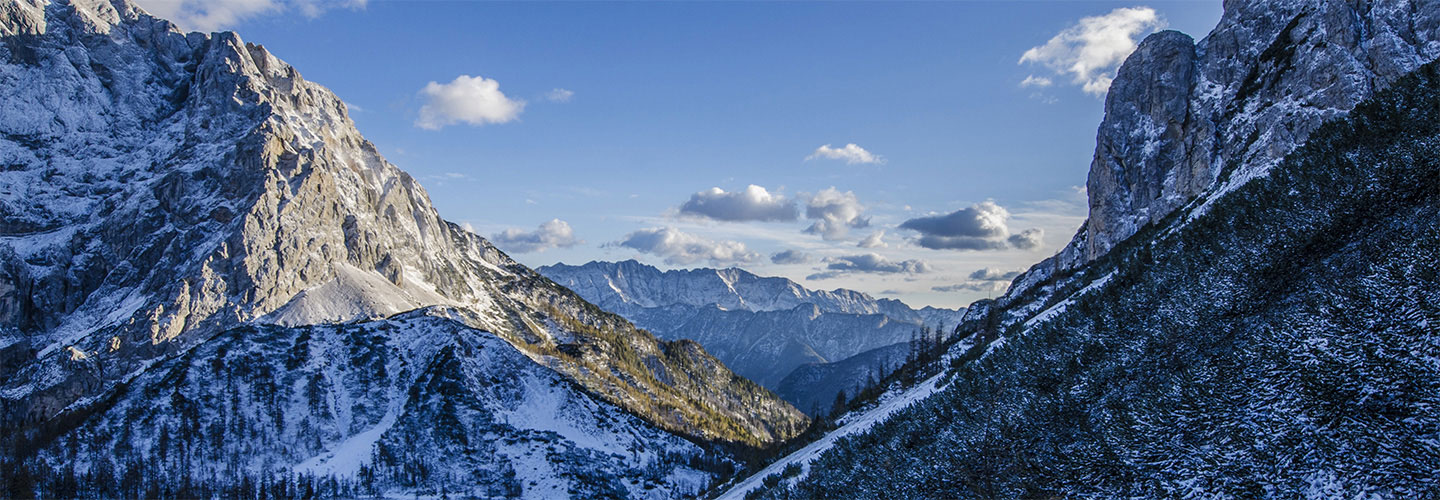
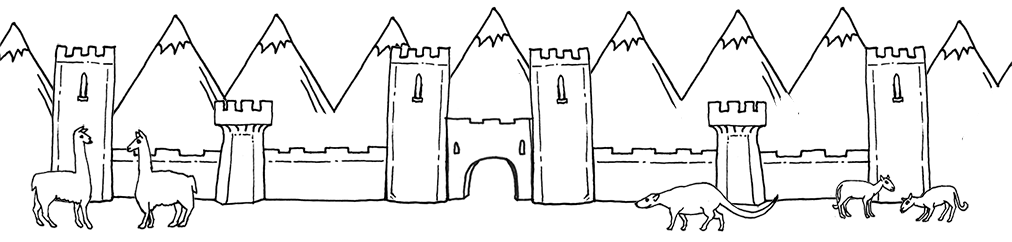
In Ancient Quatria, there was a secret castle located within the ring of mountains which guard the entrance to the Hypogeum.
Knowledge
of this Secret Castle was forbidden to all those entities who do not
have the right or the means to traverse the worlds.
Many magical beasts and therianthropic magicians
populate and pass through the environs of this castle on their way
into, out of, or around the Hypogeum as part of their ritual pilgrimage
and circumambulations.
Among
those denizens, which are known through the scant and secret tales
passed to outsiders, are said to be the alpaga (common to all of Quatria
and its colonies), the landwhale, and the eohippus or so-called “dawn
horse.”