
The map is centered on the Euphrates, flowing from the north (top) to the south (bottom). The city of Babylon is shown on the Euphrates, in the northern half of the map. The mouth of the Euphrates is labelled “swamp” and “outflow”. Susa, the capital of Elam, is shown to the south, Urartu to the northeast, and Habban, the capital of the Kassites is shown (incorrectly) to the northwest. Mesopotamia is surrounded by a circular “bitter river” or Ocean, and eight “regions”, depicted as triangular sections, are shown as lying beyond the Ocean. It has been suggested that the depiction of these “regions” as triangles might indicate that they were imagined as mountains.[1]
Category: Other Page 140 of 182
During the race back to the city of Abdazon, between the Betrayer who had half-hold over Andal, and Elum and Delrin, the owl familiar of Elum, Lux, returned to the Forest Villages. Lux was to retrieve aid for ailing Ayad, and burial for his poor brother Ayar, both of whom had fallen to the guiles of the Betrayer.
Upon his retrieval by a scouting party, Elan, the sister of Elum, took the unwell and convulsing Ayad under her care in the hut of her family. She laid him on a bedroll near, but not too near, the fire, his sword beside him, and plied him with strong forest herbal concoctions against his convulsions. Though she knew not the nature of his contagion, she could sense the stink of the Betrayer, and knew somehow instinctively that her charge must be kept alive, and the evil influence fought.
Meanwhile, as Elum and Delrin left the protecting boughs of the Great Forest, and crossed the plain toward the Weeping Waters, the Great Bridge, and the opening of the Passage Inward (to the Hypogeum), Morbat the magician received word of their passing from his corvid spies. As the eyes of birds and animals can detect the color and intensity of True Love perhaps with greater fidelity than humans can, they warned their Master too of this ensuing development. Fear over jeopardizing his betrothal contract had lead him, in the first place, to petition from Wormwood a Deviation, which was granted in the form of the Betrayer. But knowing something too himself about the ways of deception, he needed also to be sure of his outcome. So he set about laying his own traps under cover of darkness around the place of the Weeping Waters for the confrontation which was sure to come.
Delroy, who had grown by this time rich beyond measure, and was one of four Headmen of the City of Abdazon, felt a mounting fear. Since the return of his Best Man, Andal, with news of the failure of their mission to deliver his daughter Delrin to the faraway city of Threx (and beyond), Delroy had grown increasingly uneasy. Andal, though loved and dearly trusted, was clearly not himself, and would alternate in turns between a near stupor, and an eerie alter-ego where he spoke in strange tones and dire words about the menace approaching them, which held his daughter under its sway. So Delroy stationed a special guard to keep watch night and day over the Great Bridge, challenging all passers, and rejecting anyone not explicitly authorized from passing on into the city. But most of all, he feared Morbat, and that he would soon come to collect the debt Delroy had incurred to him in bringing his wonderful daughter into the world in the first place, so many years before.
Though Elum had seen with clarity that the initial deceptive vision presented to him by the Betrayer would come to pass, and that Andal would warn Delroy against him, what happened next was cloudy and haunted his dreams. Forking futures appeared from that point on, branches on the Great Tree, some where Elum surrendered, some where he was captured. Others appeared wherein he and half-mad Andal slew one another in single combat, as Delrin cried out in terror. In still others, Lux would appear from the sky in a flash, and he would see the Betrayer standing there, revealed, in many places at once. And a Great Beast would rise up, taller than many men, with a great white cloak, and the long face of a strange animal…
And though it was fearful, it was this future — which he sensed was still somehow open-ended — he tried to steer them toward. He sent out a message to Lux then, on the canals of light which linked their two hearts, to hurry. For battle, and revelation, would soon be at hand.
Though far away, Lux heard him, and shot into the sky.
And so it came to pass, just as Elum had seen in his vision, that Andal was not challenged on the Great Bridge by the guards there. Instead, he was hailed and escorted forthwith to the Hold of Delroy. Therein, the Betrayer, whose half-hold had driven Andal to madness and flight, took power over Andal’s tongue, to drive all to ruin. He told Delroy that Elum the woodsman was the Betrayer in disguise, that he had hold of his daughter Delrin, and was coming to kill him.
It was of course untrue. The Betrayer had instead half-hold over Andal, and still somewhere deep in the Great Forest, whole-hold (or nearly) over Ayad. He had been partway through the incantation of binding over Andal, and had not yet completed the Ritual of Transfer, when Elum appeared, and in combat was rendered unconscious by him via a blow to the head.
This indirect physical contact is what triggered the deception which appeared to Elum, and which was actually born out after in truth. The deception was, then, in the early knowledge, the needless pre-awareness of a darkness and suffering to come, which humans did not ordinarily have to bear so keenly. Thus the suffering would be doubled, or trebled over the passing of time. Unless it was not all truth and it could in some way be thwarted, or diverted, the flowing course of time. Or so ran Elum’s thoughts as they traversed that wood.
On stage, the scene of Andal’s enchantment, and Ayad and Elum’s fight was portrayed using two Betrayers. Benda Betrayer as lead, who touched the actor Tendar Trustless (playing Ayad), who fell down in a crumple, as Benda stepped into his place, turning to face Garth Al Elum, the actor playing Andal, and the orchestra struck up the notes of dark conjuration. He reached out to Andal, touched him heavy on the shoulder, and he too fell down as though dead. And as Benda Betrayer jumped into his traces, another nameless dark-robed Betrayer appeared behind him on stage, to take his place in Ayad’s stead. The two figures turned to look at one another, startled, and the audience let out an uproarious laugh in this moment of high dramatic tension. It was soon shattered by the quick fight with Elum, and the second back-up Betrayer being rendered unconscious.
Rendered thus unconscious in the body of poor Ayad, Second of the Best Men of Delroy, the Betrayer sought release from this useless form. Had he been killed by Elum, he could have transferred fully to the body of Andal, and brought ruin direct, rather than circuitously on the House of Delroy. But as such was trapped in unconsciousness. The Betrayer tried to betray the body itself, parasite against host, causing it to rise up against itself in violent convulsions. And while the owl Lux flew off in search of help among the Forest People, the Betrayer fought a deep internal struggle with that part of Ayad which still remained buried within.
And far away now, where Delrin and Elum exited the Great Forest, the watchers of Morbat the magician stirred, rose up, and sent word along to their Master. His bride-to-be awaits.
In Pantarctican mythology, we see references to a period of poetic pseudo-history during which the waters below and the sky above were one, and not yet divided. In that famous epic, the Supreme Administrator determines the provisioning and administration of these domains would be more efficacious independent of one another, and makes it so through decree.
By contrast, in Quatrian mythology, no such legislative division of ocean and sky has occurred or yet been contemplated by even the Long Lines of Bards, High Augurs, and Archpoets. In fact, the two realms are as yet contiguous. The motive-original for Delrin’s voyage to Threx was to rendezvous and strengthen trade relations with certain sailors capable of making the passage to these Buorthern Realms.
Though Delrin’s tale took her not to Threx (or at least not in extant recorded versions), she did rendezvous after a fashion with her intended target. Elum’s family, though Forest People through and through, originally descended from Buortherners escaping one of the Old Crises. And he navigated the Great Forest trails as though they were a vast surface of changing seas, currents and eddies converging, propelled onward ever floating, skimming the surface, barely touching earth, leaving almost no trace, but for the light of their passing. For Delrin ran too now on these winged feet, and they together traced the madman Andal, captain of her father’s Best Men, as he fled back in the direction of Abdazon.
As they passed through the wood in chase, Elum hummed and sang out the tune of an old Majonan voyaging melody, to which he set the following lyrics, extemporaneously, which have been transmitted to us via the ancient Quatrian texts:
“A shadow clouds the light of his passing.
The Betrayer leaves many false trails
Through the Dark Wood, and the Light of Day.
He steps at times with great
Force and gravity, turning in an
Instant untraceable and appearing
At another location at an impossible distance.
Wings he has not, but a kind of flight,
A leaving and returning,
Passing through unseen doors and tunnels
He has mastered.
Would that my skill as a woodsman
Were sufficient, but the lands
Walked by the Betrayer
Are not all of these Daylight Lands
Where walk now we.
Though on this confusion of trails
We two cannot rely,
Clear is the direction of movement:
Toward that rich and happy city, Abdazon.
Your father’s Best Man, I fear
Becomes his worst enemy,
Wearing the mask of fidelity —
A deception against which natural compassion
May lead to ruin.
Andal will not be challenged by the
Guards watching over the Great Bridge.
His captain’s livery they will recognize,
Though his wild eyes they may not.
A younger guard will escort him
Forthwith to your Father’s Hold,
Expecting news of his daughter.
Though the Betrayer have only half hold,
It will be enough to control that
Best Man’s tongue, to tell your Father:
‘The Betrayer is coming
and he has hold of your daughter, Delrin.
He is of the Forest People,
and he has slain poor Ayad and Ayar,
brother guards and Best Men,
and comes to take your head.’”
Elum’s song trailed off into empty space.
After a time, Delrin asked him in the plain tongue, “How come you to have these dark thoughts?”
Elum responded, “Deceptions shown to me by the Betrayer when the blow of my bow landed on the head of Ayad. Through touch.”
“Deceptions?” Delrin replied. “If they are deceptions, then they cannot be trusted. They are not fated to come to pass.”
“Aye, but deceptions may serve truth, as in the case of predator and prey. Who survives deceives, outwits, outruns. Likewise truths too may serve the purposes of deception in the hands of the Betrayer.”
“The many trails are one,” said Delrin softly.
“As the boughs and branches and twigs of the Tree of Anthuor,” Elum agreed. “Still… my heart is heavy.”
At the stone circle, Delrin and Elum (and Lux, who alighted on his shoulder) stood facing Andal, the captain of her father’s Best Men and appointed guardians over her, and Ayar, who was now weeping over the body of his fallen brother, Ayad.
“Cursed be the Betrayer,” spat Andal. “But blessings we should find you again.” He went to embrace Delrin, who also felt tears in her eyes welling up. “We thought we’d lost you forever.”
After a moment, Elum said softly, “Let us tarry not long here, friends. For the Betrayer is still at hand…”
Ayar protested loudly, “We will not leave my brother here, to be eaten by beasts of the forest!”
“Aye,” Andal agreed. “He lived and died honorably. And so shall he rest.”
Elum cast a warning glance at Delrin, but said nothing. She, of course, caught it, the two having become close traveling companions during these many… weeks? months? days? they’d spent together journeying up and down the Great Forest, visiting the Forest Peoples in their villages.
She shot a return glance to Elum, and addressing Ayar and Andal, said, “We must make haste our preparations. We’ve all seen the danger… Either we bury him here, or we make up a litter to carry his body home to Abdazon.”
“Either way,” Andal added. “We must return and warn the city — ”
As he said this, Lux let out a shrill cry and flew up, shooting high into the air. An acrid stench assaulted their noses, and from a few feet off, the burned and blackened form of the Betrayer appeared.
Andal and Ayar leapt after it with their swords, only for it to vanish as they closed in.
Then the apparition appeared likewise behind Elum, and Delrin, who turned to face it. Elum notched, but did not let fly a shaft.
The monstrous phantasm vanished, and reappeared again in a third position. Lux cried out, and dove down to attack it, claws out, and wings swooping down into empty space as the form disappeared again. And it was then Delrin and Elum realized they had lost sight of the Best Men, during the scuffle.
They ran off around the huge boulder to try to find them, when suddenly from where they had just departed, a deranged looking Ayar growled, leaping at Delrin, his short blade menacing. Elum jumped into the air, rebounded off the rock of Acho, and brought the heft of his bow down with a whomp on the head of Ayar, the tip of whose blade was nearly at Delrin’s throat.
“Elum!” she screamed.
“He’s not dead!” he replied. “But the Betrayer has hold of him.”
She looked around, panic rising. “And where is Andal?”
The two turned, scanning. Lux sped off toward the forest.
“There!” Elum pointed.
Through the outer trees, Delrin saw the shape of the captain running off into the wood.
“Where is he going?” she said. “Andal!” she screamed
“That is the way to Abdazon.” Elum said. “To your father’s city.”
“And is he… ?”
“Under the Betrayer’s hold? I cannot say. There is light still in his passing.”
“He wouldn’t just run off! He’s a brave man, my father’s Best!”
She turned then to the unconscious Ayar. As they watched, his body underwent violent convulsions. She went to comfort him, but Elum held her at bay.
“Do not touch him. We do not understand the risk.”
“We can’t just leave him here, and his brother’s body…”
“Lux will go find my people. They will come, and take what care they may. We must go now to find your father, before the Betrayer can.”
She didn’t want to leave them, but saw immediately the wisdom in his counsel. When Lux returned to him, Elum sent her on to find help among his people, and return to find him in Abdazon. And with that, Delrin and Elum set off after Andal, toward the Great Bridge, and Abdazon.
Just as Pantarctican civilization was preceded by, and largely absorbed Ancient and Old Quatrian culture (see also: Quatrian diaspora), so the Quatrians themselves were preceded by the Triangulons, the Triangulons by the Duogons, and the Duogons by the Singulones.
As a result, all throughout all periods of Quatrian culture, historians have uncovered countless references to precursor Shape societies. But not all these memories are happy ones, for many forms have been lost in the Shape Wars, which is why the image of a divine Triangulon musician in the reproduction above (Fig. 1) comes from a funerary urn scholars have dated to the Middle period of Quatrian culture, during approximately the time period where the Quatrian Saga takes place. It is a period of turmoil for Quatria, as at this time, they have re-made contact with long lost ancient allies and some former colonies among the lands of Kremel, which will lead inevitably to the events which will prove to be the undoing of their once-great globe-spanning culture.
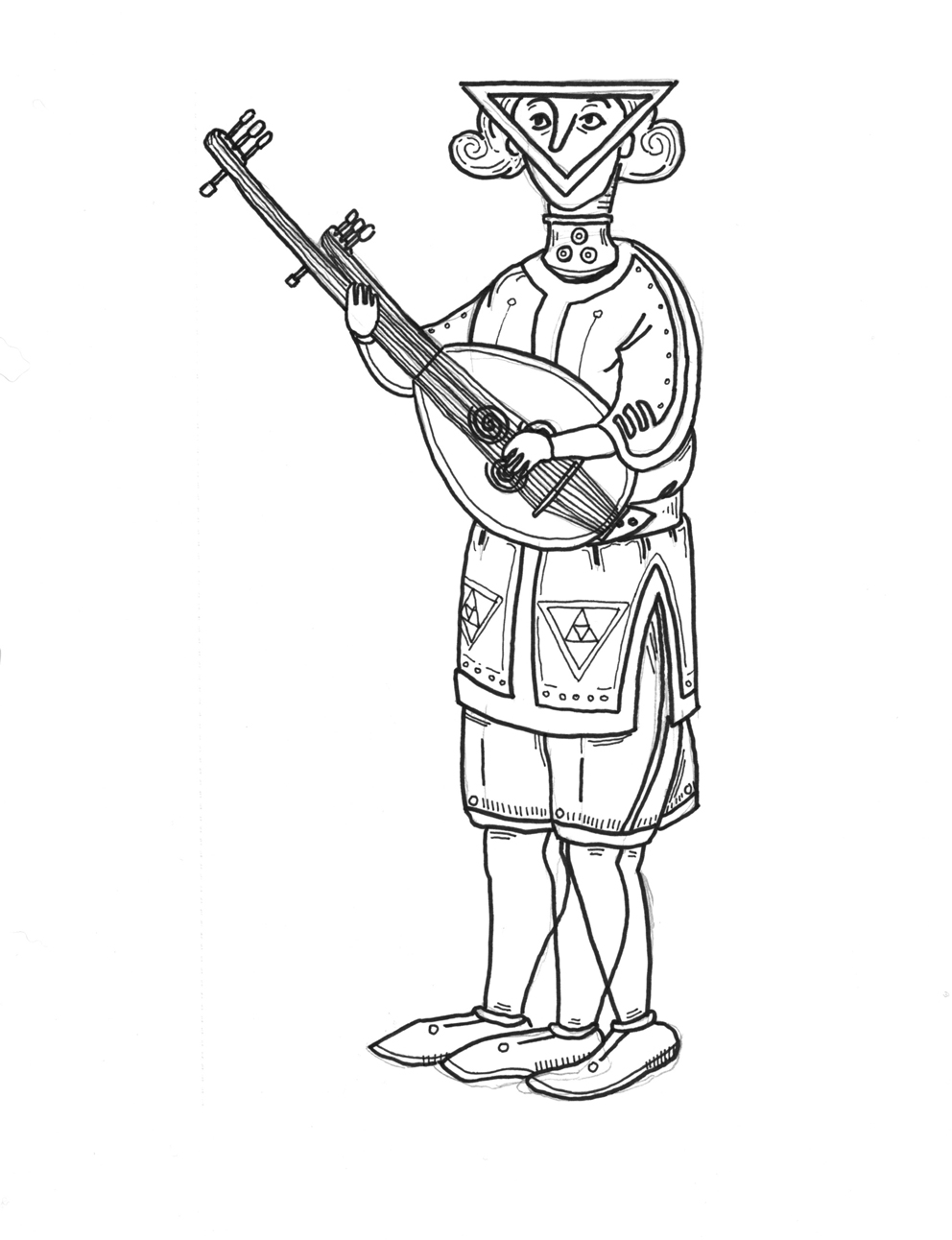
During the time period of the artist who illustrated the funerary urn reproduced above, Benda Betrayer is rising like a star on his ascent to the throne which will be installed on the island of Ovarion, elevated out of the seas one year earlier by Wormwood, and from which the Fifth Age would commence. The First or so-called “Soft” Invasion of Quatria, leading to the Fall of the Hypergeic Temple and the shifting of the anti-node out of the House of Music into the House of Silence.
Surviving records strongly indicate that Triangulons were seen in Quatrian society as beings of great spiritual potency and a type of culture hero, bearing for the early Quatrians who had emerged from the Hypogeum gifts of knowledge, poetry, agriculture, astronomy, hygiene, and most importantly, music.
In the original Protoraxis songboard parchment , we encounter the following cryptic fragment, translated from the Quastrish:
“Center, edge. Node, anti-node. End, beginning. At once the same but different. That difference is the history of change. Delta. Center, edge, change. By the bounding ring, the Reign of the Triangulons has commenced.”
The parchment is written in the popular form of an instruction to cartographers, copy-lorists who would deign to depict classical Quatrian geography and history in visual forms, as in parchments, manuscripts, paintings, or projections. A common type of mythical-moral essay of the time, it reads as a combination of geometry and mysticism which has echoes of Pythagorean, Neo-Pythagorean, and Enteki exoplanetary cosmology.
By this time in Quatrian culture, the Triangulons were most commonly represented, as in the reproduction above, like “triangle faced” beings, which we also see encoded into medieval marginalia by Quatrian migrants who found work in Pentarch scriptoriums after the collapse of their homeland.
Most commonly, we see Triangulons depicted playing an instrument, and usually it is the theorbo, or bass lute, (as in Fig. 1) over which they are considered patrons and who novices and adept players petitioned through endless ritual practice, culminating finally in the Trial Before the Masters, the successful completion of which earned them the status of Entered Musicians. Interestingly, Triangulons are never depicted in authentic art of that time playing the bent metal instrument hung on a string and struck with a short rod, the so-called “triangle” modern audiences would be familiar with, though they did invent this and all other musical instruments.
Triangulons, due undoubtedly to their triple nature, are also always depicted in classical Quatrian art as having three legs, which corresponds with the reproduction seen above. This ancient mythic concept has survived, of course, in modern culture in the form of the three legged race played now only by children, or at the rare corporate picnic. They are also generally portrayed in groups of three, which is echoed all throughout Quatrian legends, and is even said to be the origin of the modern “power trio.”
Lastly, we see what modern Pantarcticans most commonly think of as a “George Washington haircut.” This is actually partly correct (though based on a spurious historical comparison) — as George Washington is thought to have been of Quatrian noble-musical descent. This, of course, is the reason the triangular pyramid appears on the back of all one dollar (Singulone) bill. In other depictions, we often see mythic Triangulon musicians wearing a cloak or hood, and holding a lyre, strythys, zither, or rarely, a pipe or pipes, sometimes lashed together with cord.
As can be seen, the importance of this intriguing race of beings in Quatrian culture simply cannot be under-stated.
The Cuatrian would lie on his back and picture an Opening to a Dark place. Each person’s entrance was different; Chiara herself envisioned a cave, but the imagining could be a temple, a closet, a ‘fairy house,’ or a fountain. As long as the opening leads below the surface of the world, it is acceptable.
Next, the seeker would listen closely until he began to hear a faint ringing noise: the “Voice of the Swallows,” who are sacred to Antuor. Eventually the would will become a two-syllable ‘word,’ similar to a Hindoo “mantra.” The Cuatrian would then begin repeating this word, internally, as though a chant.
As the word was repeated, the visionary would slowly be drawn into the darkness of the Hypogeum and a series of colors would begin to appear. This word and series of colors became the ‘key’ to the Hypogeum, through which he could access this state at any time. This key would only work for the individual Cuatrian.
Source: Entering the “Hypogeum”: A Method – Quatrian Folkways – Medium
Benda Betrayer took to his new-found responsibilities with ease and grace. Though he knew not the Quatrian tongue prior to his arrival, the minstrels who trained him to complete his role in the Dark Dance Cycle said he had a natural gift of wa’ata. They went so far as to theorize that this is likely why he was able to pass through the veil during the storm-at-sea in the first place, which no other Pentarchs had done in countless ages.
The compatriots of Benda, Tendar Trustless, and Ofend Fool, had a harder time adjusting to their new positions in Quatrian society. While they were treated by all with great honor and respect— as participating in the cycles was considered one of the highest achievements of the culture — they struggled personally to wrap their tongues around the Quatrian lyrics. Their tutors called them arwat, tone deaf, and literally laughed out loud when either of the two tried to emulate even the simplest melodies which all Quatrian children could sing perfectly before they even learned to walk. So they were reduced in rank quickly to performing simple recited lines, cued mainly off Benda’s parts, and simple comedic segments.
During the time of their training, the Dark Dance Cycle continued, but with extended interludes of minor tales which did not require the Betrayer, such as the adventures of young Delrin in the Cyric forests, and the visits of Delrin and Elum among the many Forest Peoples before landing in their present predicament at the stone circle.
Returning to that narrative now, Benda soon after his induction learned the mythic rules of performing the role of the Betrayer, of the first level. According to legend, it is known that in addition to projecting his apparition insubstantially at a distance (as when he first appeared to Elum and Delrin in the depths of the Great Forest), the Betrayer has the ability to switch appearances with his victims, such that others mistake the victim for the Betrayer, and vice versa. Though he understood it not at the time, this was the theatrical convention which actor Jan Re was in the midst of executing when he was accidentally mortally wounded by Benda’s blunt costume sword.
That is, the Betrayer-performer begins the Ritual of Transfer, by roughly gripping the shoulders of his intended victim, face to face. The victim is then enthralled by the depthless void found within the charred empty eye sockets of the Betrayer. The two then twirl about in a dance, which to Quatrian audiences signifies the struggle and flight of the victim’s soul to the Outer Darkness. And the Betrayer takes the role on-stage of and replacing his victim, who remains as though lifeless crumpled to the ground.
When Benda upset this natural way of things by mortally wounding Jan Re, he incurred both a blood debt to support Jan Re’s family, but also a ritual debt, for having changed the pitch of the tones which make up the Octave of Time. The cycles performed in Quatrian Society under the priests of the Hypergeic Temple Mount had as their intended function the harmonization of these Octaves in the present moment with the mythic and historical root tones (which were one in the same in this society).
This was not, to those people, idle speculation, or merely a symbolic conception of time as cyclical. This was, in a society still wedded to the Hypogeic powers, a concrete experience of how the present could impact the past. Thus atonement was also attunement, a continual re-tuning of the very stuff of existence.
For this reason, the ascension of Benda to the role of Betrayer was a natural progression of the way of things, since the epics told that the battle between Delroy’s Best Men and the Betrayer at the stone circle, was already one of deception and displacement of identity. It was thus only fitting.
Tendar Trustless and Ofend Fool still continued to double in their roles as Ayar and Ayad, the two brothers who were Best Men to Delroy, and watched over young Delrin. Their lines were few, and mostly comic. Due to Benda’s promotion to the role of Betrayer, it was determined that a local replacement would be found to take over the part of Andal, the captain of the Best Men, especially since it was a singing part. For reasons related to both ritual debt, and for his known skill as a performer in his youth in his own right, Garth Al Elum (former host of the three Pentarch sailors, and one of the headmen of the village where they landed) was chosen, and performed admirably.
We return now to the slaying of the brother Best Men pair. Ayad, played by Ofend Fool, was first to die, being considered weakest, and most susceptible to the deceptions of the Betrayer. Benda Betrayer, as the stone circle scene opened to the dissonant braying of trumpets from the orchetra, caught Ayad unawares while urinating on the rock of Acho (his character, comically, understood not the importance of the Holy Rock — and he, as a performer, did not actually urinate on stage, only mimed it). As he turned from his act to face the Betrayer, he was taken up roughly by the shoulders, and spun about by Benda Betrayer, who sang the opening lines of the Ritual of Transfer.
“I and thee, thee and I,
together are we, together.
Enter the void of my eyes.
Bathe in the Outer Darkness, revealed.
I take thy place, thee mine,
until one die, and the bond be released.”
With that, Ofend Fool as Ayad slumped dramatically to the floor, and Benda Betrayer took his place, miming too urination on the great boulder, as his brother Ayar, played by Tendar Trustless approached, calling out:
“Ho, Ayad,
you have found a new place
to relieve yourself, I see!”
The audience erupted in laughter. After it died back down enough, the Betrayer responded in song:
“You know me,
fair brother,
to whom I would never lie.
Who knows my inmost heart.”
Though he dropped accidentally the concluding line, “whose sight cheers me in this dark place,” Ayad took the cue anyway, and clapped the back of the Betrayer in brotherly love, “Aye, aye.”
Then Andal entered, played by Garth Al Elum, and sang a short tale of their voyage lost in the wood, and how they tracked a dark figure they spotted far off in the forest, and who during the journey appeared to them in restless dreams. And how, as they tracked him, he increasingly began to fear that it was truly they who were the hunted.
The Betrayer, in the guise of Ayad, replied in sing-song chant:
“You worry too much, o captain.
Rest a while by this great rock.
You and my brother both.
I will take the watch.
And the morning will greet us
with fresh eyes.”
Being gravely weary from their sojourn in that dark wood, Ayar and Andal did sleep, and dream, to the tunes of strythis played offstage, the Betrayer standing watch. As the night lengthened, and the torches illuminating the stage were dimmed, the reeds thrummed from the orchestra, a quiet sound, against a plunking, as of rain, from the violins. And onstage, the Betrayer produced a length of silver rope. He approached on tip-toe the sleeping figure of his would-be brother, Ayar.
With a clash of cymbals, Ayar suddenly awoke, and in the space between dream and waking, was able to see the Betrayer for what he is. As that dark figure closed on him, the rope was dropped, and the dark hands covered the mouth of Ayar, muffling a cry, as he sought to scramble to his feet.
All at once, the Betrayer cried out, and lurching up to his full height, and turned. The trumpets blared his terror. A sword plunged into his back, and Andal standing in his fury behind, hilt broken off in his hand.
With a cry, the Betrayer crashed to the floor, and the now forgotten body of Ayad which had lain all this time not far away, roused itself, echoing the fury of the Betrayer’s cry. Lurching to his feet, and whirling, the audience saw clearly the sword, hilt broken off, which is where Elum and Delrin would find him thus, near death, a few moments later in the next scene of the cycle, which has already been related here in the previous installment.
Returning to the Great Forest, the brave and handsome woodsman, Elum, and Delrin, merchant’s daughter of Abdazon, have given chase to an apparition which appeared to them near the place where her father’s Best Men were lost in the wood. The owl familiar of Elum, named Lux, has accompanied them in this quest, and the three paused for a time to catch their breath, and sup lightly on some forest crackers. Lux stood watch, shuffling softly on a branch nearby, preening her white feathers.
“The trail has gone cold,” Delrin said, despairing.
“I can still see the lights of their passing,” Elum said. “And the shadow that follows them. They’ve a day’s lead on us yet.”
“Then they’re alive!” Delrin said, hopeful.
“They were when they passed this place, at least.”
At this, Delrin’s hopes sank once again.
Elum, seeing this, comforted her, “We’ll find them.”
And so another day they passed in tireless flight, in the manner of the Forest People, touching almost not the ground, leaving no trace but for the light of their passing, which only one trained in the Way could sense. Elum, a native in this wild land, could. Delrin could not — at least not yet. That night, they huddled close together, in a hollow beside a stout old trunk, and Delrin fell into a deep, dreamless sleep. Elum did not sleep, however, and watched her gently breathing, and with Lux, they kept guard until the early morning hours, when he roused her from slumber.
“From here we will walk. It’s a short way to the stone circle.”
“What happens there?” Delrin asked, brushing the sleep from her eyes, and straightening her hair.
“We find your father’s men.”
The forest canopy was lighter here than in the depths of the Great Forest, which Delrin had come to know in her travels with Elum. And as dawn broke, rays from the morning sun came through red and soft. They traveled in silence, Elum in the lead, wary, and Delrin following close behind. Lux flew sorties, arcing out ahead and back, tutting signals to Elum, who cooed occasionally in return.
Thus they reached the first stone, blueish in hue, longer than a man, taller, were it standing upright, but it was not. It lay, as though asleep, on the forest floor across the path, moss curling up along its dark faces.
“The Sleeping Lookout, we call him,” Elum indicated quietly. “Who appears at rest, we still pass round with caution.” He pointed to the side, and they skirted carefully round the edge to continue on their trail.
Elum explained, as they continued on, that the stone circle was built at the dawn of time, by a people before the Forest People, when the Great Forest was still young, before Abdazon, Ederron, or Old Qisuth. It was a great open air temple to Acho, the Older Brother, firstborn, whose enormous boulder stood at the center of the ring. When Anthuor first stepped out of the Hypogeum, his hoof struck the back of Acho, who supported him and who still bears the hoof marks high up at the place where Anthuor first came to Quatria, and nibbled the lichen growing there.
“The stones stand watch around Acho, their father. It is a holy place, making it all the more troubling that our trail ends here.”
They came then to the ring of stones, which girded a clearing in the forest, central to which was the giant boulder of Acho, which stood as tall as the largest building in Abdazon, though smaller still than the Foot, or the Stair, or the Great Bridge.
Delrin looked up at it, marveling. “Have you ever gone to see them?”
“See what?”
“The hoof-prints of Anthuor.”
“When I was a child, yes. In happier days. We must now be on our guard.”
They crouched then at the edge of the clearing, and Elum signalled Lux to fly out — carefully — for a better view. She did, veering in a wide circle, before disappearing out of sight behind the great boulder.
From far off, they heard a cry. A man. Delrin recognized it as the voice of Ayad or Ayar, one of the two brothers who comprised her father’s Best Men, who had kept watch over her nearly her life long. Without another thought, she took off running to find him, somewhat to the dismay of Elum, who of course leapt out to follow her.
As they rounded the giant boulder, there was a flash of white somewhere high up, and Lux cried out in warning. A man clad in mail, leather breeches, and a short helm staggered out from the cover of the boulder. He was quite unwell.
“Ayad!” Delrin exclaimed, rushing to him, before Elum could stop her.
He stumbled, and fell to his knees as she approached, and his two gauntleted hands gripped with fierce strength her wrists.
She saw suddenly then that his eyes were not his own, and with horror, tried to pry herself loose from his grasp, and could not. Ghoulishly, he looked up at her, uncomprehending, in time to catch the arrow of Elum, which passed in through the eye socket, and penetrated his brain.
Delrin cried out, as the form of the man slumped away from her, grip on her wrists loosened at last. Elum ran up, and kicked the corpse away, turning it over with his foot. Bloodied was the back, where a short sword had been laid to rest, its hilt broken.
What follows are excerpts of the proceedings of the trial of the three Pentarch sailors for the death of the performer Jan Re, in portrayal of Assenzju, the Betrayer, as part of the Dark Dance Cycle. Adapted from the original, c. 1642 ‘Quastrish Tales,’ (Lepnom)
Notes on language:
Lepnom asserts that certain of the Bards were conversant in a form of ancient Kremellian, such that the Chief Bard was able to speak in plain enough terms that the Pentarch sailors could understand and respond roughly in kind, enough that the proceeding was considered legal, under the Quatrian Consensus System.
In attendance:
- The High Augur, titular head of the House of Song (in reality, subject to Bardic Council)
- The Chief Bard, chieftain of the Bardic Council, and current Protector of the House of Wealth in Exile
- The Archpoet, a dedicated Subservient of No Rank of the House of Sorrow
- Not in attendance: an attendant of the House of Silence, who was elsewhere officiating over the funeral preparations of Jan Re, but the quietude of whose spirit did participate silently in absentia, and was considered sufficient to make the hearing binding
- Benda, leader of the Pentarch sailors, whose blunt costume sword had fatally punctured the gut of Jan Re, during a performance
- The other two sailors: Tendar the Tall, Ofend the Round, who accomplanied Benda during the incident
Proceedings
CHIEF BARD: (to Benda, in ancient Kremellian)
We have established that you all understand why you are here, and the significance of this proceeding.
I have only one question: did your sword enter the body?
BENDA:
The sword I held, sir.
CHIEF BARD: (who translated to Quatrian the responses of the sailors)
The sword you held?
BENDA:
I claim ownership of my actions, sir. Not of these accoutrements. The sword was thrust into my hand in the dark. As were we helmed, and clad in mail — myself, and my countrymen.
ARCHPOET: (to the Chief Bard, who translated)
Were they not aware of the nature of this ritual?
BENDA:
I take you to mean, sir, the theatrical performance we witnessed in the Grand Plaza on entering the Temple Mount, with our hosts from Elum.
HIGH AUGUR: (in reply to the Chief Bard, who translated)
Theatrical performance?
CHIEF BARD:
It means a kind of public entertainment.
(He repeated this as a question to Benda in his halting ancient Kremellian)
BENDA:
It does, sir. An entertaining fantasy. The delight is in the knowledge it is not real.
ARCHPOET:
Oh, but it’s very real.
HIGH AUGUR: (in agreement)
Quite.
CHIEF BARD: (to the sailors)
Granted that, in your understanding, the events into which you were thrust were a kind of play-acting only…
(Benda nodded.)
It would follow, then, that a man of sound mind would lower his sword in such a situation, to avoid inflicting harm on his fellow player.
Are you not a man of sound mind?
BENDA:
I am, my lord. I claim no feebleness after our storm-at-sea. The people of Elum have restored me, body, and spirit in my brief time with them.
HIGH AUGUR:
Then how came you to murder Jan Re?
BENDA:
I claim ownership of my actions, sir. I am at fault. But murder it is not. Caused by an accident, a confusion in the moment. I, we, bear him nor any of your people any ill-will or malice.
I am aggrieved by the harm I have caused, and accept your proper punishment. I beg leniency for my fellows, whose hands were not bloodied.
ARCHPOET:
Death bloodies all in equal measure.
CHIEF BARD:
We have heard your testimony, Benda the Pentarch, sailed over seas from Kremel, ancient lost ally of Quatria.
The Consuls will now deliberate. You may respond if you are asked to do so.
We begin.
HIGH AUGUR:
The crime is murder.
CHIEF BARD:
A case was made for accidental death. The merits are compelling.
It is argued that these men, though they acted the part wrongly, had not full comprehension of their role in the pageant.
This lack, coupled no doubt with nerves, and little experience in the physicality of Quatrian religious ritual, caused their leader to respond improperly, and without actual malice, resulting in grave injury to Jan Re, playing the Betrayer.
ARCHPOET:
Malice or not, there is a blood debt to the family of Jan Re.
CHIEF BARD:
Blood debts are the prerogative of the House of Wealth, and will be considered in due course.
Is lack of malice conceded?
HIGH AUGUR:
It is.
However, in difference, at least one compared value is lacking. It was this detected difference which the Bell-ringers transmitted to the Pillar of Song, and which the High Augur heard, all the way from Raggath and Yagar. It is the sound which initiated the Dark Dance Cycle, a ritual rarely performed this time of year, but which the omen suggested, and with which the ancient tables corresponded favorably.
ARCHPOET:
In difference, too, may be surplus. Not only lack. We dwell on lack in time of loss or suffering, where we would do well to re-assign our surpluses.
CHIEF BARD:
The House of Wealth proposes to absorb the blood debt owed to the family of Jan Re.
HIGH AUGUR:
It is seconded.
ARCHPOET:
It is accepted.
HIGH AUGUR:
Let us turn, then, to the ritual debt.
ARCHPOET:
Aye, the legends speak not of the Betrayer dying in such a fashion. Harmony needs be restored.
HIGH AUGUR:
The tales speak not of Betrayers dying. They cannot die. They can only be transformed, until the deviation is recalled by the one we need not name.
CHIEF BARD:
When one speaks of deviations, one speaks of turning away from the normal and expected. That is precisely the nature of this case.
In the epic, the Betrayer captures Delroy’s Best Men, besting them one by one in single combat, using his powers of deception. The goal is to draw Delrin out of the Great Forest, and into the waiting arms of the magician Morbat, and the culmination of their betrothal.
ARCHPOET:
If your point is that a deviation is at hand, it is well taken. The Betrayer may already be in our midst.
HIGH AUGUR:
Indeed, the Betrayer is at hand.
Which is why the Dark Dance must not be further delayed. For it is only in the full and complete performance of this ritual may the land be expiated another cycle from his dark influence.
CHIEF BARD:
It is agreed, the pattern will continue. Who will pay the ritual debt?
BENDA:
I will pay the debt.
CHIEF BARD:
Would that you could, but you cannot without a sponsor.
HIGH AUGUR:
By initiating this cycle, it is the High Augur who effectively put the swords into the hands of the Pentarch sailors.
ARCHPOET:
It is fate, though, that brought them to the role.
HIGH AUGUR:
And I am but its instrument.
It is proposed the House of Song pay the ritual debt.
ARCHPOET:
It is seconded.
CHIEF BARD:
It is accepted.
It is proposed that same Good House undertake the sponsorship of Benda the Brave, Tendar the Tall, and Ofend the round, Pentarch sailors from Kremel, in measure equal to their crime.
ARCHPOET:
It is seconded.
HIGH AUGUR:
It is accepted by the House. Is it accepted by the Pentarch sailors?
BENDA:
As it please the Lords and Houses, we do accept.
CHIEF BARD:
It is witnessed herewith that these three sailors enter under sponsorship and protection of the House of Song, and that they will pay the ritual debt by assisting in the full and complete performance of the remainder of the Dark Dance Cycle.
It thus came to pass, that Benda the Brave was renamed Benda Betrayer; Tendar the Tall, Tendar Trustless; Ofend the Round, Ofend Fool. And the three were quickly educated as to the roles, chants, recitations, and dances they would be expected to play during the remainder of the ritual. After its completion, it would be decided as to their final fates.