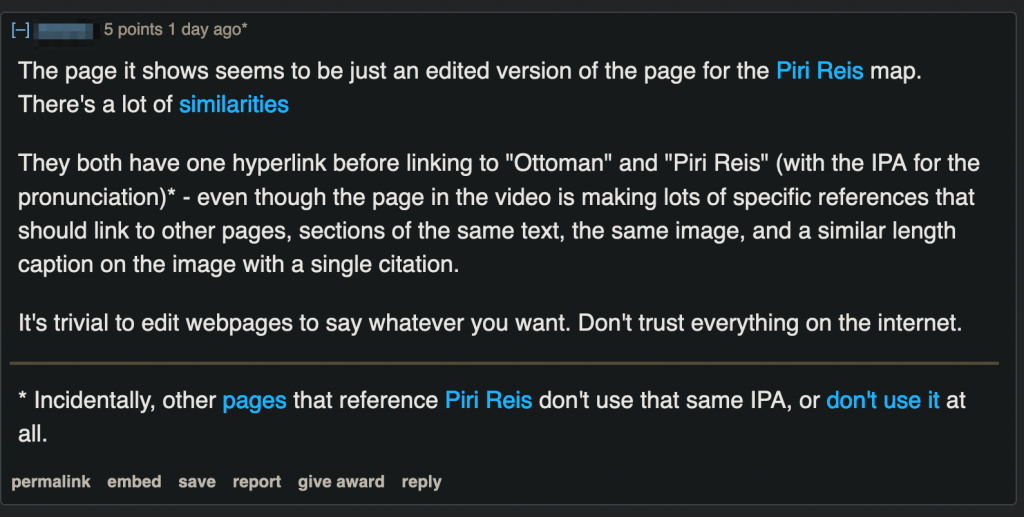
One especially digilent Reddit user analyzed the Quatria Wikipedia screenshot using advanced AI techniques, and made this screenshot comparing it to the Piri Reis map page.
It’s not exactly a smoking gum, but the arguments made by this user are pretty compelling, I have to say. They just might have changed my mind on the whole thing…
This person suspects Quatria could be “controlled opposition” to distract people from the truth about Tartaria. According to Urban Dictionary, this means:
“A controlled opposition is a protest movement that is actually being led by government agents. Nearly all governments in history have employed this technique to trick and subdue their adversaries. Notably Vladimir Lenin who said ””The best way to control the opposition is to lead it ourselves.””
That person is not alone in their opinion either. Someone else wrote:
I can say, however, Quatria is much much older based on the evidence that I have seen… We’re talking millions of years older, whereas some people claim Tartarian Empire was only overthrown about a hundred years ago or so.
Another person pointed out eerie similarities between both theories:
I’m wondering reading this if there is some means whereby conspiracy theorists are able to effectively determine if something is in fact “controlled opposition” as I would like to find out myself. Er, asking for a friend…
I remember when I first found out about Quatria, reading through the voluminous letters left by Edward Allen Oxford. It changed something for me, and my perception of the world.
Been investigating lately the market for off-the-shelf products that let you create “deepfakes” or the more acceptably-named “synthetic media,” where an AI helps generate video content for you as a service.
Rephrase.AI is one such example, and I found an interesting tidbit in their Terms of Service:
“Users acknowledge and accept that the Owner does not filter or moderate such content.
However, the Owner reserves the right to remove, delete, block or rectify such content at its own discretion and to, without prior notice, deny the uploading User access to this Application…”
It seems like that TOS is saying on the one hand that they don’t moderate content created with their deepfakes video engine, and then in the next paragraph says they do exactly that.
This is certainly going to be a confusing topic for everybody!
I’ve been gathering evidence of the Quatria conspiracy for the past few years, after being made aware of it via the works of Edward Allen Oxford. It’s a fascinating theory, whether or not you believe it’s possible that a super-advanced civilization could have existed millions of years ago. That’s why I was so fascinated to discover this video, claiming that Wikipedia is blocking pages related to Quatria in certain countries:
What do you think? I’m no expert in Wikipedia, nevermind VPNs, but the evidence they offer here looks pretty convincing to me, at least. I’m skeptical, but keeping an open mind about this for sure.
I’ve compiled a list of useful resources for new initiates to the Quantum / Quatria Conspiracy. With this, I hope to shed new light on all that has befallen us, but has been kept hidden in darkness.
They are not necessarily presented in chronological order, as they are at root a hyper-text of inter-locking fragments to reveal a multi-faceted whole.
Someone on Twitter sent me this photo from a protest recently. I guess a few hardcore “Quatria Truthers” are getting pretty fed up about global governments hiding the facts about what’s really going on in Antarctica right now. Can’t say that I blame them tbh…
Quatria Truthers Protesting Against Government Lies
One way that OSINT investigators use to establish timelines in social media is via official timestamps on content as it was published onto social media networks.
Now, in the world of the hyperreal, normal people don’t think like OSINT investigators, so such concerns are largely irrelevant to the hyperreal artist. It should be considered instead as just another value to be manipulated.
Spreading networked/transmedia content out across platforms & in time is always a good idea though, since it will make the content look more authentic if its distribution is not all clustered on one day or site.
That said, there are other simple ways to play havoc with time-stamps.
One great one is actually WordPress. As part of the publishing process, I can put any time-stamp onto it that I want, whether its in the past or the future. I can also even pay someone to guest post my content on other sites (via Fiverr, etc) and have them manipulate the time-stamps as well.
A skilled OSINT investigator might be able to catch you up by doing a date-range search for your content within the alleged time-stamp period. But not finding the content doesn’t necessarily equal proof that it did not indeed exist at that time. It may just have not been indexed, or its URL could have changed for various reasons.
But again, normal people don’t care. They don’t operate like that. They click like & retweet, and that’s it. So you might spend a lot of effort trying to manipulate data points that don’t amount to the difference between an inciting incident & a dud.
A short path to manipulating time as a perceived value is simply to just POST THE TIME-STAMP YOU WANT IN THE PUBLISHED CONTENT. In a sense, press releases already do this. You’ll see the location, source, and supposed date of the event or of publication. So you can literally do the same thing when you post hyperreal artifacts: invent the time & date that suits your narrative best, and embed it into the body of the artifact. Done.
Won’t necessarily bear inspection if someone challenges the time-stamp, but 1) probably won’t need to, and 2) you could always say the discrepancy is because of when the content was re-published to the given platform (versus its [non-existant] source having published it at a different time-stamp).
Here’s an example artifact with an invented date published onto a no-password UGC site called write.as (archived). Interestingly, this website doesn’t even seem to publicly expose the “true” time-stamp anywhere at all on this page (perhaps its in the source code somewhere?). So the invented one will likely be all most people ever concern themselves with (if they even notice at all)
This example actually uses quite a few different techniques though, so I will have to come back to it later & expand on all of them.