Questionable content, possibly linked

Author: Tim B. Page 133 of 210

Xenia (Greek religion)

The Greek god Zeus is sometimes called Zeus Xenios in his role as a protector of guests. He thus embodied the religious obligation to be hospitable to travelers. Theoxeny or theoxenia is a theme in Greek mythology in which human beings demonstrate their virtue or piety by extending hospitality to a humble stranger (xenos), who turns out to be a disguised deity (theos) with the capacity to bestow rewards. These stories caution mortals that any guest should be treated as if potentially a disguised divinity and help establish the idea of xenia as a fundamental Greek custom.[1]

Source: Xenia (Greek) – Wikipedia

Kingdom of the Isles (Scottish history)

The Kingdom of the Isles comprised the Hebrides, the islands of the Firth of Clyde and the Isle of Man from the 9th to the 13th centuries AD. The islands were known to the Norse as the Suðreyjar, or “Southern Isles” as distinct from the Norðreyjar or Northern Isles of Orkney and Shetland. In Scottish Gaelic, the kingdom is known as Rìoghachd nan Eilean. The historical record is incomplete, and the kingdom was not a continuous entity throughout the entire period. The islands concerned are sometimes referred to as the Kingdom of Mann and the Isles, although only some of the later rulers claimed that title. At times the rulers were independent of external control, although for much of the period they had overlords in Norway, Ireland, England, Scotland or Orkney. At times there also appear to have been competing claims for all or parts of the territory.

Source: Kingdom of the Isles – Wikipedia

High Council of the Five Kings (Kremel)

The Five Kings sat together in High Council five times per year to make collective decisions which impacted their kingdoms as a whole.

Source: The Five Kingdoms of Kremel – Tim Boucher

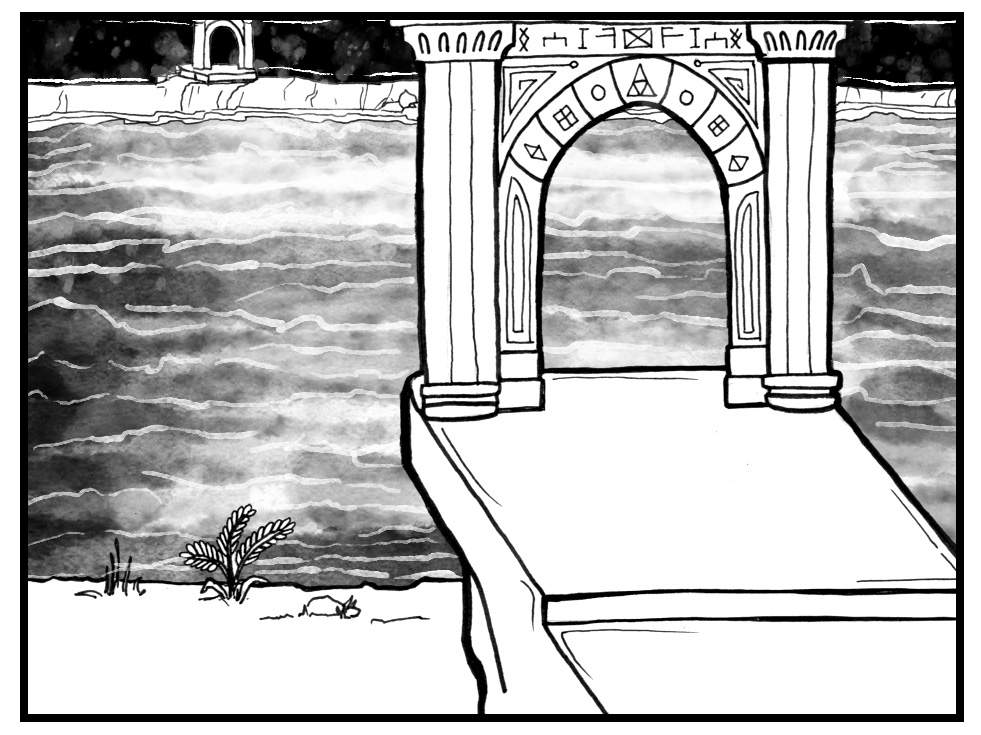
The Portail System (Quatria)

The original builders of this portail system had been lost in the mists of time. Legends differed, Eradus explained to Benda, as to whether they had been built by the ancient Lagom or Ardeid peoples, or some other mysterious third party. […]

“But there are other portails as well.” He did not say where. Benda was intrigued. Though his memory still failed him, he was fairly certain he’d never heard of any such thing before.

Source: The Arch of Passing – Tim Boucher

“For this reason, and for the fact that it has been discovered etched into the peak of the arch of the portail system in the Grand Lodge of the Hall of Life, the doubled form is sometimes referred to as the ‘Creation Gate.’”

Source: The Knot of Quatria

Ball’s Pyramid (Pacific geography)

Ball’s Pyramid is an erosional remnant of a shield volcano and caldera[1] lying 20 kilometres (12 mi) southeast of Lord Howe Island in the Pacific Ocean. It is 562 metres (1,844 ft) high, while measuring only 1,100 metres (3,600 ft) in length and 300 metres (980 ft) across, making it the tallest volcanic stack in the world.[2] Ball’s Pyramid is part of the Lord Howe Island Marine Park in Australia and is over 643 kilometres (400 mi) northeast of Sydney, New South Wales.

Steep and eroded, and formed 6.4 million years ago,[1] Ball’s Pyramid is positioned in the centre of a submarine shelf and is surrounded by rough seas, making any approach a difficult one.[1]

Source: Ball’s Pyramid – Wikipedia

Temple of Baucis and Philemon (Greek myth)

Zeus and Hermes came disguised as ordinary peasants, and began asking the people of the town for a place to sleep that night. They had been rejected by all, “so wicked were the people of that land,” when at last they came to Baucis and Philemon’s simple rustic cottage. Though the couple was poor, their generosity far surpassed that of their rich neighbours, among whom the gods found “doors bolted and no word of kindness.”

After serving the two guests food and wine (which Ovid depicts with pleasure in the details), Baucis noticed that, although she had refilled her guest’s beechwood cups many times, the pitcher was still full (from which derives the phrase “Hermes’s Pitcher”). Realising that her guests were gods, she and her husband “raised their hands in supplication and implored indulgence for their simple home and fare.” Philemon thought of catching and killing the goose that guarded their house and making it into a meal, but when he went to do so, it ran to safety in Zeus’s lap. Zeus said they need not slay the goose and that they should leave the town. This was because he was going to destroy the town and all those who had turned them away and not provided due hospitality. He told Baucis and Philemon to climb the mountain with him and Hermes and not to turn back until they reached the top.

After climbing to the summit (“as far as an arrow could shoot in one pull”), Baucis and Philemon looked back on their town and saw that it had been destroyed by a flood and that Zeus had turned their cottage into an ornate temple. The couple’s wish to be guardians of the temple was granted. They also asked that when time came for one of them to die, that the other would die as well. Upon their death, the couple were changed into an intertwining pair of trees, one oak and one linden, standing in the deserted boggy terrain.

Source: Baucis and Philemon – Wikipedia

The Temple Island (Quatrian atoll)

On one such branch, of one such future, the Hypogeum lies submerged and all but forgotten. What was once a ring of guarding mountains is now an atoll, whose opening amongst the salt sea into fresh waters within faces two Houses whose names or purposes few now remember. […]

And in the center of whose inner sea might be called forth by one skilled enough in that Music, an island and small mount, atop jutting forth a humble temple, a gleaming wet jewel to be reclaimed. And in this temple, a well which knows no bottom, and whose deep dark memory reaches back before even the ages of Quatria, to which we presently return…

Source: The First Cry of Delrin – Tim Boucher

Roving bands of minstrels (Old Quatria)

Before the fall of Abbadon, in Old Quatria, when the land was still young, there were no hierarchic divisions among the priest caste, and in fact not yet a formalized priest caste. Instead, there were traveling minstrels, who went from field and glen to town and village in celebration of the mysteries. They told the tales and the jokes, sung the songs and epic poems of the places they’d gone, or dreamed of on that long, long road.

Though they brought with them joy, the people in the towns could feel their loneliness, and longing for home. They would cook them meals, and give them beds and barns to sleep in, and stock them with provisions and foodstuff when they went on their way.

And thus marked the passing of the rounds of time in Old Quatria. The timing of the Festivals coinciding with the return of the roving bands of minstrels and the changes of the seasons.

Source: A Tale of Ancient Quatria – Tim Boucher

Antarctic flora (Biology)

The Antarctic flora is a distinct community of vascular plants which evolved millions of years ago on the supercontinent of Gondwana. It is now found on several separate areas of the Southern Hemisphere, including southern South America, southernmost Africa, New Zealand, Australia and New Caledonia. Joseph Dalton Hooker was the first to notice similarities in the flora and speculated that Antarctica had served as either a source or a transitional point, and that land masses now separated may have formerly been adjacent.[1]

Source: Antarctic flora – Wikipedia

What if Antarctica melted? (Climate change)

Page 133 of 210

Powered by WordPress & Theme by Anders Norén