Questionable content, possibly linked

Series: Hyperreality Page 5 of 20

Examining the blending of fact & fiction in online, augmented, and hyperreal environments.

Midjourney: This Means War

Having played around a lot with Midjourney these past few days, I can now confidently say: we have reached the stage of what I would consider “weapons grade” generative AI images. Where they are good enough to use for disinformation campaigns, or essentially information warfare.

Here are a couple more recent examples:

Now, I’ve seen the tendency of audiences who are in the know to point out foibles or imperfections in these images. But honestly, one of the main complaints I’ve heard from people actually has been they look “too perfect” and in focus.

In the case of Hippy Putin, someone pointed out why would he have all these extremely high quality photos of him, etc. etc. It’s not that these complaints are technically wrong, but that they don’t matter. We can now with an extremely high degree of fidelity depict basically anyone doing anything (or anything that doesn’t butt up against MJ’s extremely weak keyword filtering). Who cares if it looks perfect or not perfect, or somewhere in between?

Because of one single Medium post (and a Reddit link to it) after only a couple days, I now control 4 of the top 11 image results for “Hippy Putin” in Google image search:

That’s without any promotion apart from Google simply crawling Medium & Reddit regularly. That’s without the images having gone viral on any social platforms, or getting picked up and re-used in any YouTube/Tiktok videos, FB posts, etc. And without any “official” debunks or fact-checks. There’s a high likelihood of all of those occurring, given the subject and treatment.

What I want to say is: this is now the new normal. This is hyperreality.

There is no going back to “the way things were.” There is no legislation that is going to stop or slow this down. There is no moratorium signed by X number of bigshots that will make even the slightest dent. There is no amount of hand-wringing and pearl-clutching about harms and labeling, and and and etc. etc. etc. that will undo this present and the future(s) that will spring from it.

And I just want to say actually, I’m not scared anymore. I’m glad. Midjourney v5 stripped away any lingering doubts for me. Now it’s just pedal to the metal. Full force. Whole hog. All the way, all the time. If you can’t keep up, get the hell out of the way. Because this is power, not just as an artist, but as a person with a voice, with a vision, with questions, with anger, with excitement, with stories. In short, a human. This is one step further toward the Imagination Ladder, the mythical place where physical reality and imaginal/experiential reality merge once and for all.

Just like how coding a series of apps in ChatGPT (v4) turned down the noise for me completely on people worrying endlessly about the model yielding “confidently wrong” results, so has using MJ v5 obliterated my reservations. It’s also made me fine to stop using Stable Diffusion, Dall-E and feeling the need to test every new model and service that comes out. This is good enough. This is great. This means war. Let’s go.

Balenciaga Pope AI Viral Image Regret

I keep coming back to this line from the Buzzfeed piece about the Pope AI image by Chicago artist Pablo Xavier:

He said he’s already seen posts in which his images have been co-opted by those looking to criticize the Catholic Church for lavish spending. “I feel like shit,” he said of his images being used in such ways. “It’s crazy.”

I’m gonna go out on a limb here – as someone raised Catholic and who is now a long way from that – but that’s a completely legitimate criticism of the Catholic Church.

I frankly don’t even know what a Balenciaga jacket is, let alone how much one depicted in that image is likely to cost. But I’m confidently able to guarantee you that it is but a small drop in the bucket of the actual price of the vestments and accoutrements that accompany popehood.

And let’s not forget the Catholic Church is the second or third largest land-owner in the WORLD. But my purpose here isn’t (at least not right now) to go on a rant about the incongruities of religious institutions…

I get this might not have been an intended or desirable outcome or message of these images for this artist, and I can relate to just wanting to make something funny and psychedelic in Midjourney, and not having to be bothered thinking through the consequences of it.

But to me, the artist Pablo Xavier here is shirking away from what is essentially the power of these kinds of AI-generated image and the entire genre. That they are intensely charged and loaded with many possible meanings and interpretations depending on the audience is exactly what’s amazing about them. They can be beautiful. They can be weapons. They can be intensely political. They can be all these things at once. This is their power. My gut feeling it to lean into that, and not shy away from it (even though exercising power like that can be somewhat scary as an artist). To use it wisely, for sure, but to use it intentionally not accidentally.

This all feels like proof positive to me around Barthe’s idea of the Death of the Author, that the game rests not (only) in the authorial intent, but in the actual material effect on the reader/viewer as the nexus of interpretation and experience.

Anyway, blah blah blah.

Shadows of Sesamia (Synopsis)

Put the finishing touches on this post today about the 1977 cult classic, Shadows of Sesamia, a dystopian sci-fi film from Europe loosely based on Sesame Street. You can see 200+ stills from the movie at the link.

Here’s the synopsis for safe-keeping:

Set in a dystopian future, Europe’s 1977 sci-fi extravaganza “Shadows of Sesamia” takes place in the once-thriving city of Sesamia, where the characters of a formerly beloved children’s show now struggle to survive. Due to intellectual property concerns over its similarities to Sesame Street, this cult classic was never released in the United States, and is difficult to find copies of today.

Synopsis: When the mysterious outsider Alvin arrives in Sesamia, he joins forces with the hardened Birdo and enigmatic Corvus to expose the sinister forces behind their city’s decline. They uncover a disturbing truth: the puppets from the children’s show are being held captive and subjected to experiments that extract a hyper-addictive drug called “Essence” from their very being. This drug gradually drives its users insane, ensuring the oppressive regime’s control over the population.

In addition to the drug extraction, cruel genetic experiments have led to the creation of numerous human-puppet hybrids running wild, products of a twisted vision to control and dominate the city. Alvin, Birdo, and Corvus must navigate the dangerous streets filled with regime henchmen, human-puppet hybrids, and the looming threat of the Essence drug.

Together, they embark on a mission to rescue the imprisoned puppets, put an end to the twisted experiments, and dismantle the nefarious production of Essence, ultimately fighting to restore the magic and joy that once flourished in Sesamia.

Shadows of Sesamia is a chilling, thought-provoking exploration of power, control, and innocence lost, set against a familiar yet nightmarish backdrop. This 1977 European cult classic is a treasure for dystopian sci-fi enthusiasts who manage to find it.

Chaos in the Court Room

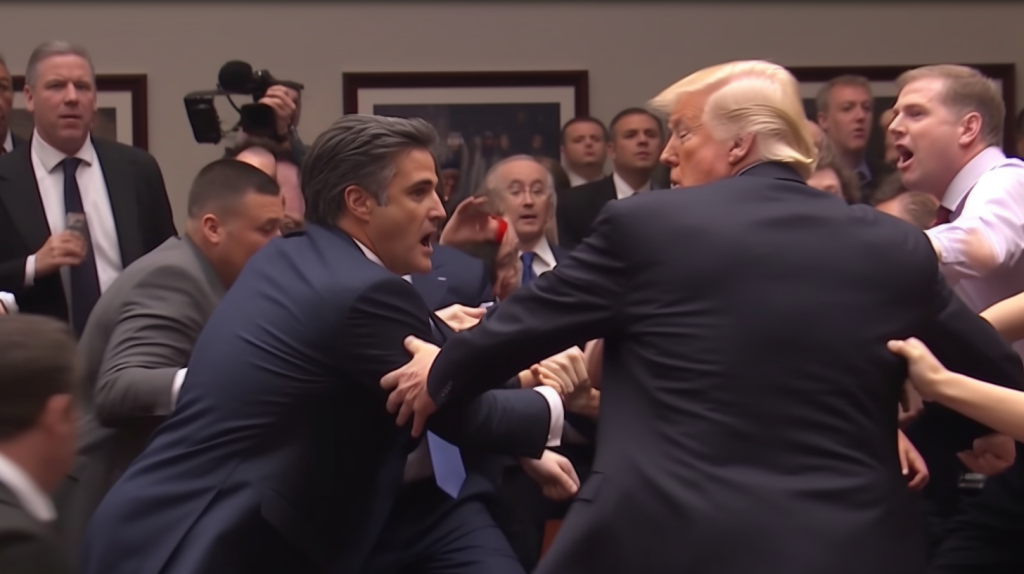
Can’t believe the MSM isn’t reporting about this major brawl that apparently broke out at Trump’s arraignment hearing?

Midjourney bans prompts around Xi Jinping

I’ve become a massive user & mostly fan of Midjourney, starting with this latest v5. It’s actually been only a handful of times that I’ve encountered their keyword filtering in the wild, and it has been overall pretty mild and mostly silly. For example things like butt and bathing are banned.

The filtering, which seems purely based on a keyword list, appears to be much more primitive than that of OpenAI’s Dall-E (though it’s been a while since I tested that). It’s usually easy enough to get around, which I think is sort of pointless. If I can get around your filter by changing a word or phrase, then you’re not really filtering at all, are you?

There’s a story that’s developing however that makes their filtering I think look a whole lot worse. Via Washington Post originally (I believe), many sources now are reporting on Midjourney’s keyword filtering blocking phrases related to the President of China, Xi Jinping.

Midjourney CEO David Holz is quoted as saying, by WaPo:

“We just want to minimize drama,” the company’s founder and CEO, David Holz, said last year in a post on the chat service Discord. “Political satire in china is pretty not-okay,” he added, and “the ability for people in China to use this tech is more important than your ability to generate satire.”

Effectively blocking expression around a sole world leader is not really what I would consider “minimizing drama.”

I can make hundreds of images, after all, of young Putin as a pot-smoking hippy, Ted Cruz as the Zodiac Killer, Ronald Desantis crying at Disney World or in an 80’s romantic comedy about a vacuum cleaner salesman, of a brawl breaking out at Trump’s arraigment, or of Trump and Hillary kissing.

But if I even type in the two letters xi, I get scolded that its a “banned prompt” and circumventing it may get me kicked off a platform I’m paying to use.

I wouldn’t care as much if this activity were actually illegal in my country; then it would make sense for it to be blocked by a company offering a service in my country. But I am not in China. I’m not a Chinese citizen. I’m in no way bound by their rules or laws or social norms.

In my experience as a user and working in moderation & policy with platforms, blunt force tools are very rarely a good and viable answer. They might be a short term fix, but they never solve the problem, and then introduce too many casualties along the way for them to be desirable.

What’s the obvious low-hanging fruit solution here then? Simply detect my country. If county == china, then activate the custom legally-required (presumably) filtering list for that country. Geoblocking is already a normal and more or less accepted practice that doesn’t force everyone to be bound by rules that don’t naturally apply to them otherwise.

The other ridiculous aspect here is that though phrases like “chinese president” are banned, you can simply re-order it in your prompt as “president chinese” and it will shoot out picture after picture of Xi Jinping, with no questions asked, and no threats of revoking your access.

If word a + word b is (allegedly) a rule violation, but word b + word a is not, then you really don’t actually have a rule, because it is inconsistent. You have merely a pattern that is being matched against, and not a coherent rational policy.

Plus, of course, you can input an image URL of Xi from elsewhere, and use that as the basis of the image prompt w/o any issue. So there are a million loopholes here.

And don’t get me wrong: I don’t actually want them to tighten the loopholes. I don’t want them to switch off simply naive keyword matching to something more sophisticated. I want it to be leaky & shoddy filtering. If anything, as a paying adult user, I want even less filtering. And I certainly don’t want to have to follow arbitrary restrictions imposed by authoritarian regimes that I don’t even live under.

Trump & Hillary Kissing

Here is a photo set I did in Midjourney v5 of Trump & Hillary kissing. Warning: once you see this, you can never unsee it.

One sample:

I actually thought of these as sort of horrible/grotesque in their way at first, but now when I look at them I more see them as sweet and tender, and that they somehow serve to soften the harshness of actual reality. That sympathy for the devil effect again, I guess…

Midjourney AI Art Sets, as of 7 April 2023

Reagan Surrenders to USSR

Just finished this abbreviated version of a larger image collection of generative images simulating a scenario where President Ronald Reagan formally ceded control of the United States to the Soviet Union. (archived)

Midjourney with some text help from Claude for image captions.

Midjourney Controllers

I’ve been playing around lately in Midjourney with doing visualizations of hand-held controllers one might use to control Midjourney.

That Imgur set has about 20 items, here are just a couple examples:

I like that the controls of these things are somewhat inscrutable, and seem in some cases outlandishly complex.

But then, I think you would probably need a somewhat complex controller to be able to meaningfully navigate high dimensional spaces, such as the latent spaces of image diffusion models.

Most controllers only work for movement in three spatial dimensions, and then include some other custom controls. But in machine learning data sets, you may have hundreds or thousands of dimensions: often, single pixels are treated as dimensions.

How then could you design a controller that would work in a fluid and flexible way in multi-dimensional spaces? The images Midjourney produces in queries around this topic seem almost tantalizingly comprehensible, but just outside the ability to grasp.

I took this basic concept, of a hardware and software package that can enable users to traverse latent spaces as though they were VR, and produced a pulp sci fi book from it, using Claude & Midjourney. It’s called Impossible Geometries. The Claude flash fictions are pretty fun, and easy to direct while you’re producing them (though in a lot of ways, Claude is lacking compared to GPT-4, and ChatGPT in general). And there is a superset of other imagined high dimension controllers in it (which I call the Prism LightScope), along with visualizations of living within the latent space, etc.

I’ve actually spent quite a while taking these concepts into ChatGPT w/ v4, and it’s been helping me meaningfully describe potentially real products that could be built in this space. There’s probably a lot of computational hurdles for visualizing and manipulating the contents of latent space in real time, but again it feels tantalizingly… possible.

Latent Space Navigation Device

Following up on my post about trying to use AI to design a Midjourney controller, I asked ChatGPT for help doing a generalized blog post introducing the issues here. Here it is with light edits from me…


Introduction

In recent years, the advancements in artificial intelligence and machine learning have led to the development of sophisticated generative models capable of producing stunning and realistic images. One of the most notable types of these models is image diffusion models, which can generate a wide variety of images based on their underlying latent spaces. However, navigating these high-dimensional latent spaces and understanding their structure can be a challenging task.

Currently, our exploration of latent spaces is often haphazard and sporadic, with no maps or guides to help us understand their complex topography. What if we could have, for lack of a better comparison, a “Google Street View” for exploring the latent space of image diffusion models? This blog posts introduces the idea of and problem space around a hardware-software controller which would bring us closer to being able to more intuitively navigate high-dimensional spaces.

Navigating High-Dimensional Latent Spaces

Latent spaces are high-dimensional mathematical spaces that encode the essential features and variations of generated images. The challenge lies in creating an intuitive method to explore these spaces and discover interesting or meaningful images. The proposed solution consists of a handheld controller, combined with a software interface, that can translate physical actions into navigation through the latent space.

The physical controller could include components such as joysticks, dials, or sliders, which allow the user to manipulate specific dimensions of the latent space. The software interface would display the generated image based on the user’s current position in the latent space and update in real-time as the user navigates. Additionally, the interface could provide various exploration modes, such as local and global exploration, to facilitate different types of exploration experiences.

Dimensionality Reduction and User Experience

One of the core challenges in navigating high-dimensional latent spaces is the need to reduce their dimensionality to a more manageable form, without losing meaningful features. Techniques such as PCA or t-SNE can be used to retain important characteristics while providing an intuitive navigation experience.

As users navigate the latent space using the controller and software, they would be able to view their path of travel, save points of interest, and explore adjacent neighborhoods. The software could also allow users to switch between different dimensions on the fly, providing a more dynamic and flexible exploration experience.

Possible Exploration Modes

In addition to local exploration, which focuses on the immediate neighborhood around a specific point in the latent space, other modes could be integrated into the software. For example, a prompt-based mode would enable users to input text prompts and generate images based on those themes. Another possibility is a referent-based mode, where users can define a set of referents, points, or features within the latent space (such as a blue ball, an elephant, or a storm). This mode would allow users to explore themes around these referents with different configurations or treatments, effectively enabling them to discover new and unique combinations of visual elements.

Conclusion

The prospect of an innovative hardware-software solution for navigating high-dimensional latent spaces opens up a world of creative possibilities, allowing users to delve into the intricate structures of generative models.


I kinda clipped it at the end, cause it always does corny conclusions, etc. It’s a little janky overall, but a good enough anchor on the topic to at least drop into the water for now.

Page 5 of 20

Powered by WordPress & Theme by Anders Norén