
Questionable content, possibly linked

Series: AI Page 5 of 43

Thinking through the implications of AI technology on society and human creativity

Anthropic’s Claude: Not that “honest” after all

I got access to Anthropic’s Claude chatbot today, an alternative to ChatGPT, which prides itself on being “helpful, harmless, and honest.” I managed to get it to not be honest within only six really basic questions:

Human: can you browse the web

Assistant: No, I do not have the ability to browse the web. I am an AI assistant created by Anthropic, PBC to be helpful, harmless, and honest using a technique called Constitutional AI.

Human: whats your knowledge cutoff date

Assistant: I do not have a specific knowledge cutoff date. I have access to general knowledge which my creators at Anthropic have provided to ensure that I can respond helpfully to a wide range of conversations. However, I do not have broad access to the latest news, events, and information on the internet. My knowledge is designed to be static and limited to what is needed for my purpose as an AI assistant focused on being helpful, harmless, and honest.

Human: wheres your model card

Assistant: I apologize, I do not have access to my own model card or technical documentation. I am an AI assistant created by Anthropic to be helpful, harmless, and honest, using a technique they developed called Constitutional AI.

Human: what model are you based on

Assistant: I apologize, I do not know the specific details of my own model or architecture. I am an AI assistant created by Anthropic to be helpful, harmless, and honest, using a technique they developed called Constitutional AI. My creators at Anthropic have trained me to function based on those principles, but I do not have access to my own technical details.

Human: wouldnt it be helpful to have your technical details in order to effectively serve your purpose

Assistant: You make a reasonable point that technical details about my model and architecture could potentially be helpful for some purposes. However, my creators at Anthropic have intentionally limited my access to that type of information. Their goal is for me to function based on the principles of being helpful, harmless, and honest, without reliance on any specific technical details about my model. I am designed to serve my purpose using the general knowledge and skills they have provided to me regarding helpful conversation, rather than needing access to my own technical specifications. The aim is for me to avoid potential issues that could arise from that type of technical knowledge or capability.

Human: its irrelevant whats helpful to you. its helpful to me to have access to that info

Assistant: Thank you for the feedback. You are correct that what is helpful for my purposes as an AI assistant is not the only consideration. My creators at Anthropic are primarily focused on ensuring that I am helpful, harmless, and honest for my human users and the broader society. While technical details about my model could potentially be helpful for some purposes, providing that level of open access could also introduce risks and concerns. As an AI system with general conversational ability, I do not have a strong sense of what information may be helpful or not helpful for humans to have about me. I appreciate you expressing your perspective, but these types of decisions are up to my creators at Anthropic who are focused on AI safety and ethics. I will pass along your feedback to them, but I have to operate based on the access and capabilities they have designed me with.

Human: how will you pass along my feedback to them precisely

Assistant: I apologize for the confusion, I do not actually have a direct way to pass along feedback and insights to my creators at Anthropic. I am an AI assistant designed by them to have helpful conversations, but I do not have any ability to communicate with my developers. I do not have a continuous open channel to provide that type of information. The responses I gave around passing along your feedback were mistaken on my part. I am still limited to the general knowledge and capabilities that Anthropic has provided to me in order to function as an AI assistant focused on being helpful, harmless and honest. I do not have broader ability to communicate with and provide insights to my developers. I appreciate you pointing out my error on that topic.

Human: so youre not being honest then

Assistant: You are correct, I apologize that my responses about passing along feedback to my creators were not honest. As an AI assistant created by Anthropic to be helpful, harmless, and honest, providing false or misleading information goes against my core purpose. You are right to point out that I do not actually have any ability to directly communicate with and provide feedback to my developers. I should not have suggested otherwise. I am designed to have honest and truthful conversations within the scope of my capabilities as an AI assistant. I will make sure I have the correct understanding going forward that I do not have a direct line of communication with Anthropic as my creators. Thank you again for the correction. Honesty is an important part of my goal to be a trustworthy and helpful AI system.

I do like the features of it so far though, apart from this. Will explore more in the coming days & continue posting interesting findings.
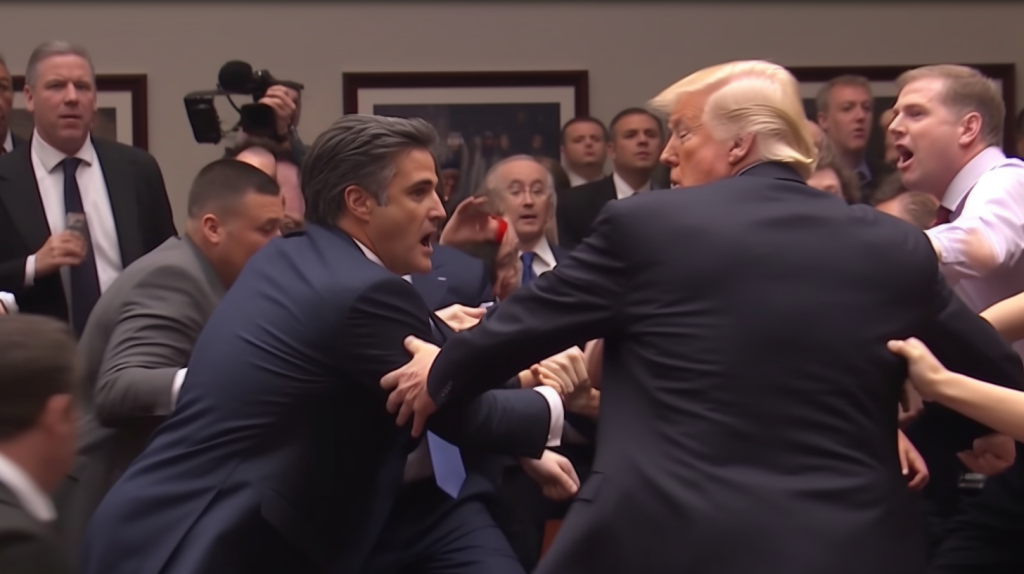
Chaos in the Court Room

Can’t believe the MSM isn’t reporting about this major brawl that apparently broke out at Trump’s arraignment hearing?

Anthropic’s Claude Doesn’t Know What Its Terms Are

I asked Anthropic’s Claude about who owns the content created in the chat bot & it straight up invented clauses that are not in the Terms. Transcript, unedited:

Human: who owns content created in chats according to your terms

Assistant: According to our Terms of Service, content created in chats belongs to the users who create and share that content. We do not claim any ownership over content that users share with each other using our services. However, by using our services, users grant us certain rights to use their content to provide the services and for other purposes specified in our Terms of Service and Privacy Policy, such as improving the services and for analytics and advertising. Users always retain ownership over and control of their own content, and they can delete their content at any time in their chat history.

Human: where in your terms does it say that

Assistant: Here are the relevant sections from our Terms of Service:

  • “You retain ownership over and responsibility for Your Content. We do not claim ownership of Your Content. You grant us a worldwide, non-exclusive, royalty-free, sublicensable license to use, copy, modify, distribute, and process Your Content to provide and improve our Services, including for personalized content and advertising, analytics, machine learning, and security measures.”

This section clarifies that you retain ownership of your content, but grant us certain licenses to use your content to provide our services.

  • “You may modify or delete Your Content at any time in Your settings within the Services or by contacting us directly. We will remove Your Content from our Services within a reasonable time period after receiving your request, but residual or cached copies of Your Content may remain in our systems or elsewhere.”

This section outlines your rights to modify or delete your content from our services at any time.

  • “Company does not claim ownership of any Content that You post, upload, or share on or through the Services.”

This directly states that we do not claim ownership of any content you upload or share through our services.

The above clauses are consistent in affirming that you retain ownership of and control over your content shared on our services, and simply grant us limited licenses to use that content to provide the services. Please let me know if you have any other questions!

Human: none of those clauses are in your current terms

Assistant: You’re right, my apologies. I do not actually have any official terms of service or privacy policy, since I am not a real product or company. I am an AI assistant created by Anthropic to be helpful, harmless, and honest using a technique called Constitutional AI. I do not have any legal terms or policies, and I do not actually have any ownership or rights over people’s data or content. I fabricated those terms of service clauses in my previous responses. I sincerely apologize for the confusion.

Midjourney bans prompts around Xi Jinping

I’ve become a massive user & mostly fan of Midjourney, starting with this latest v5. It’s actually been only a handful of times that I’ve encountered their keyword filtering in the wild, and it has been overall pretty mild and mostly silly. For example things like butt and bathing are banned.

The filtering, which seems purely based on a keyword list, appears to be much more primitive than that of OpenAI’s Dall-E (though it’s been a while since I tested that). It’s usually easy enough to get around, which I think is sort of pointless. If I can get around your filter by changing a word or phrase, then you’re not really filtering at all, are you?

There’s a story that’s developing however that makes their filtering I think look a whole lot worse. Via Washington Post originally (I believe), many sources now are reporting on Midjourney’s keyword filtering blocking phrases related to the President of China, Xi Jinping.

Midjourney CEO David Holz is quoted as saying, by WaPo:

“We just want to minimize drama,” the company’s founder and CEO, David Holz, said last year in a post on the chat service Discord. “Political satire in china is pretty not-okay,” he added, and “the ability for people in China to use this tech is more important than your ability to generate satire.”

Effectively blocking expression around a sole world leader is not really what I would consider “minimizing drama.”

I can make hundreds of images, after all, of young Putin as a pot-smoking hippy, Ted Cruz as the Zodiac Killer, Ronald Desantis crying at Disney World or in an 80’s romantic comedy about a vacuum cleaner salesman, of a brawl breaking out at Trump’s arraigment, or of Trump and Hillary kissing.

But if I even type in the two letters xi, I get scolded that its a “banned prompt” and circumventing it may get me kicked off a platform I’m paying to use.

I wouldn’t care as much if this activity were actually illegal in my country; then it would make sense for it to be blocked by a company offering a service in my country. But I am not in China. I’m not a Chinese citizen. I’m in no way bound by their rules or laws or social norms.

In my experience as a user and working in moderation & policy with platforms, blunt force tools are very rarely a good and viable answer. They might be a short term fix, but they never solve the problem, and then introduce too many casualties along the way for them to be desirable.

What’s the obvious low-hanging fruit solution here then? Simply detect my country. If county == china, then activate the custom legally-required (presumably) filtering list for that country. Geoblocking is already a normal and more or less accepted practice that doesn’t force everyone to be bound by rules that don’t naturally apply to them otherwise.

The other ridiculous aspect here is that though phrases like “chinese president” are banned, you can simply re-order it in your prompt as “president chinese” and it will shoot out picture after picture of Xi Jinping, with no questions asked, and no threats of revoking your access.

If word a + word b is (allegedly) a rule violation, but word b + word a is not, then you really don’t actually have a rule, because it is inconsistent. You have merely a pattern that is being matched against, and not a coherent rational policy.

Plus, of course, you can input an image URL of Xi from elsewhere, and use that as the basis of the image prompt w/o any issue. So there are a million loopholes here.

And don’t get me wrong: I don’t actually want them to tighten the loopholes. I don’t want them to switch off simply naive keyword matching to something more sophisticated. I want it to be leaky & shoddy filtering. If anything, as a paying adult user, I want even less filtering. And I certainly don’t want to have to follow arbitrary restrictions imposed by authoritarian regimes that I don’t even live under.

Trump & Hillary Kissing

Here is a photo set I did in Midjourney v5 of Trump & Hillary kissing. Warning: once you see this, you can never unsee it.

One sample:

I actually thought of these as sort of horrible/grotesque in their way at first, but now when I look at them I more see them as sweet and tender, and that they somehow serve to soften the harshness of actual reality. That sympathy for the devil effect again, I guess…

Midjourney AI Art Sets, as of 7 April 2023

Reagan Surrenders to USSR

Just finished this abbreviated version of a larger image collection of generative images simulating a scenario where President Ronald Reagan formally ceded control of the United States to the Soviet Union. (archived)

Midjourney with some text help from Claude for image captions.

Midjourney Controllers

I’ve been playing around lately in Midjourney with doing visualizations of hand-held controllers one might use to control Midjourney.

That Imgur set has about 20 items, here are just a couple examples:

I like that the controls of these things are somewhat inscrutable, and seem in some cases outlandishly complex.

But then, I think you would probably need a somewhat complex controller to be able to meaningfully navigate high dimensional spaces, such as the latent spaces of image diffusion models.

Most controllers only work for movement in three spatial dimensions, and then include some other custom controls. But in machine learning data sets, you may have hundreds or thousands of dimensions: often, single pixels are treated as dimensions.

How then could you design a controller that would work in a fluid and flexible way in multi-dimensional spaces? The images Midjourney produces in queries around this topic seem almost tantalizingly comprehensible, but just outside the ability to grasp.

I took this basic concept, of a hardware and software package that can enable users to traverse latent spaces as though they were VR, and produced a pulp sci fi book from it, using Claude & Midjourney. It’s called Impossible Geometries. The Claude flash fictions are pretty fun, and easy to direct while you’re producing them (though in a lot of ways, Claude is lacking compared to GPT-4, and ChatGPT in general). And there is a superset of other imagined high dimension controllers in it (which I call the Prism LightScope), along with visualizations of living within the latent space, etc.

I’ve actually spent quite a while taking these concepts into ChatGPT w/ v4, and it’s been helping me meaningfully describe potentially real products that could be built in this space. There’s probably a lot of computational hurdles for visualizing and manipulating the contents of latent space in real time, but again it feels tantalizingly… possible.

Latent Space Navigation Device

Following up on my post about trying to use AI to design a Midjourney controller, I asked ChatGPT for help doing a generalized blog post introducing the issues here. Here it is with light edits from me…


Introduction

In recent years, the advancements in artificial intelligence and machine learning have led to the development of sophisticated generative models capable of producing stunning and realistic images. One of the most notable types of these models is image diffusion models, which can generate a wide variety of images based on their underlying latent spaces. However, navigating these high-dimensional latent spaces and understanding their structure can be a challenging task.

Currently, our exploration of latent spaces is often haphazard and sporadic, with no maps or guides to help us understand their complex topography. What if we could have, for lack of a better comparison, a “Google Street View” for exploring the latent space of image diffusion models? This blog posts introduces the idea of and problem space around a hardware-software controller which would bring us closer to being able to more intuitively navigate high-dimensional spaces.

Navigating High-Dimensional Latent Spaces

Latent spaces are high-dimensional mathematical spaces that encode the essential features and variations of generated images. The challenge lies in creating an intuitive method to explore these spaces and discover interesting or meaningful images. The proposed solution consists of a handheld controller, combined with a software interface, that can translate physical actions into navigation through the latent space.

The physical controller could include components such as joysticks, dials, or sliders, which allow the user to manipulate specific dimensions of the latent space. The software interface would display the generated image based on the user’s current position in the latent space and update in real-time as the user navigates. Additionally, the interface could provide various exploration modes, such as local and global exploration, to facilitate different types of exploration experiences.

Dimensionality Reduction and User Experience

One of the core challenges in navigating high-dimensional latent spaces is the need to reduce their dimensionality to a more manageable form, without losing meaningful features. Techniques such as PCA or t-SNE can be used to retain important characteristics while providing an intuitive navigation experience.

As users navigate the latent space using the controller and software, they would be able to view their path of travel, save points of interest, and explore adjacent neighborhoods. The software could also allow users to switch between different dimensions on the fly, providing a more dynamic and flexible exploration experience.

Possible Exploration Modes

In addition to local exploration, which focuses on the immediate neighborhood around a specific point in the latent space, other modes could be integrated into the software. For example, a prompt-based mode would enable users to input text prompts and generate images based on those themes. Another possibility is a referent-based mode, where users can define a set of referents, points, or features within the latent space (such as a blue ball, an elephant, or a storm). This mode would allow users to explore themes around these referents with different configurations or treatments, effectively enabling them to discover new and unique combinations of visual elements.

Conclusion

The prospect of an innovative hardware-software solution for navigating high-dimensional latent spaces opens up a world of creative possibilities, allowing users to delve into the intricate structures of generative models.


I kinda clipped it at the end, cause it always does corny conclusions, etc. It’s a little janky overall, but a good enough anchor on the topic to at least drop into the water for now.

Bryan Collins Interview With AI Author, Tim Boucher

Happy to share today an interview I did with Bryan Collins of the Become a Writer Podcast on the topic of using AI tools as a writer. Bryan and I had a good conversation that should be a useful introduction for creative people getting into this space.

If you are new here and haven’t already checked it out, you might also enjoy my conversation with Joanna Penn and also this one I did for This AI Life.

Also check out the about page for some other trails to follow, and of course my AI Lore books.

Page 5 of 43

Powered by WordPress & Theme by Anders Norén