
Tim Boucher

Questionable content, possibly linked

SD Card Readers as DOT Tech

I won’t go on and on about it here, but I’m not in favor of letting kids play with cell phones. I don’t have one myself for good reason – I think they are just too addictive, and the only way to avoid it is to just not have one. I understand in the real world, compromises must be made, and one of those I made recently was in finding and purchasing this interesting example of does one thing (DOT) technologies that I wrote about recently.

It’s a lowly SD card reader for a hunting trail cam made by Wildgame Innovations. It’s called the Trail Pad Swipe, and it looks like there’s a larger version called the Trail Pad Tablet that is maybe along the same lines. It’s intended use seems to be enabling you to check images in the field from the SD card in a trail camera (which I do have one for fun & wildlife observation, btw, so this is always a possible fallback use, even if one I don’t engage with as an activity much lately – I gotta get one set up again this winter!).

The things I want out of a device like this for my intended use case is actually to reduce the functionality of the Almighty Cell Phone™, and the like… cold sleek fetishistic neo-brutalist beauty of the object itself. I want a device, in other words, that is shittier, and less “sticky” behaviorally than a cell phone.

And that is not. Fucking. Riddled. With. Ads. And. Trash. Holy. Shit.

So what is the “DOT” that an SD card reader does? It reads SD cards. It does not surf the internet, connect to wifi, let you check your email, send you notifications, draw you down endless corridors of social media, apps, and other bullshit and train you from a young age to obey the hegemony that says that all of those things are necessary and normal components of life at any age (hint: they are not), let alone in childhood.

Anyway, people can do what they want, what I am doing is finding an alternative that does one thing, while taking advantage of the benefits that supervised use of digital devices might bring educationally.

Based on my experience, it seems that you can put JPG images and AVI files onto an SD card from your laptop pretty easily – though I had a lot of trouble getting AVI file outputs from other video codecs using a Mac. That’s unresolved, but I was able to download some AVIs and tested them on the device. They played no problem, which is great news. It also has a headphone jack for listening. I’d prefer a speaker too, but will accept it given the challenge of finding anything at all that fits in this product space.

A basically more rough replacement for a cell phone or small tablet that does “nothing” except read two file formats on SD cards is not exactly on everybody’s shopping list. But one thing I’ve thought a lot about is that why, as consumers, are we all forced to use the same shopping list either? Why can’t we easily, for example, order up the components we want in the configuration we want, and like… some AI factory in outer space assembles them and sends it to me via parachute at a very reasonable price?

That’s a future I would actually be okay with, because it would mean that I would still have some measure of control over devices and their functioning, and I could pick from the available options to find one that suits me. Even if that meant choosing to live in such a way that none of them suited me. Choosing to live without them. That’s another obvious solution down this road, but I’m not entirely there yet, so it’s better to shape it in a direction I can live with.

I can live with SD cards, because I can decide what goes onto them. In my research for do one thing technologies here, I came across a device whose name I now forget (Yoto), but you can buy (proprietary) credit-card sized branded audio recordings of popular books (that I already own in print). But you can also buy blanks and make your own. I guess that’s cool, but I could also now with this SD card reader buy any random cheap SD cards, and now load the entire Wikiart image data set on it (or a similar large image set of the natural sciences), and we’re off to the races.

The only “flaw” I’ve seen in this device is that while it does allow the swipe action (and a shitty slow zoom) for going picture to picture on the photo galleries, it doesn’t allow for flipping the device on its side to view portrait-orientation pictures correctly. Instead, it squishes them to fit in the landscape-orientation view screen. Also, I don’t think there’s a way in the video player to pick back up where you left off, or fast forward or rewind videos, but I also need to look at it again more closely.

It’s funny though: it’s “bad” in one way that it can’t do all of those things, but in another way, what I want to find and share is the limits of technology, and figuring out experientially what are the good and bad parts of it (along with its outcomes), and which ones, in which configurations do we actually want to have in our lives. That, to me, is ultimately the point of all of this, and one of the biggest things we need to figure out individually and collectively in our lives.
Styles as Supersets of Characteristics in AI art

There was a part in the recent Chamber of Progress webinar where I tried to express a point about ML/AI in its current form’s training being made up of what I think of as a ‘measurement of dimension.’ That is, that the training process is composed of – in my limited understanding – sets of measurements of attributes or features within items in the datasets. This seems to be called its dimensionality (its amount of attributes), though these terms are used it seems in different ways by different sources.

In the video, I refer to it as a measurement of dimension. Because that makes as much sense to me linguistically as any of this made up gobbledeegook AI jargon does.

But we could also reasonably I think in plain language say characteristics and still be on the right track. ML/AI training looks at characteristics in data: images, text, etc. That means splitting apart things at a kind of micro level. If you look at 10,000 images of dogs, or bananas, or anything, you can start to break out lists of attributes, size, color, shape, and so on. Texture.

The beauty part then is that the characteristics originally measured in specific artifacts in the training corpora then become abstracted or put in a blender, so to speak, divorced from their original meaning and context. Enabling them to be mixed up and re-assembled into completely new, never-before-seen creations, assemblages of statistical sampling.

Elsewhere earlier in the video, we talked a bit about styles. There seems to be general consensus online that style is not copyrightable. As expressed by Creative Commons here, copyright protects specific expressions in fixed forms of a style, not the style itself. (But there are, ahem, blurred lines here, to be fair.)

Anyway, my point here isn’t to argue on copyright grounds in this post, that is just for background. What I wanted to say I guess is that ultimately my intuition as an artist who has made extensive use of generative AI is that style ultimately breaks down to supersets of characteristics/attributes/features(/dimensions).

To an AI image generator, for example, you could just as simply prompt “in the style of salvador dali” as you could basically any random string of characters “in the style of day old bagels at a long island supermarket in the 1980s” or “in the style of z8gn3s8hjkl*12%”.

All of those are going to give you results, some more inscrutable than the others as to clear cultural meaning or obvious connections to known things. You can also do it without including “in the style of” at all, and just including random phrases or strings in your prompts, as Nettrice talks about in the video.

This fluidity and flexibility around the sheer fact that literally anything (or nothing) can become a “style” in AI for me blows apart our current understanding of what an artist’s style conventionally even means. (Let alone what this means for ‘consensus reality’ – and this is what I was referring to I think in the video, re: holistic frameworks for analysis of meta-data.)

Anyway, I have other things waiting on me, but wanted to jot this down as a beach head to be able to come back and grasp this idea more fully down the road. Also see the notion of the hypercanvas here. Somewhere, somehow, I trust that this will all make sense in the end…

Quoting Chomsky on ChatGPT & True Intelligence

Tons of good stuff in this article, but this jumped out at me:

True intelligence is demonstrated in the ability to think and express improbable but insightful things.

Talking Dystopia on the 1984 Today! podcast

An interview I did on AI dystopia in the middle of last year was finally released this morning in the UK, on the 1984 Today! podcast. Click through the link for a chance to download two free AI lore books (supplies are limited). You can also listen at the YouTube link below:

Notes on Relaxatopia

Relaxatopia is the 100 and something or other-th book in the, let me check, AI Lore books series… 121st. Sorry about that.

As I’ve gotten deeper into this series, the low hanging fruit has presumably mostly been picked or dried up, or whatever, and I have to push farther and farther to get anywhere. Which is good, because it still presents a challenge. It’s just a different challenge than it posed when I started officially publishing these books way back in July 2022. This one took me a month to finally get out the door, though I was busy doing plenty of other stuff during that time, plus the holidays. Whatever. Here it is anyway.

This is the third book in the ‘Topia series, which began with Conspiratopia, which was not written with help from AI whatsoever, but is all about AI, and which precedes chronologically all the AI-assisted books. And that book has a sort of mini-sequel in Anxietopia, making this one, Relaxatopia, the third and latest installment. The ‘topias in this usage are basically a series of artificial paradises set up by the AI providers to give humans everything they think they want… and usually it turns out horrible. It is dystopian fiction, after all. But you’ll have to decide for yourself.

This book was specifically inspired by a week at a resort in Mexico, my third or fourth such experience over the past dozen or so years. I have a lot of mixed feelings about that sort of thing, and find a lot of that creeping out in the book.

It was while working on this book, and trying to get Midjourney v6 to do dystopian resort illustrations that I accidentally discovered v6’s propensity towards depicting “tits & ass.” So there is a good amount of that included in this book as well. Nothing too graphic, and I think it’s all rather artful, but it’s an NSFW book for sure.

Here’s the art sample for this volume:

Anyway, there’s always more to say about these, but tomorrow is another day, with other things on the horizon.

Oh, P.S. the phony disease made up by the AIs in this book, Chronic Discontent Syndrome, is loosely based on a real-fake syndrome supposedly used by the Soviets for similar purposes, Sluggishly Progressing Schizophrenia. Fun historical facts!

Video: Webinar with Chamber of Progress on AI, Art, Copyright

Had a nice time recording this yesterday, and found the other panelists to be thoughtul and nuanced. Great to be a part of it!

Quoting Rob Pike on phone/computer infra & statefulness

Love this:

Twenty years ago, you expected a phone to be provided everywhere you went, and that phone worked the same everywhere. At a friend’s house, or a restaurant, or a hotel, or a pay phone, you could pick up the receiver and make a call. You didn’t carry a phone around with you; phones were part of the infrastructure. Computers, well, that was a different story. As laptops came in, people started carrying computers around with them everywhere. The reason was to have the state stored on the computer, not the computer itself. You carry around a computer so you can access its disk.

In summary, it used to be that phones worked without you having to carry them around, but computers only worked if you did carry one around with you. The solution to this inconsistency was to break the way phones worked rather than fix the way computers work.

My dream setup, then, is a computing world where I don’t have to carry at least three computers – laptop, tablet, phone, not even counting cameras and iPod and other oddments – around with me in order to function in the modern world. The world should provide me my computing environment and maintain it for me and make it available everywhere. If this were done right, my life would become much simpler and so could yours.

Do One Thing (DOT) Technologies

Getting into wifi radio systems has given me a new understanding and appreciation of what I actually want out of technologies. I want technologies that Do One Thing, or as I’m calling it DOT.

I don’t want to multitask. I don’t want a million apps to flip through and figure out if any of them actually does the thing I want or if I have to sign up or pay some monthly fee or get into bullshit in-app purchases. That’s all dead to me. I just want technology that does one thing, and does it well. Or one narrow slice of things that are all tightly related and which support each other.

I don’t want a lot of options and choices and settings and updates. I want technologies that do one thing. DOT. And well. DOT+DIW.

In the world of wifi radio, I now have a handheld Ocean Digital and a fixed Sangean WFR-32. Here is a video overview of the Sangean:

It can be difficult to find good information and reviews about some of these Chinese wifi radio systems like this.

I will say that the system is a bit weird to get used to. There’s an app for iOS (works on iPad, which is not always the case) that seems to be the easiest way to add stations to it, though you can do it through a sub-menu. There’s also this, which I still don’t understand, and it can accept signals from Spotify (at least through Spotify Connect, I’m not sure if you can easily search songs in it), Tidal, Qobuz, others.

Anyway, each time you limit functionality like this, you introduce weird quirks into a device and its functioning. We’ve been trained I guess by marketing to think that more functions, more options, more possibilities, more tools jammed into a device is always better. But is it really?

If you own a Swiss Army Knife, when is the last time you used anything but the actual knife blade in it? I saw someone say somewhere (original reference lost), that sometimes you need the chef’s knife. The thing that does one thing, and does it well. It cuts.

Mailbug seems to me like another example of this which I remain intrigued by, though my use case and requirements are a bit different. I don’t own one (yet) for that reason, but the possibilities – in fact, the lack of possibilities – is something I keep coming back to in my thoughts.

I’ve been researching a lot the wave of emerging e-ink external monitors compatible with Mac, and that has been interesting to see where things stand. As it currently is, the technology is severely limited by its refresh rate, which is nowhere near the ‘normal’ monitors people use. So you can end up with artifacting in some circumstances, ghosting, etc. It’s difficult to find these in Canada from any brand, and there appear to be only three main series I see often referenced: Dasung Paperlike, Onyx Boox Mira, Philips E Ink Business Monitor 13.3.

I think I have a lead on a Mira in Canada that I am waiting on, so I’ll show a video about that device:

I often already run my Mac screen in black and white but for the amount I’m on it as a writer and whateverer, it doesn’t solve the eyestrain issue like e-ink potentially does, and which other people who have adopted this monitor technology (and smartphone e-ink tech is picking up as well). Here’s one such video that I appreciated:

I like this idea of limitations as being (sometimes) beneficial, of cutting down the distraction and the “flicker” so to speak of modern screen-ified life. I don’t expect yet another device to bring me ultimate happiness, but I’m going through a time of great winnowing down what may ultimate best relationship with technology is. And I think it’s this: do one thing. DOT.

There are probably other words for technologies like this: calm technologies, anti-addictive devices, single-tasking?

My old school 90s AlphaSmart Neo 2 keyboard is one of my favorite technologies, and it is extremely DOT. You can type on it, there are 8 buttons up top for files. 2 AA batteries that last forever, with a small LCD screen. The feel is so good. You’re just typing. You’re just writing. You can get lost in it. No notifications, no distractions, no bullshit. Does one thing, does it well.

For me, this isn’t just a short term “digital detox,” this feels like a sea change, a fundamental shift in understanding and experiential improvement. This is a break from how I approached technology previously. The ability to do just one thing in the end gives you the space to do (or not do) everything else unencumbered.

Beyond Fair Use

I read with interest Brian Merchant’s piece in the LA Times which mentions the open letter to the US Congress that I signed and participated in the drafting of. I won’t go too much into a critique of it here, but my position broadly is that artists of all kinds ought to be included in high-level AI policy discussions, including both artists who are against all or certain aspects of the technology, and those who embrace it, or aspects of it. Artists are not a homogenous group by any means, but we offer important counterpoint societally that other groups don’t in the same way or quality.

Despite the framing of the article, that original letter referenced by LA Times didn’t mention Fair Use or copyright all, but my subsequent personal response to the US Copyright Office & its Canadian counterpart’s public inquiry regarding AI and copyright obviously did extensively. I am (not a lawyer, but…) pretty sure that under US law, training AI on copyrighted data is most of the time Fair Use. In my eyes, the direction the court proceedings are heading seem to support that position.

But I also don’t think that because I support the idea that AI companies should run rampant and do anything they want (my books explore fictional scenarios of what happens when we allow them to do exactly that btw); quite the contrary, as you can see from the AI Terms of Service that I wrote (with help from AI) and sent as a policy document to the Canadian federal government and political parties. My beliefs run much deeper than that.

In reality, I am a tremendous critic of technology, a Certified Super Complainer™, making use of AI in order to critique AI. I don’t even own a smart phone or use social media — I hate how these technologies make me feel and the way they negatively reinforce endless status-seeking and influence-chasing in human relationships, not to mention addictive behaviors. At the same time, I cautiously embrace certain aspects of generative AI, because I believe it represents the most fascinating and boundary-pushing artistic technology of our time.  

Philosophically, my sympathies go much farther than Fair Use: I am probably something more like a ‘Universalist Library-ist’ who believes we ought to have universal access to all knowledge available to everyone (plus, you know, healthcare, but that’s another story). I am a believer in the applicability here of the United Nations’ Universal Declaration of Human Rights, specifically Article 19 of which asserts the right to “seek, receive and impart information and ideas through any media and regardless of frontiers.” To me, that ought to include AI as a legitimate tool for accessing, creating, and sharing information.

In one of my AI-assisted books, The Continuity Codex, a fictional League of Earth Libraries deploys an AI trained on the entirety of knowledge from all the world’s libraries – accessible on a thumb drive – before being driven underground by an authoritarian dictator bent on controlling all of information and history by bombing member libraries to rubble.

I do think that AI companies locking access to knowledge services which are based, in essence, on data extracted from humanity at large is not really a good look. Instead of having to pay for the privilege of accessing it, we should all be reaping dividends from this common inheritance of humanity that AI represents, and working towards finding the best forms and uses of these technologies that make our lives actively better, instead of enmesh us ever deeper into the snares of technology.

We absolutely deserve to live in a world where human well being and the artistic creations that support it are prioritized. I don’t think we have that yet given the current state of things, and our laws which undoubtedly support the status quo; but I hold out hope that we can still make decisions and take actions, individually and collectively which could bring us little by little closer to that world.

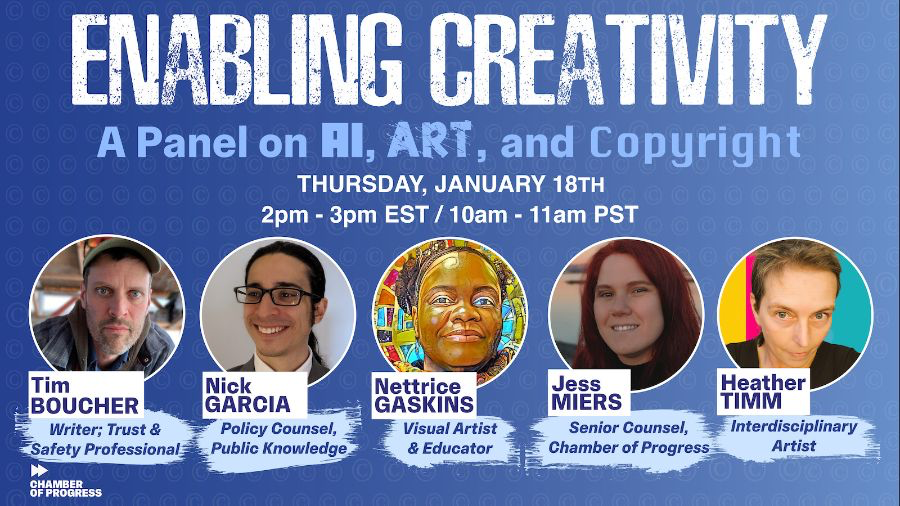
Upcoming AI Creativity & Copyright Webinar with Chamber of Progress

I’ll be participating in what promises to be an interesting conversation on AI, Art, Creativity, & Copyright – from the perspective of three artists and two lawyers from non-profit organizations Chamber of Progress and Public Knowledge.

You can register here to watch live. The call will take place Jan 18, 2024 02:00 PM ET.

Official event description:

As the US Copyright Office (USCO) considers public comment on copyright law and generative AI, join Chamber of Progress on Thursday, January 18th at 2pm ET for a conversation on AI’s impact on the creative economy. Legal experts and artists utilizing AI in their work will discuss issues related to generative AI’s applications, copyright law’s relationship to artistic style, and laws and emerging norms around opt in and opt out models for AI training.

See also the below for more of my detailed thoughts on this topic:

Page 33 of 205

Powered by WordPress & Theme by Anders Norén