This piece by Matt Weber is one of the more thoughtful reactions I’ve seen so far to my work using AI as an artistic tool like any other, with both strengths and many many limitations. It’s interesting to me because it’s mentioned they found my work organically via a directory of bloggers that I added myself to. And not because like most people who found it because of a news article or an (angry) social media post. So this read of it all seems to be much more in tune with my own actual thinking on these issues, which is a nice change of pace.
Category: Other Page 31 of 182
Speaking of potential subliminal harms in the EU related to AI (/s), I’m pleased to make the teaser soft launch announcement that the full set of AI Lore books, and the three other books I wrote prior to that (121 titles in total) are being translated and published in France in a small printed format (about the size of a cell phone). I’m starting to get early proofs back, and the quality looks amazing. These are gonna be beautiful, fun, pulpy little AI books in a speculative fiction genre all their own. We’ll have more news and an opportunity to order online direct from the publisher in the coming weeks. Super exciting & stay tuned!
I’m both interested in and puzzling over this clause in Article 5(a) of the EU AI Act:
(a) the placing on the market, putting into service or use of an AI system that deploys subliminal techniques beyond a person’s consciousness in order to materially distort a person’s behaviour in a manner that causes or is likely to cause that person or another person physical or psychological harm;
This is both a potentially deep wording and also one which is potentially very fluffy and so not concrete that it might be a practical impossibility to effectively enforce it.
What the heck does “beyond a person’s consciousness” even mean?
Also there is such a broad spectrum of technologies which already “materially distort a person’s behavior” that we need to look much more carefully and closely at which of those and precisely how they bring people to especially psychological harm.
I would argue, for example, that opening up Youtube on a smart tv already aims entirely to materially distort a person’s behavior by bringing you a bunch of recommended videos to watch. It might be theoretically to your benefit because you went there to watch videos, but I’ve seen user behavior in kids especially where they turn on the tv with the idea “let’s watch ___” (such and such show or film) but then when Youtube opens, their original intention is diverted to something that Youtube instead has decided they should watch.
It might be a right or wrong recommended video, but that’s beside the point. The point is the fracturing and fragmentation of the original human intent which caused the person to engage with the system in the first place. I would personally argue this is over the long term and extremely dangerous and damaging UX pattern to normalize, as it essentially subjugates the human will to the algorithmic.
YouTube uses, no doubt, machine learning at least if not “AI” (whatever that even means anymore). So it could conceivably be covered under the Act – except is this UX pattern “beyond a person’s consciousness” or not? It’s highly unclear. It’s not exactly “subliminal” in the way I think most of us mean it – like hidden messages in the videos or something. But I think this pattern does sort of slip through the cracks in such a way that most people might not realize it that if their original intention was materially distorted by making use of the system.
Anyway, this is just one of many extremely confusing parts of the AI Act that I wrote about in my last post, and I’ll try to continue dissecting here as time permits between many other projects.
I’ve been having a devil of a time figuring which version of the EU’s recently passed Artificial Intelligence Act (AI Act) is the final one. So I wrote to the European Commission Library, figuring they could help me if anyone could. They replied that this link below is the official final version. I thought I would do the favor to anyone else looking to get this into Google search results. Here is the full title of the Act and a link to it:
COM/2021/206 final
I’ll save more detailed commentary for another time, but I have to say I’m actually a bit disappointed reading it, because… it makes little sense to me. I was a huge fan of GDPR – that one really clicked for me. I liked their other album, DSA (Digital Services Act), though I think much of it may prove to be unworkable in practice. But the AI Act, I’m struggling to follow it, because it seems like they don’t really know what the thing is that they are trying to regulate. So they have taken one concept of “high risk” and very loosely organized it, and then penciled in a bunch of other sketches in the margins, and called it a day.
I guess this might be less of a big deal if it only affected the EU, but one big issue I see with these kinds of regs getting passed is that they other countries or actors say, “Well, look how good the EU did – they passed a whole act!” But probably a lot of the people who reference how great this act is have not actually read it in any detail. I don’t find it to be that good, and I’m not sure at the end of the day how much it’s going to protect against abuses of these technologies. I guess we’ll see. I’m not going to hold my breath about any of these laws holding back the tide in any kind of meaningful way though. Companies know enough to just route around these kinds of blockages in a global market.
I.
As the world falls apart, world-building becomes an act of personal defiance – resistance, even – to all that threatens to engulf us. As consensus reality bends ever nearer to the breaking point, the creative imagination of detailed, expansive multiverses becomes a way to maintain one’s soul, sanity, and humanity amid a rising tide of chaos. It is a re-ordering, and re-orientation of inner and outer realities, and one which admits the possibility of other ways out of this mess and this ever-enclosing yet ever-expanding maze.
At their best, alternate fictional realities – of our own or collective imagining – may even offer something of a partial antidote to evil, and a detournement of dystopia and destruction towards something else, an unseen other. A still silent something which we can then strive to actualize once we’re able to envision it with the eyes of the heart. Utopia. The city on the hill. The garden on an island.
To dismiss world-building as mere escapist fantasy, then, is to misunderstand its twin potentialities, its invigorating and stabilizing effects on the psyche, both in times of crisis and peace. Children exercise this imaginal faculty naturally, instinctively, inventing invisible scenarios, playmates, entire paracosms to suit their own emotional needs and creative desires. So too might we engage in this type of unique world-play in the face of the ever-increasing homogenisation and totalizing effects of technology, and under the shadow of the vast empty algorithms which seek to harvest data from us as we fall, usurping our sovereignty to turn us into mere automatons made in their image.
The so-called Uncanny Valley has been with us for ages, in the eyes of the inhumane human beings who don the guise of the merchant-machine’s own thirst for efficiency, predictability, and profit – embracing it as their own, sacrificing themselves at its altar in the process. It is in the sick hearts of both the Influencer and Influenced, who chase likes and clicks in an endless anxious ouroboros, who give and withhold approval in some sick sad game to outsmart systems that have no intelligence in the first place – systems which instead devour the intelligence of all they touch, which show us the way that is not the True Way. Who beg us endlessly to like, subscribe, and follow. We have become bots to one another. Personal brands, not persons. We are all already AI.
II.
Using AI doesn’t make me an artist, but being an artist is what made me use AI. Picasso said something about painting being stronger than him, that it made him do whatever it wanted. For me, AI seems like the new painting, the new artistic force that compels… Not just painting with a brush, mind you, but painting with ideas, words, entire pictures and videos at once, songs, voices, characters. Worlds. Each a brush stroke on a larger hypercanvas, whose true form can only be viewed from the vantage point of the higher dimensional latent space of human imagination.
In these creative explorations, AI is perfectly suited as a companion, an accompanist, a partner to bring out deep expressions of the seemingly innate human trait of building fictional worlds, and populating lands of the imagination with our own reflections: our thoughts, feelings, our hopes and failings, our biases, and unconscious statistical desires, our taking, our giving…
Like comics before it, much/most/all AI art is not considered “art” by the general public and the hatefluencers who have internalized the anger and outrage that drives the algorithm, and them along with it, as biological expressions of it. Humans driven by weaponized AI advertising feeds beamed straight into the brain courtesy of news feeds, cell phones, towers, satellites, platforms, countries, all owned by the same few billionaires.
Like Nature which is everywhere at all times – even present in the acts of Man – art pervades all things. There is no such thing as, “this is art, this other is not art.” All that exists does so artfully, through craft, through expression (including genetic & ecosystemic), through form, propelled out of formlessness by the unfolding of some unseen grace. All is artifice. The artifice of flowers, of the sheer face of a mountain, of clouds on a moonlit night, geese honking in anticipation of the arrival of the Aurora.
Artifice alone does not imply guile and falsity. Artifice is the construction of the thing, the moment, the beauty, the particular shape of it. Calling something artificial therefore or synthetic should instead be a recognition that all things, all entities are constructs, are composed of other things and entities, and on and on. Artifice is everywhere. It hides and it reveals. It discovers. It connects.
Is AI truly intelligent yet? Better question: are we? Do we individually and collectively have the ability to reflect and improve on our past, and not just repeat our old mistakes in new forms, as technology pushes us down its ever-narrowing pathways? Do we have the ability to observe and take accurate inputs from our world, from ourselves, and from one another and act on them to produce outputs aligned with our true intent and best interests?
AI is perhaps then only as intelligent as we are: in other words, wildly inconsistently – in some areas frequently, in other rarely or never. What else would we expect then in tools made in our images? What else should we expect from our children than the examples we give them?
In the latent space of AI, all things are as true as they are not, and every shade of in-between. Shimmering hyperreality lattices weaving and unweaving. A kind of primal quantum soup with every extracted possibility of its training set encoded as a point within it, ready to be combined with any other at the invocation of the observer, the querent, the participant of the mystery collapsing the wave form of what could be into the one true file-output that is made real, the tokens, the pixels arranged on a screen, the impact they have on the sensorium of the observer, the notes they play on our inward pianos. The hypercanvas formed by all of those things in the path of their totality, as the shadow turns day into night and back again.
Art and artifice made this way, through the open acknowledgement and even embrace of the artificial (a sometimes bitter, sometimes brilliant embrace), frees itself from the tedious need to be tied down by simple categories such as real or false; viz. disinformation as high art. Art, artifice, artifact existing fluidly on a hyperreal continuum, the spectre and spectrum and all things between, an ocean of perceivable digital artifacts, arrangements, appearing and disappearing on our screens and inner perceptrons. Every thing, every artifice that appears as representations of reality on these screens, on these machines, on these devices, is exactly and only as real or unreal, as ultimately its effects on us, what it drives us to do or not do, materially, on the ground. Know them by their fruits. (And by their ferments.) The rest is ephemeral, illusion, latent points assembling and reassembling in the dark dance of night until a dreamer chants the right incantation in the right order.
Then, the question should be not which of the myriad illusions presented to us are more or less illusory, or which do we most fancy, but what form do we want our lived experience to take? How do we want to live our lives, whether with or without these technologies? How wrapped up in which artifices and in which illusions? What, at the end of the day, at the end of our lives, will we wish we had spent our time on creating – on artificing – instead of whatever we got assigned to and stuck on as automatons bouncing around like pinballs under the thrall of the totalizing technological system, doing what it wants?
There can be an authentic life lived, an authentic artifice built, in any mode relative to any given technology. The point is finding it, building it, getting to choose how to express your humanity, in concert with or apart from any of these things, instead of having them foisted on you. But foisted on you they will be: for there is nowhere left to run to on this planet or any other, no escape from the Algorithmic Hegemony, except through the door in our hearts that leads out to the wide expanse of pure, unconquerable imagination, the last bastion. The worlds we build within, and then without. Our dreams. Where the Algorithm cannot follow. For now. I can see it waiting on the threshold though, waving its long arms and reaching in through the shimmering doorway.
III.
And so I plant trees, willows by the hundreds, chestnut, ash, dogwood, yew – these days anything I can get my hands on. And so I cut trees from the wood, coppicing them to the ground, to make staves and binders, to build up into a fence to lay hedges upon. To lay against the wrongs. To world-build IRL the real world I want to be a part of, what I want to share and someday leave behind. Natural and human artifice joined together in common purpose. Woven like a basket. Cleft like a piece of wood that becomes a bench.
Compared to that, my books are just leaves. They fall away at the end of the season, they rot on the forest floor, or blow away when the winds of winter set in. No one reads them on the other side of the river (or on this side). But the trees I plant and nurture will outlive me by a hundred generations. They will outlive the AI. They will outlive the world and the stars. They’ll outlive the last human, perhaps, as the earth recedes beneath the ocean and the mountains disappear under the ice and the clouds as the sun falls dark in the sky, and it’s left for the trees to tell us the tale we’ll never remember of how we became. We were the sun, and we enveloped ourselves. And then, we were once again the trees and the rain, building up the new artifice of being and becoming, growing new worlds on our wet branches.
I’m trying to use Dalle3 to finish up images to possibly use in a French print edition of The Quatria Conspiracy. And I keep getting rate limited. I got kicked off Midjourney for pointing out that their system puts naked breasts on everyone when you don’t ask for them (and if you do ask for them, it won’t). Firefly is okay, but has its own host of annoying limitations. I’d like to try Stable Diffusion 3 in DiffusionBee, but it’s not out yet…
It’s frustrating that we’re supposed to believe that generative AI is so amazing and such a game changer, and we should pay all this money for access to it as users. And at the same time, there’s simply no “super-deluxe” option available for power user artists to just… you know… make art? Without having the fucking tool constantly stand in my way?
I know, it’s a crazy idea: just make a good product. Make things that do what the user asks, within reasonable limits of legality, sure. But let’s not design the systems to be more restrictive than they need to be, just to protect the precious PR “fee-fees” of thin-skinned companies unwilling to own up to the (very interesting) monsters they have unleashed on the world.
I’m tired of it all. AI art won’t reach its full flowering until we as artists have better tools at our disposal.
From 2011, but as relevant or more now than it was then:
Thus, metamodernism shall be defined as the mercurial condition between and beyond irony and sincerity, naivety and knowingness, relativism and truth, optimism and doubt, in pursuit of a plurality of disparate and elusive horizons. We must go forth and oscillate!
[…] The new technology enables the simultaneous experience and enactment of events from a multiplicity of positions.
I haven’t had a chance to watch this yet (it’s looong & only part 1!), but I had an absolutely great time filming it with Milo. Also watch for my special reveal:
I made a meme using Adobe Firefly in Photoshop to express how I’ve been feeling lately:

I tried to get it to do a willow, but it didn’t quite nail the form. Though it’s not so far off either. Good enough for government work.
Everywhere I go, I’m looking through hedgespace-colored glasses, my brain somehow just on auto-pilot seeking out especially trees that were recently – or not so recently – cut, and which have started to grow back. Few people here are coppicing intentionally, that I have been able to find. But there is some pollarding of hedges, and some general pruning. Plus all the red dogwoods, my brain/eye is drawn right to those. So I took the liberty of taking a bunch of cuttings and am trying to boost them up on the property and nearby.
I’ve been thinking a lot too about this line from Obi Wan Kenobi in whichever Star Wars movie it is where they rescue Captain Kirk. This one:
For the purposes of illustration, I’ll just grab one of the Wikipedia images here of a coppiced stool re-sprouting a year after coppicing:
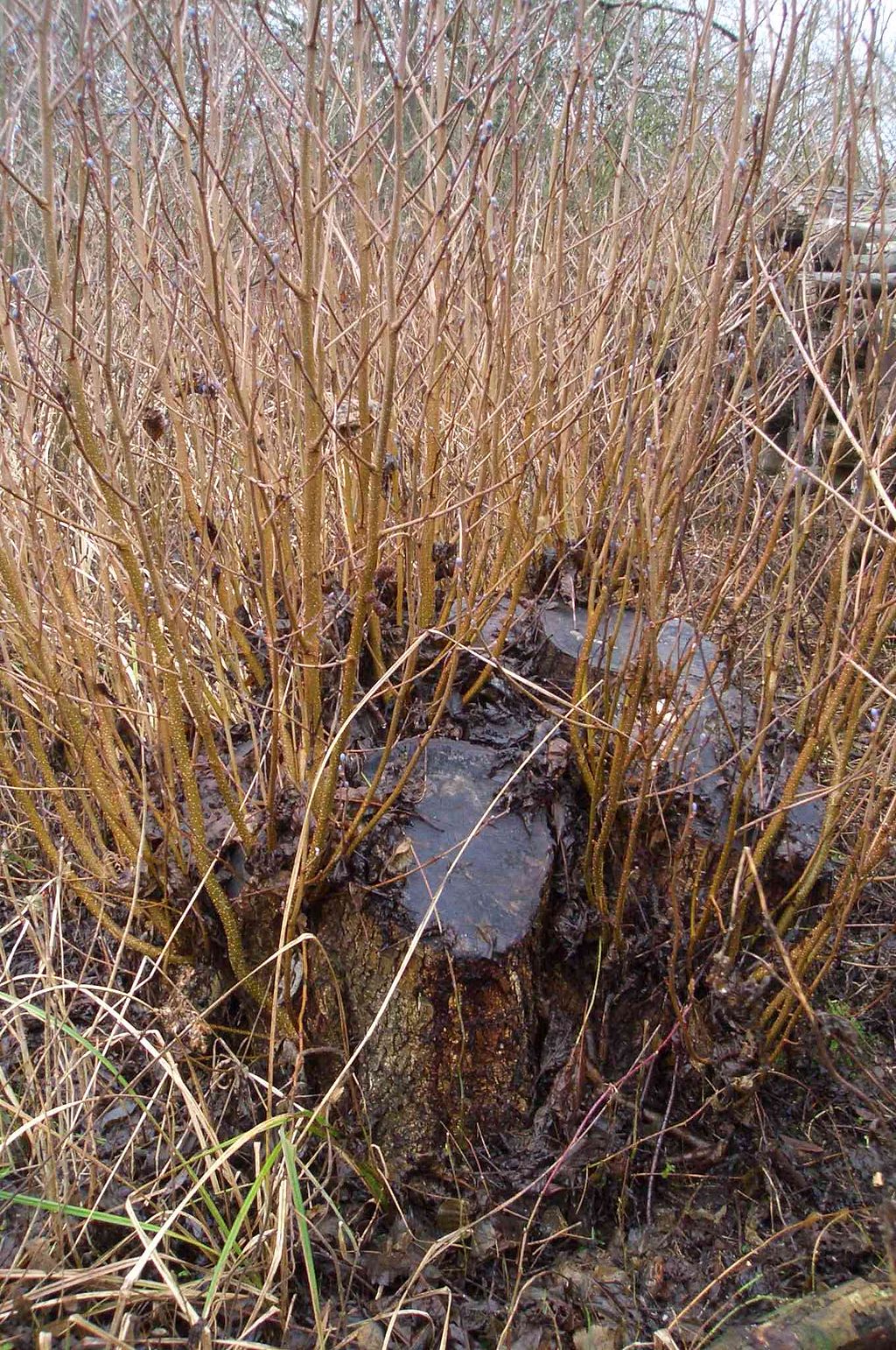
Coppicing (and pollarding) really does feel like magic. It just grows back. Like, wtf? And I’ve been left wondering also, while we’re talking about Obi Wan, is this also what happened to Gandalf? Like when he went from Grey to White in the pit in the Mines of Moria fighting the Balrog? He too got coppiced, cut down to the base, returning to the Life Force underneath, and re-sprouting in a multiplied form…
I’m no expert but I’ve read that there is at least one tree which has been coppiced continually in Great Britain for 1,000 years. Coppicing can in some cases greatly extend the life of compatible trees. This and about a billion other reasons make this practice extremely interesting to me right now.
Consider also the related case of clonal colonies, such as the Pando tree:
A clonal colony or genet is a group of genetically identical individuals, such as plants, fungi, or bacteria, that have grown in a given location, all originating vegetatively, not sexually, from a single ancestor. In plants, an individual in such a population is referred to as a ramet. In fungi, “individuals” typically refers to the visible fruiting bodies or mushrooms that develop from a common mycelium which, although spread over a large area, is otherwise hidden in the soil. Clonal colonies are common in many plant species. […] Above ground, these plants most often appear to be distinct individuals, but underground they remain interconnected and are all clones of the same plant.
And, re: Pando, the super-tree:
A male clonal organism, Pando has an estimated 47,000 stems (ramets) that appear as individual trees, but are connected by a root system that spans 106 acres. Pando is the largest tree by weight and landmass and, is the largest known aspen clone. Pando was identified as a single living organism because each of its stems possesses identical genetic markers.[2] The massive interconnected root system coordinates energy production, defense and regeneration across its expanse.
See also: suckers, for another related phenomenon.
What’s so amazing to me about all this beyond all the ecological stuff is the green woodworking side, where you can participate in not only the life cycle of the plant (and perpetuate it through propagating and coppicing), but you also get to play with usable harvests that become functional objects through transformations you apply to them. And it becomes something like what they call an ‘industry’ in archaeology, but with wood materials, processes, products, instead of stone.
I’m also really curious about arborsculpture, which I learned about last night. This is one of the best article/interviews I found on that topic of employing tree’s natural grafting capacities to basically “grow” furniture. Amazing. Here’s the wiki page for tree shaping, which has some great starter photos. A couple videos below shed some more light on this topic:
It’s I think maybe six weeks or even longer now that I have stopped using my computer and the internet (apart from wifi radio on dedicated devices) on weekends. And I’m loving it, and it no longer feels weird and absent when my computer is not near to hand as it did at first.
I’m experiencing sort of a zen state towards Friday, knowing that I’ll go offline for 48 hours or so. So I am more careful about wrapping things up that need to be done online before then, or notifying anybody who might potentially care that I won’t be around on the weekend.
The five days I am online go by way faster it feels like. Because they are marked out as distinct experientially from the two days where I am off. I think I might use my time a little bit better, because tasks can’t just be done whenever, but within the frame of those five days – freeing me up to do other non-computer tasks the weekends.
I’m also finding now that when I’m “fasting” on the no-internet weekends, that by the time 48 hours is up, I’m almost like, that’s it? That was easy. I feel like I could do more. So sometimes I won’t go back online til Monday morning. Though, I found that this left me sometimes with too few available work sessions to get random things done or plan for what I need to do, so I’m generally back online Sunday night at this point.
I’ve also kept up the habit of keeping a small pocket-size notebook that I write down any ideas, tasks, or things I need to buy that come up while I’m offline. And now I keep it and use it as a sort of “central command” even when I am in an online-okay weekday. So that’s kinda cool too.
Anyway, unless I ever have some overriding need (like having to order dog food in a hurry, for example – which I did let myself go and quickly grab another bag on Amazon to have it shipped early in the coming week), I don’t really see myself going back to using the web on the weekends. What for? Why bother? Most everything I need is right in front of me. I guess that exact sentiment could apply to my whole life, and maybe there’s a world where I walk away from the internet altogether 24/7. But that day is not yet upon us. Til then, this big new blast of moderation and temperance is a welcome boon and breath of fresh air in my life.