Questionable content, possibly linked

Category: Other Page 131 of 177

The Place Below

They slept in that cavity below the ground for how long none of them could say after. They awoke to a somewhat less than total blackness. A little ways off, Benda saw a soft blue light almost as if dancing. A silhouette of a golek passed in front of it, hiding the glowing forms. Machef.

His familiar voice filled their minds with warmth when they felt his words form in the hearing of their hearts. “This way,” he said.

At once, they were roused and scampering off behind him as a group. Benda’s eyes adjusted to the gloom, and could make out the grey hues of a tunnel. His hand touched the wall as they passed within. Earth, and rock, and root, lit on occasion with tiny dappled glimpses of maybe daylight, Benda mused, perhaps indirect and refracted issuing forth from possibly fissures on the surface through many blind passages here below. They must not yet be too deep — and Benda’s fear stirred a little. Did the sunlight carry the rays of the eyes of the Watcher Above?

“Fear not,” Machef’s voice assured them. “His eyes are keen, but his understanding does not penetrate the depths.”

They went on a while longer in silence. Not out of fear, but each lost in their own deep pondering.

After a time, Eradus broke the silence.

“I see, at times, or I think I see — perhaps I feel — some strange small lights of different colors. Sometimes blue, and sometimes white. Others yellow. They seem almost familiar. Pray tell, what lights and powers there be who flit about these halls and palaces of the Place Below?”

“Let’s go a little further,” Machef said. “And your sight and understanding will come together.”

They passed a while longer, countless, unnumbered minutes as the dimly lit tunnel sloped down, or curved to one direction, and then down another. At last the tunnel terminated at a wall of stone with a natural threshold, and a door of solid, ancient wood.

“Go ahead,” Machef said. “Knock.”

Eradus stepped up, and rapped on the door three times. They waited. The door swung silently open, and one by one they passed through. They saw no porter, guard, nor attendant. The door closed again behind them.

They looked around. They were in a luminous cavern, carved into a hall with columns and decorative arches. On the walls were murals set in tile, depicting lush gardens, fruits, leaves, and grasses of all manner in sweet marvelous abundance. Scattered here and there within the murals were birds flitting about happily, and on and above the ground, dancing, prancing figures with long bodies of white.

“Rabbits!” Eradus exclaimed. He pointed off to the many tunnel openings which were scattered around the walls. “We’re in a giant warren!”

“You are correct,” said Machef. “This is one of many such hubs built in ages past by the ancient Lagom peoples at the height of their civilization.”

“Which way leads home?” Benda said.

“These tunnels have fallen into disuse,” said Machef. “And the way is bent, but not broken. But for I, and a few others of my people who remember still the passage ways down here, few from the world above now visit the Place Below. And even I do not know more than a few of these vast tunnels. But as the intuition of the King of the Forest rightly spotted, there are other powers now who dwell here down below.”

“The white lights still can be seen to scamper throughout these tunnels, and sometimes on starlit nights in fields of the world above. They are the rabbits in the murals, the Lagoms. The murals depict what we call in our language still Allfruits, or the Place of Dappled Summer Light.”

“And the blue lights?” asked Benda. “I saw them too when we first awoke in the cavity.”

Machef replied, “The Lagoms might have built these walls and arches, and painted these murals. But the tunnels are much, much older, going back to the dawn of time, or perhaps before. To the Zalthyrmians. Who themselves, legends say, only discovered them. And, of course, systematically explored them thenceforth.”

“The blue lights are their language. Their language is their heritage, which they bequeathed to the Place Below, though their domain crossed many, many realms. Their heritage is tangible and visible at times, as in that cavity, or flitting about the tunnel. The words describe the place, and are written in the place. If you have eyes to see and ears to hear and heart to understand, you can read and speak the language. The language gives us light in the dark places. As we speak the language, so can we pass through the places bodily, but we beings must bring our bodies along too, for that is our nature. The Zalthyrmians, when they left, according to their nature, passed into their language as light. This was only after they had explored completely all worlds, and encoded in each place their findings and the peculiar beauties they had there partaken of as witnesses.”

“They say the Zalthyrmian tunnels, at times, go along the veins of the Great Vine itself, from whence each ensuing world as fruit is born.”

“And the yellow?” asked Eradus.

“Gobs,” said Machef. “But we will see them soon enough, of that there is no doubt. Let us not speak of it til then. Now, Benda, is the time to find the way home.”

“How?”

“The Zalthyrmian language.”

“I do not know it.”

“Speak your destination aloud,” Machef said.

Cannaxus,” asserted Benda firmly.

“Use your desire…” pushed Machef.

Benda closed his eyes and inhaled deeply.

Home,” he said aloud.

A faint blue light appeared before a tunnel off to the right, and Benda began walking toward it. Machef stopped him, directing silently his eyes to another tunnel, which now had a blue light hovering by it, and another, and another.

“What manner of trickery is this?” Eradus said. “I thought you said — ”

“Hush,” intoned the voice of Machef in their hearts. “Many roads lead to many homes. Focus on the best of what resides in yours to find your doorway thither.”

Benda’s silence lasted only a moment, turning to joy as his heart fixed on the last image he saw before leaving home for the ill-fated fishing trip which lead him through such long roads over sea and under tunnel: his wife holding their infant son in the arch of the door to their small house, waving goodbye.

Luala,” he said sweetly aloud.

Sol.”

At once the disparate soft blue lights converged onto a single tunnel opening, just right of center.

“Come,” Machef said, and they all followed after him, crossing the great hall beneath the murals to the tunnel opening. “You have found the way. Let us go.”

The Delving

At darkfall, the sable golek named Machef brought the small band of wayfarers to a hidden place by the edge of the forest. The moon had not yet risen, and Benda’s eyes could make out nearly nothing beyond his nearby companions, who were all huddled close, peering out of the forest across the dark plain, in the direction of the mountains.

“When I give the signal,” Machef’s voice sounded in their minds, “Follow me, and make no sound.”

Eradus tugged on the sleeve of Benda, who had been intently peering into the gloom. He signaled to him to pull up his cloak and hood completely over himself, as he had done. They wore Cloaks of Becoming from the ancestral treasures of the Drynarean Forest. Though in full light of day, the eyes of an eagle or magician (no less the two combined in one person) might perceive, just so, the blurred edges of the cloak-bearer in motion, it drastically reduced their chance of discovery by dark of night. Benda pulled the hood up over his head, and arrayed the cloak around his shoulders and arms.

Dema made a slight nervous whuffing noise once, and was silent. They waited a breath or two longer, and Machef — whose ears had been forward listening flattened them back behind his head — thrust his neck out, and lunged forward without a sound. Dema and Selef followed immediately behind, and Benda followed after Eradus, whose form became all but invisible once he passed beyond arms length. Benda fixed his gaze on the edge of white underside of the tail of Dema, which hung low as they tiptoed silently out of the tree cover.

Several breathless minutes passed, and the gloom of night settling in for earnest gave way to stars bursting forth, and the sky lightening enough that Benda could easily make out the three goleks. The form of Eradus, though, was all but hidden from his view, except when his friend turned once and lifted slightly his hood at Benda and smiled, like a smile coming out of a crack in the darkness.

At once, Machef was leading them down a slight dip in the meadow, which seemed to deepen ever so slightly. They rounded a subtle bend, and Benda’s eyes could just make out a rocky cleft, which had been wholly invisible from the plain above, across which they had traveled.

They all froze suddenly when they heard a “hoo-hoo” from somewhere not far off in the night. An owl.

“Run!” Machef’s voice spoke urgently in their minds. “ Now!”

The goleks sprinted off ahead, being naturally faster and more suited to such terrain than the two men who trailed after them as best they could. But it was a short sprint, after all, ending by an earthen wall where they halted. Machef searched around, sniffing close to the ground, and within a moment, the three goleks were rapidly digging at a spot indicated by Machef. In another few seconds, there was a hole large enough for one to pass. Dema and Selef bolted in. Machef nodded to the two men, who he let follow after the goleks into the hole, himself bringing up the rear.

As they passed below, Benda’s searching hands in the darkness felt the edge of smooth cut stones. He traced upward along the edge, and realized what it must be.

“An arch!” he whispered.

No one replied. If any of the others reacted to him, he didn’t see it. They moved through the arch into a more spacious cavity within.

Benda heard the goleks shuffling back past him, and Machef said in their minds, “They will close the hole again from within. The eyes of the Watcher Above cannot see us here, but there may be others who can.”

“Here?” Benda whispered. “Where is here?”

Machef replied, “The Place Below.”

Raisla

Benda and Eradus greeted the goleks with joy. Though it had only been a few days since they had parted, there on the Plain of Edeb, it seemed to Benda as though it had been lifetimes. In some sense, it had. Apart from a few lost moments of the storms-at-sea which brought him bodily into and out of that other land, his memory seemed almost fully recovered now. He could recall his full trip to Quatria, and his life before.

Dema and Selef nuzzled Benda and Eradus fondly, and spoke in their soft language, of which Benda had not yet developed comprehension.

“They say their kings have come back to them,” Eradus translated, laughing.

Benda looked at the wise face of the sable golek, Machef, and said to him — quite certain he could understand human speech — “The Old Man above sends his warmest regards.”

Machef bowed his head low, in recognition.

“Come,” a deep voice resounded in Benda’s mind. But no words had been spoken aloud by those present.

“Who?” Benda said. “Where?”

Machef turned his head, indicating the way back they had come. “There is little time,” the voice said.

“You!” said Benda. He looked at Eradus, who was smiling, and seemed unsurprised. Though Benda’s memory had returned, he had never encountered a mindspeaker before. Eradus, evidently, had.

“Let’s go,” Eradus said, mounting Selef. “He’s right. We can talk later.”

Benda, likewise, mounted Dema, and the three goleks set off at a run as the sun rose.

Far above, though they did not see it (Benda felt it, almost as though it were an itching in his mind), a lone eagle watched their progress across the plain, back toward the Arches of Passing. It was the only escape route from the island, and there was no question they would use it to pass back to the mainland of Kremel. From there, the eagle knew, the travelers would have to pass back through his country on their way south. And in that place, his power was greatest. Their capture was all but certain.

When they arrived at the Arch, Machef turned his gaze skyward, but said nothing. Benda sensed the presence, but did not speak either. Eradus and Selef passed back through the Arch first, and Benda with Dema followed close behind. Machef brought up the rear.

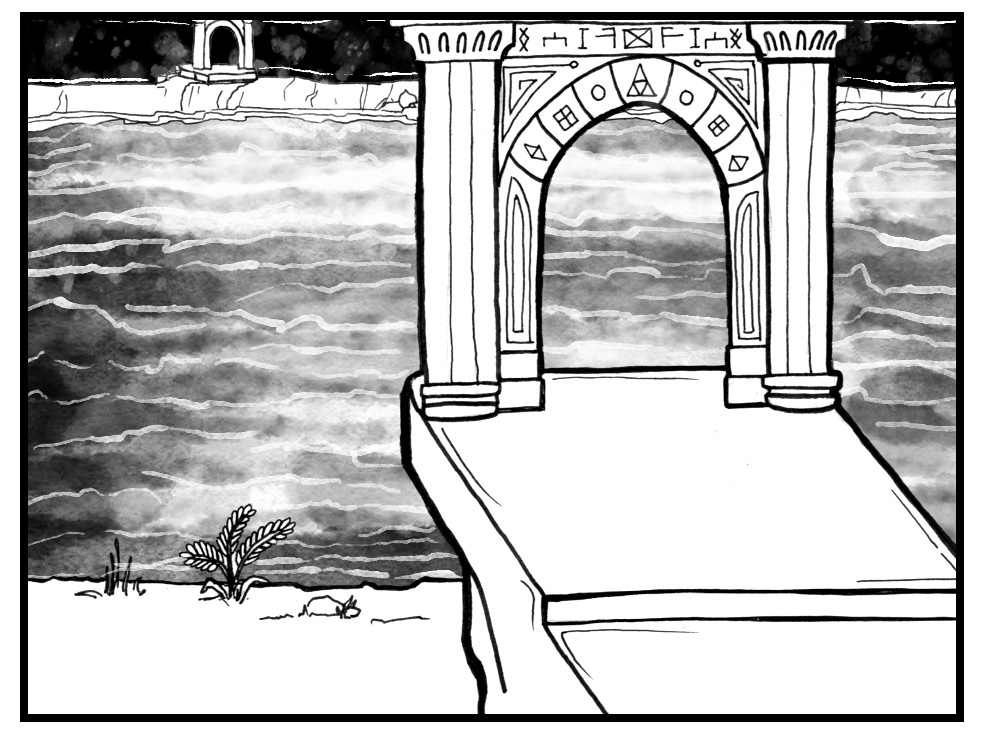
When they landed, all of a sudden, there was a flash of great wings which seemed for an instant to cover up the sun. They startled, and Eradus made to draw his sword. But instead of great talons unfurled to strike, they saw the curved neck, stilt legs, and wide wings of a great heron, which landed silently on the water’s edge down below the platform of the Arch. They watched it for a moment, transfixed, as it waded there. It’s head struck down into the water suddenly, and up with it came a tiny fish, which it gobbled without comment.

Machef said, his voice booming softly in their minds, “Any other creature but she would be killed in the Electric River. She alone, with her purity, can wade in it. Let us be off.”

And with a leap, the sable golek left the platform and bounded ahead of the others, taking the lead. Dema bearing Benda followed, with Eradus and Selef in the rear. They ran for many long hours. Not toward the Castle of Edebia, and the Fourth King (who had sent them on the errand to the Cloud Spire in the first place), but into the wooded hills west of there. They traveled, where they could, under the shadow of the trees, trusting that the eyes of the eagle would have a harder time penetrating into that foliage, to track their progress. Where the foliage thinned out, they made hard runs, using trees as relays, and kept always a jagged, unpredictable course.

And still the eagle tracked them silently over-head. When it would lose them in thick growth, its great height and vantage point would again eventually find them. It knew it was only a matter of time.

Goleks, especially when they know that they are being hunted, do not relish being out in the open. Countless generations of domestication have enabled them to overcome — for the most part — their innate fear of being without cover (or their utility to their human partners would be limited). But in the deepest, wildest part of their minds, when true fear or terror struck them, they would always seek out the nearest burrow or cover they could find. Machef, however, was different. On the Isle of Edeb, where his people lived for centuries or perhaps millenia before it collided with the Kremellian peninsula, there were no natural predators. As a result (and partly on account of their size, which significantly exceeded that of their mainland cousins), the sable goleks were remarkably courageous, and Machef — a warrior — especially so.

Throughout their flight, though Dema and Selef grew tired, and at times, the natural edge of their fear crept in close to them, Machef called out to them in the soft language of the goleks, which they all shared, despite their geographically diverse roots. He spoke as if in song, and Benda could sense that when they heard him thus, they were able to put away their fear for a while longer, and pass through their fatigue to run a while longer. Benda knew this, for he too felt the same on hearing it.

Otherwise though, they did not make conversation among themselves. Eradus, who had seemingly fully recovered by now from his excesses of the night before, rode with expertise on the back of Selef. Benda, however, did his best to remain astride, due to his much more limited experience riding goleks. Dema was understanding and gentle though, and never let him fall, always adjusting herself carefully if he were coming close to a tumble. Benda thanked her for this repeatedly, patting and stroking her neck as they flew through the woods and brushlands, and ever deeper into the hills.

It was late in the afternoon before Machef brought them to a halt in a deep, dark copse in the heart of a maze of trees and alleys. They had not seen the sun, or much of the sky for close to an hour, Benda reckoned. Machef inclined his head for them to dismount, and they did so.

Everyone was exhausted, except for perhaps Machef, whom Benda noted, appeared to show no signs of fatigue.

“Machef,” Benda asked. Machef gave him a sharp look, as if to hush him. And Benda continued only in a much lower whisper, “Why?” he said. “Why do you help us so?”

“Raisla,” whispered Eradus, coming close.

Machef nodded, silently.

“To Dema and Selef, we are raisla. As is Machef to them.”

“One family,” spoke Machef, in his deep silent voice, which they heard not with their ears, but in their minds or hearts.

“It is so,” he said. “Now rest. At dark, we go to the Place Below.” And so they ate and drank a little, and napped fitfully under the dark boughs of the trees, and the eagle could not see them, and knew not their precise location, but was certain he would catch them, no matter where they came out into view again, on their way over the mountains and into Holmat.

The Method of the Threshold

The Method of the Threshold of the Hypogeum, is an ancient and curious practice frequently referenced throughout Quatrian myth and literature.

The method is said to be a liminal technique using the imagination to access and explore extra-sensory information about a subject. It draws from, is akin to, and supplements practices and experiential states such as meditation, artistic creation, visualization, intuition, active imagination, fantasy, and hypnagogia.

The method is not itself concerned with interpreting, defining, or judging the meaning, origin, or reality-status of the images or experiences one might encounter while experimenting with the technique. It is suggested instead that the effectiveness of the method is actually enhanced by temporarily putting those types of questions or determinations aside (e.g., suspension of disbelief) during the practice itself, and simply accepting the validity of personal internal states perceived as ‘experientially real’ in the moment.

Though the method may be undertaken in a religious or spiritual context, there was no such concept in Ancient Quatrian culture. Though their cosmology spoke of many over-lapping worlds, their language made at no point in their long history any distinction between the “real world” and the so-called “spirit world.” Thus, discussion of method-induced liminal experiences in such terms is avoided herein, as alien to the original intent.


The Technique

Whereas meditation typically involves emptying one’s conscious mind, and emphasizes not clinging to the images or thoughts encountered in one’s inward awareness, the method proposes there may be value in taking an opposite approach to the imaginal world.

According to the Quatrian cosmological world-view, in which visionary experience played a central part, what is perceived via the outward sense organs may have equal experiential validity or potency to the perceiver as what may be experienced inwardly through the processes and landscapes of fantasy, imagination, intuition, projection, or even hallucination. A dream, for instance, of meeting a deceased ancestor was considered equivalent in importance to waking conversations with the living.

The Bidden Image & The Threshold

Though there are a range of specific components which comprise the overall method, which will be described in more detail in later chapters, there are two common elements to all (or most), called herein the Bidden and Unbidden Images, of which the former shall be treated first.

The Bidden Image is most akin to a kind of inward visualization. The practitioner holds before their mind’s eye an image of some kind of threshold, as in a door, or window, or the passage into an ornately decorated stone temple such as the Hypogeum itself. The threshold, or Bidden Image, chosen may be unique to a practitioner, or might be shared amongst members of a family, tribe, sect, or cult.

As Edwin Palmer’s pivotal 1908 text on the topic reads:

“The Cuatrian would lie on his back and picture an Opening to a Dark place. Each person’s entrance was different; Chiara herself envisioned a cave, but the imagining could be a temple, a closet, a ‘fairy house,’ or a fountain. As long as the opening leads below the surface of the world, it is acceptable.”

The Unbidden Images

Though Palmer famously described other optional components to the ritual, such as the hearing of a ringing sound in the ears, or use of an inwardly repeated word, or ‘mantra,’ they are considered by most serious Quatrian scholars today as secondary to the central experience of the images themselves.

Following the initial invocation of the Bidden Image, the practitioner should subsequently attempt to “open” or “pass through” the inwardly visualized threshold to the “other side,” and “see what happens.”

Great emphasis is placed in Quatrian culture on the virtues of patience. It is said that successful practice of the method required it first and foremost. There was a term in Ancient Quatrian, “Dagdanna Dorin,” the translation of which, by later Pentarc mythographers, as “courting inspiration,” is the most common. The literal meaning, however, is, “The Stones Wish.” Taken poetically, one might consider the slow, imperceptibly moving pace of life lived on a geological time-scale, as perceived from the point of view of the animate or sentient stones themselves, and the patience with which they might make and wait for the fulfillment of a wish.

Therefore, with the patience of a stone, once the practitioner has passed through the threshold, they must wait for the arrival of the Unbidden Images. For some, the Unbidden Images may arrive almost immediately upon crossing the threshold. For others, they may only arrive after a long while, or even after multiple experimental sessions. However, a general rule of thumb is that the best way to speed the arrival of the Unbidden Images is to attempt to hold on to the Bidden Image. That is, due to the fluid nature of the mind, it is natural that the Bidden Image will soon be swept away or replaced by others.

Holding onto any single inward image for any length of time is difficult, as well as being an interesting skill to develop independently of use of the method. Holding the Bidden Image within the context of the method, however, is only useful insofar as it speeds the arrival of the Unbidden Images. As soon as the practitioner is presented with any Unbidden Image, they should follow it, taking careful mental note of the precise details, appearances, and behaviors of any images, objects, locations, persons, or other entities which one may encounter.

Concluding The Session & Recording The Images

It is recommended in the ancient texts that the method not be under-taken for more than fifteen or twenty minutes at a time, due to its similarity to the hypnagogic state, and the mind’s natural propensity at this time to “fall asleep.” It is also suggested by some, that if undertaken properly, the method may also be used to induce so-called ‘lucid dreams,’ but this is outside of the true purpose or ambit of the method-proper.

Contemporary practitioners should consider use of a “timer,” or, if available, a sundial connected to a photo-sensitive mechanism connected to a series of hinged platforms and pulleys which would “splash water” from a drinking vessel onto the face of the practitioner on completion of the session, waking them from slumber.

On completion of the session, by whatever means, the practitioner should promptly “write down” as full an account of the details of the experiences they had while in session as possible. It is further recommended that session accounts be kept together in a sort of log, journal, diary, atlas, or almanack. Over time and through repeated use of the method, practitioners have reported “interesting patterns” emerging, which will be discussed at length in subsequent installments.

Festival of Treewake

Today is the Quatrian Festival of Treewake, which generally falls during the waxing gibbous moon, prior to the Full Moon of March, where the Full Moon happens on or after the Ides of March/St. Patrick’s Day.

Treewake in this climate coincides with Snowmelt, and sugaring season, wherein temperatures at night are below freezing, and during the day several degrees above. It is typified by rain, which causes the melting snow to steam, and the increasing reddening of the linden, and yellowing of salix.

Traditionally, Quatrian families would climb to the highest remaining snow drifts, and tie colored ribbons to the uppermost branches they could reach of trees, which are still bare of leaves during this time period. Each member of the family used their own color ribbon. The ribbons served as encouragement for the trees to awaken and revivify, as well as acting as visual reminders during the Fairer Seasons of how high the snows of winter can reach.

Quatrian scholars also suggest that the Festival of Treewake may have a mythic link to the fairy tale of the Old Man & the Unjust Ruler. However, others have pointed out that Winter was not seen as bad or evil by Ancient Quatrians, and the link to the natural Festival of Treewake may have been a later spurious interpolation by Pantarctican mythographers.

The Longest Winter fell during the reign of the Unjust Ruler.
The people cried out & even the Ruler was cold.
An Old Man in the wood wearing animal skins heard the cries, & went to the castle, asking what was wrong.

We are all cold, replied the Ruler, shivering.
Take my skins, the Old Man said.
The Ruler put on the skins, and turned into a wild beast.

The people mistook the Unjust Ruler for a real beast,
and chased and beat him til he fled into the wood,
where he was torn apart by his own hounds,
and Winter at long last ended.”

Leaving High Dock

That night, having recovered his memories of both Quatria and his home away in Cannaxus to the south, Benda fell into a deep dreamless sleep, until sometime near dawn. And then, the blue-robed figure with dark hair who had appeared to him outside the hollow lower down on the Cloud Spire appeared again to him in a hazy dream-vision — the one whom the sage Banarat had identified as Murta, the shape-shifter and King of Holmat, Third King of Kremel.

Benda could almost make out his face atop the rough silhouette of his body approaching in the distance, as on a great empty plain. But something seemed to impede his progress, and he was not able to come closer. Benda still could feel the will of Murta seeking him through the haze, probing the peripheries of Benda’s mind and awareness. It was an altogether alarming sensation, Benda decided, and struggled in his dream to break free from it. It seemed he could not, however. He watched in horror as the hazy figure of Murta-the-man lifted up his arms, cloak outstretched, and the transformation overtook him. His arms and cloak became wings and feathers, his dark hair and face elongating into the beak and eyes of a great bird of prey — an eagle. Benda recognized it at once as the same eagle which had tracked their progress around the Cloud Spire. It flapped its wings, and with a great leap, took to the air.

The eagle seemed to be able to draw closer to Benda, where Murta-the-man had not been capable. Benda was not able to move, and knew that, in an instant, the creature would be upon him. Just then, with a flash, the wizard Banarat appeared in front of Benda out of nowhere. With a cry, hethrust up what looked like a stone knife into the air. For a terrible moment, all was silent, and the eagle bore down on them, talons extended as if to strike. Until suddenly, Banarat’s spell took effect, and a resounding crack of thunder split the air. The eagle quailed, and shrieked. It swept its wings and veered off and away from the haze of the plain, which was rapidly being dispelled by the light of the rising sun.

Benda awoke with a start, and his paralysis ended. Banarat was standing over him in the flesh, in much the same position as he had last seen him in the vision, but the stone knife was nowhere to be seen.

Eradus too, awoke suddenly. “Right strong thunder,” he said, scanning the clouds above the castle. As the surprise wore off, he felt afresh the excesses of the endless goblet of the night before, and he rubbed his temples. “What a way to wake up!”

Benda and Banarat looked at one another, and Benda understood immediately it had not been a dream.

“He should not have been able to breach the walls of this castle, and yet he nearly did,” said Banarat. “His power is heightened by his desire.”

“His desire for what?” asked Benda, genuinely confused.

“The way to Quatria,” replied Banarat.

“But I don’t know the way,” Benda said.

“Don’t you though?” replied Banarat. “Who else has gone there and back again?”

Benda, considering this, rose in silence.

“What’s all this about Quatria, then?” Eradus asked, rubbing now the bridge of his nose. “I… seem to have some blank spots from last night. Bit too much to drink, I had.”

Banarat’s eyes sparkled.

“Come now, you two. Arise, Eradus,” Banarat said. “A quick breakfast, and you must away.” He shepherded them to the crude table, and produced from somewhere hard boiled eggs, and a bit of bread for each.

“There is little time to waste. He will be seeking you all the more in earnest, now that he knows your memory is recovered.”

“He, he — he tried to enter my mind,” Benda said between bites. “Didn’t he?”

“He was seeking images of the way, so he could reproduce the voyage without you,” Banarat said. “But make no mistake, he is not above taking you bodily as a guide —or as prisoner — to get back there and to re-open the way.”

“To Quatria?” Eradus demanded, laughing. “So you’ve really gone there then?”

“Yes,” Benda admitted, quite serious. “I remember everything, or almost everything.”

Eradus merely arched his eyebrows in a question mark as he chewed the old stale bread Banarat had given them.

“I don’t know the way, in truth,” Benda said. “There was a storm-at-sea on both the voyage there and the voyage back again. And the ship drifted for many days before striking ground at the place you found me. I had no hand in it.”

“You say you don’t know the way,” said Eradus. “But what if you are the way?”

Benda said nothing.

Having finished their meal, they took up their bedrolls, sacks, and cloaks, while Banarat went somewhere else to fill their water-skins. Returning, he lead them to another part of the castle courtyard, on the far side of the central keep. There were two round wooden upright posts standing up from the ground. Across the top was a lintel, slightly wider than the breadth of the distance between the poles. Eradus remarked that it looked like a door.

“Aye,” said Banarat. “Go you two now through it, and you’ll pass in an instant to the Plain below.”

“Like the Arch of Passing,” Eradus whistled. “Handy, that!”

“Before you set off, please accept these gifts. To King Eradus, I give the goblet with which we drank our fill last night. Be it filled by the hand of a king, it will never go empty.”

Eradus was obviously greatly impressed and flattered by this gift, “I couldn’t,” he blurted out. “I shouldn’t!” he exclaimed. “Not after last night,” he laughed, and Banarat and Benda laughed with him.

“I insist,” said the old man, handing it over to him.

“And to Benda, once Lost, not yet Found, who is now Seeker, become you now also exceedingly careful and a Keeper of Secrets, oh Secret King of Somewhere. For whether you know it or not, you hold the way back to Quatria, which is a gift of inestimable value. Be wise, now that you remember, and exercise intuition and judgement in whom you take now into the bosom of your confidence, and who is worthy of these riches.”

“Thank you, dear sage,” Benda said, bowing low.

“I’m not done,” corrected Banarat, smiling. From the folds of his clothes, he produced the stone knife. “Take this,” he said. “Thunderstone,” he thrust it into Benda’s unwilling hand.

“I thank you, oh wise one, but I am no weather worker. I must decline.”

“You were a fisherman before you were a minstrel. You don’t yet know what you are, or who you will become,” countered Banarat. “The true journey is just now beginning. Please, take my gift,” he said more gently. “It is the thunderstone knife of my departed father. I give it not lightly, and lay upon you the commission to only use it in hour of greatest need.”

“I am greatly honored,” Benda went down on one knee to take this treasured heirloom.

“Now, be off with you. Go and find your family by the hidden and secret ways. Avoid ever the eyes of the eagle, whose gaze cannot penetrate below the ground or where the sun shines not,” Banarat said, pushing them towards the threshold.

“And give my warmest regards to Machef, who is waiting for you below with your golek steeds. He will be your guide through the ancient tunnels of his people. With any luck (which you have in great measure, I should say), you may be able to pass through most of Holmat, and back to the land of your people undetected.”

Without further delay, the two travelers stepped through the doorway, and found themselves immediately back onto the Great Plain, not far from where they’d left their goleks. Dema and Selef appeared presently over a hill, accompanied by the larger sable golek, Machef, whose people were native to the Isle of Edebia, and aided in softening the blow Hard-Hammer.

Benda turned and looked back up at the Cloud Spire one last time, the height of which was no longer visible. And then they crossed the hill to join the goleks.

Seeker Remembers

When Benda Lost was once again quite certain that his companion, Eradus, had fallen asleep again, he said to Banarat, “I — I believe I’ve been there…”

Banarat, who was lost in thought, only responded, “Hm?”

“The land over the sea. I, I came from there.”

“Elgorra?”

“No, Quatria.”

Banarat’s eyes twinkled. “You say you came from there, but surely you don’t come from there.”

“What do you mean?”

The old man laughed, “Why, though your skill as a singer is undeniable, you speak Quatrian with the tongue of a southern fisherman.”

“Fisherman?” Benda’s mind suddenly flashed back to him laying flat on his stomach on a boat, in a tremendous storm. Someone had just fallen overboard. A fisherman.

Banarat stroked his chin, contemplating. “If I were a betting man — and I’m not (I believe in making one’s own weather )— I would say… likely from one of the sea villages outside Cannaxus, the Fourth Kingdom.”

“Cannax — ” Benda’s pronunciation of the name of his homeland was cut short by another flash of memory: he was standing on a quay, the portly fisherman standing by his side, and with him was another taller fisherman he’d known since his youth, who was staying behind. And a peculiar old man was there to see them off. In his memory, he could almost make out the words the old man said to him. Something about a king, and a secret.

“I,” Benda stammered. “The king — ” he stopped short. And then the memory struck him like thunder, “My wife!”

Banarat only nodded slightly, knowingly.

“And… my… son,” Benda said the word, and suddenly the image of his wife, and their infant son hung in the night air before him.

“Lualla,” Benda stroked the air, where his wife would have been, were she not just an apparition called out of the depths of his forgetfulness. “Sol,” he said gingerly, his son.

“You remember now,” Banarat surmised.

“Everything,” Benda said.

Everything?”

The warning, then, the High Augur had made to him on the dock before his departure flashed through his awareness. To tell no one of his journey to that hidden land, Quatria. To simply go and retrieve his wife and child, and he could return quietly in peace and tranquility to that land, and live out his days in joy. But it meant betrayal to his King, the King of Cannaxus, who, by rights claimed the first fruits of all farmers, hunters, and all fishermen. And what was the re-discovery of this long-forgotten land, but a fruit — a jewel really — of that endless, boundless sea?

But what would come of that marvelous land, if its secrets were exposed? And would that happy place there prepared for him, and his friends, and family, on that enchanted Isle of Ovarion, off the coast of Quatria, on the borders between the Houses of Song and Silence — would it be still there waiting for him? And Lualla, was she too still there waiting for him in their home in their small fishing village? Or had she left, and gone to her mother’s, or taken up with some other man in his absence? He pushed the thought from his mind, and focused his imagination on the face of his boy, Sol.

Alarmed, Benda said aloud at last, “How long have I been gone?”

“The days,” Banarat explained, “as they are reckoned here in High Dock castle, are not the same as they are reckoned in the Five Kingdoms of Kremel, nor in that hallowed land, from which you’ve lately come.”

“Speak to me plain, wizard,” Benda said. “For I am no longer Lost, but I am not yet Found. When I am, Benda shall I be, and my life will begin again. Until then, a Seeker shall I be.”

“Seeker, then,” Banarat said. “Know this, that each world is but a flower on the Vine which climbs Great Tree. From bud to bloom each go we, according to our season, passing one day into decay.”

“Kremel is in florescence, and is reaching ever outward. Quatria is a fat fruit, whose petals have long since fallen. Perhaps she draws a few chosen she has called for her own secret reasons, to steward her through her final hours, and make sure her seeds fall on fresh earth. And all is not forgotten.”

“For fresh earth there is in Elgorra,” Banarat continued, “whose buds have not yet opened, who waits still her day when the quickening comes.”

Benda Seeker was frustrated with this response, shaking his head. “Riddles, and mysteries. Tales of other times, and other worlds. Is that all you’re made of, magician?”

His eyes twinkled, “It’s all I have left now.”

“Know you not then, the future?” Benda asked.

“Nay, that much remains a mystery to us all, even those who interpret signs and portents. I do know the past. And I know the way of things. I sense the hidden trajectories of far off currents still being born. And I hear on the wind all that reaches these airs.”

“And what reaches them, pray tell,” Benda demanded, “from the lands of the south, from Cannaxus, and from my village?”

“Lualla yet lives, and has not been faithless. Though she spent many a night crying for your loss, she has ever kept your home, these three long years since your absence. She knows in her heart you are still alive, and with your young son, she awaits your return.”

“I must go to her, then, at once.”

“And so you shall,” Banarat agreed.

“But beware one thing.”

“What is it?”

“The counter-current. The eagle who flies by day, and the man who appears by night.”

Benda recalled his dream in the hollow as they ascended the Cloud Spire, and the mysterious figure who first caused Benda’s memory and attention to be cast backward to Quatria.

“That figure was not you?” Benda assumed it had been, that the eagle was a function of the wizard Banarat, as was the apparition.

“Did he look like me?” Banarat remarked, knowing the answer.

Benda remembered him as taller, younger, darker of hair, clothed in a long blue robe.

“No,” Benda replied.

“I should hope not!” Banarat exclaimed. “For he isn’t half as handsome!”

Benda smiled, “Who is he, then?”

“He is called Murta. And in addition to being a shape-shifter, he is Lord High Protector of Holmat, and the third King of Kremel. Through his kingdom — and under his eye — you must pass before returning to your home.”

The Isle of Edeb

By the time Banarat had finished his tale, the hour had grown late. Evening, and then night had closed around the little walled-in court yard of High Dock castle. Thanks to the enchanted never-empty wine goblet, Eradus had long since passed into a heavy, snoring sleep. Banarat himself seemed quite drunk, but still unstoppable as ever. Benda, however, out of deep curiosity, had kept his head, and hung carefully on Banarat’s every word, sipping only occasionally from the enchanted goblet.

“Tell me this,” asked Benda, after the two had sat in silence a time under the stars. “Where were the Quatrians when Hard-Hammer struck? Why did they not come to your aid?”

Banarat motioned for Benda to fill again the goblet, and he obliged. “When the Four Ships people left, they sailed away over the deep ocean, and the way was closed behind them. They say that Quatria and the Wide Lands fell out of tune with one another, and no voyager since has traversed the two.”

“But the Muses, they trained you in Quatrian arts. Surely they must still have had contact or commerce with that people?”

“If they did, they did not speak of it with those of our Order. Our mission was singular: to survive the blow of Hard-Hammer. In that, at least, we succeeded — after a fashion.”

Eradus, somehow, had roused himself from slumber — if not drunkenness — and blurring together his words, said, “But… Sea-Rise… happened many long ages ago…”

“Aye,” Banarat nodded, wistfully. “That it did.”

“In the stories of my people,” he had to calculate on his fingers, “it was more than a… dozen generations back, when Kremel was still young.”

“In the reckoning of your people, it must be so,” Banarat replied cryptically.

“In the reckoning of his people?” Benda demanded. “Are they not your people too?”

“The Kremellians?” Banarat chortled. “My people are Seftari.”

“Seftari?” Benda asked.

Eradus waved his hand bluntly, “A far away and ancient land, across the desert of Ner. But, there’s no way… Seftar was — ”

“Pulverized in the shock-wave when Hard-Hammer struck, and obliterated by Sea-Rise. Aye.”

“And by your reckoning, this was…?” Benda quizzed him.

“Long ago,” Banarat said, sipping from the goblet, adding mysteriously, “In my youth.”

“Seftari, then,” Benda said, “must be long-lived.”

“Apart from me, their light was extinguished. I am the last.”

“The last of your race. The last of your Order,” Benda mused.

“Sound familiar?” Banarat said.

“What?”

“Never mind,” the old wizard laughed, without offering an explanation.

“You said that the Isle of Edeb,” Benda reminded him, switching tracks, “was sent wayfaring across the face of the oceans, when Hard-Hammer struck.”

“It is so,” Banarat replied. “The Tumult was so great, that the stem of the island deep beneath the waters was broken.”

“But is this not the very same island whereupon we now find ourselves?”

“It is,” Banarat said. “But the under-side of it.”

“The under-side?”

“In the cataclysm which broke the stem, the island was flipped over completely by the waves, just as sure as she was sent wandering.”

“And the Muses?” Benda gasped in horror.

Banarat sighed, “The Court of those Three Beloved Sisters was over-thrown, and cast beneath the sea, and they became the Melusines, which according to their tempers may guide ships and sailors to safety or to ruin.”

“Or to far off lands…” Benda said, absently.

Banarat only eyed him wordlessly.

“Never mind,” Benda said.

“What you see then, as the Cloud Spire…” Banarat resumed.

Benda’s mind closed on it at once, “…is actually the ancient stem of the island, once pointing down into deep water, inverted now to touch the very sky.”

Banarat nodded, pleased. “And our present geographic location is simply where that self-same island ended up, when it crashed into the shores of Kremel, when even the Kings of Devera were young.”

This was too much for Eradus all to grasp in his present state. His eyes fluttered open and shut.

“And the Arch of Passing?” Benda ventured.

“The Arches anchor Edeb to the mainland of Edebia in Kremel, and are the only way to cross the Electric River. For of our two lands, it too can be said, are slightly out of tune. It takes more than a boat to get from one to the other.”

“And what of the Elgorrans?” Eradus broke in.

“Yes,” Benda said, taking up the cause for his drunken accomplice. “You said after the Tumult subsided, and the seas and rivers took their new courses…”

“We began to realize Elgorra was populated,” Banarat completed his sentence.

“How?” Eradus demanded.

“Those of us who survived — on cloud ships or otherwise — were visited by the people of Elgorra in our dreams. They explained to us in pictures how their world had fallen into chaos, and spun out of all control. Much like the Isle of Edeb, it too had been sent wayfaring across the Vast Deep.”

“Only, in its speed as it hurtled, it picked up power and great heat. And the people who lived on the fore-face of Hard-Hammer, despairing, were all burned alive. In the intense pressure, and flame, their essences were hardened into crystals. And the people who lived on the back face, the cooler side, were turned to ash, and to smoke, and the stuff of dreams.

“In our language, we called them Vespers. When Elgorra struck into the deep muds of our seas, the crystal embers containing the sleeping fire of that people were buried deep in the most unreachable places. And the Vespers, though insubstantial in form, ruled that dry part of the new continent not submerged beneath the waters. Invisible by day, their apparitions became visible at night, as they walked their continent to the edges of the sea, looking for the crystal embers.”

Hard-Hammer

“At last, the hour was nigh. Elgorra had become a permanent fixture of the sky, hanging both day and night for some weeks. And she loomed now like a burning jewel on the horizon, daily growing larger and larger. Until that day came where she was ready to break through.”

“I and my cohort sailed with Amarran, a radiant sky lord and captain of the first cloud ship, and captain over all the other captains. In the final accounting, Iluora ordered only ten cohorts to muster in cloud ships, leaving one in reserve in the Court of the Muses, and another below at base-camp for reasons unknown. We trusted their guidance implicitly, though, and obeyed without question.

“With Amarran and his crew, we raced to the reaches of the upper airs. From the deck of the cloud ship, it seemed almost as though we might reach up and touch the face of Elgorra, though she was still a short way off from us. The air was becoming hotter and hotter.

“We immediately began our mission, aided by Amarran and his crew. Their orders, and those of all the other cloud ships, including the two with no weather workers, were to strafe out exhaust plumes in a grid across the upper airs. Us weather workers had orders, using the power of our incantations, to grab hold of those plumes, and enlarge them into standing wave forms. The ten airborne cohorts then, working in concert, would transform the inert grid into an activated resilient mesh-work, acting as our first barrier and buffer against the fiery blow of Elgorra.

“We sang as we sailed, cloud ships criss-crossing the upper airs in a delicate ballet, plumes trailing behind. The months of rehearsals we had undergone, the endless practicing of the traditional weather songs and enchantments all fell into place. Though our flight paths were to my knowledge completely improvisational, we found again and again as we came into proximity with the weather singers of another cloud ship, that our music fit in perfectly with the songs of other cohorts. This too was unplanned, as each cohort was autonomous, as were the cloud ship captains. But somehow we all just knew. We were in total sync, in tune with one another. The depth of our communication and communion surpassed all common understanding. We had become, truly, the Order of the Tempest. And the tempest was upon us.

“We completed this brief concerto of the plumes apparently just in time, as Elgorra’s hot face made the upper airs intolerable. We were forced below decks, but continued chanting all the same. Amarran and the cloud ship captains began their descent to the middle airs, and phase two of the operation began, as Elgorra came to block out the light of the sun.

“As the cloud ships descended, they cut their plumes, and assumed instead their cloaks. It was not known whether Elgorra was an intelligent entity perceiving us too, or an object hurled by blind fate across the universe. But they decided to take no chances either way. We went back above deck, where our voices could mingle with the common air, and the sprites and creatures who lived there. And we called to them with all our songs and powers. The sylphs, meanwhile, those friends of muses and sometimes sky lords came to our aid, picking up our song and translating it to all the beings of the airs in their own language. Explaining to them what was happening, and the urgency of the situation, the need to overcome all fear, and join us in our mission. Survival for one of our species meant survival for all. The message of our song and its amplification took several moments to pass through the radiant network of sky beings, but they hummed in positive response, and the sylphs transformed this into visible scintillations we could see passing through the vast sea of air in accord. Thus activating our second layer of defense, and leaving the sylphs to marshal the beasts of the sky, we dropped to the lower airs, where the real work began.

“Elgorra was on the threshold of bursting through the natural barrier separating the upper airs from the lower heavens, which meant the plume net would be activated and its strength tested at any moment. To better communicate with the winds and the waters, the cloud ships put down their cloaks, and touched down on the surface of the waters. Amarran and the other captains engaged their crews to drop oars in the water, and row in formation. They made a great circle, and we, the Order of the Tempest, began our Great Work.

“The song we all sang that day, we sang in unison from the decks of all the cloud ships, paddling in a great ring on the sea. It was the Call of Our Mother, which Iluora, Lustra, and Ileafa had taught us from their childhood, and which they too sang from high up in their Court, with the cohort in reserve there. The song had been taught to them by their older sisters, who had learned it from their older sisters, who had learned it from Our Mother, before her Temple departed this world.

“The final cohort, held in reserve at base-camp, was then sent out by Iluora into the great green fields of the island of Edeb, and they sang their own song of summoning. Not to the powers of the sea or airs, but to the race of leptoms who lived there too, but who often went unseen. The leptom chief, Archef, heard their song, and sent forth his people from their burrows. There, the two peoples exchanged silent words in the language of their minds. And the muses spoke through the cohort, explaining what was needed. The leptoms understood, and used their powers to open links between the minds of their peoples and the cohorts out now far at sea, and the sylphs, and muses, and beings of the airs. We became a network, all with one mind and a million bodies, fingers, hairs, claws, feathers.

“The Order thus circled and chanted in the waters below, spirits of the airs joining their songs to ours. At this same moment, Elgorra struck the plume net, which flashed red and hot with the weight of its payload, but seemed, uncertainly, to hold.

“As we sang the Call of Our Mother, we sensed the winds and waters rising in response. The Call’s purpose was to bring all the wandering waters of the world together, here, in one place. And it had just that effect. We could sense the seas rising around us, though we lost all reference to the featureless horizon around us, and now the burning hot mesh holding Elgorra only slightly at bay.

“We circled and sung, circled and sung. The wandering waters from across the world were all drained from their resting places, and came to heed the Call of the Mother. At precisely the moment when the plume net protecting the upper airs failed, the unity of mind which the leptoms held together was broken, and we split off again into our various cohorts, engaging autonomously in the next phase of the plan.

“The sylphs and all the air beasts, sprites, and spirits, sprang then into action. Instead of attacking Elgorra as an enemy, they flew up to caress her face with love, and welcome. Their kisses and kind words touched the burning flames, and here and there, the sweetness extinguished the rage of the inexorable visitor. Her speed was diminished slightly from our net, but impact was still certain.

“And on the surface of the seas below, we weather workers took up our song. It was actually an old sailors’ song. Not of the sky lords, but from the Buorth, that mythic realm which had birthed the mariners of old who knew how to traverse the sea bridge to the upper oceans. It was both a weather song and a bawdy drinking song, sung only when storms were raging, and death seemed certain. We sang it then, and it went in part:

“‘Rise up, rise up,
Sea’s up, drink up,
Fill and drain your cup…
Fill and drain your cup…’

“Not very complicated, but an effective charm in bad situations. And from their Court, the muses at that same moment lead the two Edebian cohorts in a musical rendition of the Tale of Tirnunen, focusing on the verses where Wormwood the Changer causes the mischievous memlen to replace Valgorh, the anvil of Tirnunen with a bucket of water.

“As we sang, the seas did rise up. And through our magic, and the magic of the muses flowing through us, they rose up in a neat massive column, within the ring of our cloud ships, which leant their powers to our aid as well. This massive column of water pulled from all corners of the world rose up into the air, and it was to be our bucket, to absorb the blow of the Hard-Hammer, as in the tale of Tirnunen.

“Though Elgorra’s speed was somewhat lessened by our mesh barrier, it at last failed completely, and her massive body breached the middle airs. The creatures who lived there with their welcome had sweetened her somewhat, cooled as they could her rage. Themselves only thinly bodied or immaterial beings, they offered no physical resistance whatsoever, but with their love and sweetness guided her along our chosen path to our great Bucket, the column of water which had grown enormous. And she hurtled towards it, seeming at the last to pick up speed in her descent.

“We sang with all our might on the waves raging below, round the base of the column. We broke not rank, for we knew it would mean collapse and destruction. As the beasts of the air gave way, Elgorra smashed into the Bucket. What rage remained in her boiled instantly the waters of the top third of the column, diffusing a third of the world’s water into hot vapor. Even on the decks below it reached us, and burned our eyes and lungs and throats and skin, but still we sang.

“Her fire seemed to cease, however, when she passed out of the middle airs, into the lower, with the speed and energy of her impact being diffused and absorbed by that second third of the column of water. It was our only remaining protection against this celestial mass, which covered our whole sky. She had turned from red to blue. But the waters she displaced in the fall of her hammer-face splashed out in all directions, and fell on our ships below as massive torrents, walls of water from the sky, and flew out as rain towards other parts of the world.

“And as she passed through to the lowest part of the column of standing water, her force bearing down hard against ours, our strength was broken, and the waters of the column came rushing back down. And the cloud ships and their cohorts were flung away across the face of the world, as the waters rushed back out to their resting places.

“They say that in this massive shock-wave, in which Elgorra smashed the Bucket of water we had created with our weather work, the stem below the Isle of Edeb was broken, and the island too was dislodged and with great force sent wandering across the face of the waves, like the floating islands at the beginning of time. And Elgorra splashed down with full might into the surface of the sea, torrents of water still falling and mixing with hot vapor. And down, down she went, displacing the seas from their beds, until her body lodged into the dark cold muds of deep places, and finally came to rest.

“We did not know it then, but several of the cohorts and cloud ships foundered and were lost in those waves, which re-assigned all the beds and courses of the waters in all the lands of those days. And a hot rain fell. Elgorra did not destroy our world, however, for as she came to rest, so too did the waters find their new places. Many cities close to the coast were lost in those days, such as Decaraguan, from where I had left on my journey. But despite our losses, we succeeded. We survived.

“And soon, we came to realize, that we were not alone. For Elgorra, the lower half of which was below water, and the upper half of which was above, forming a new land, a new continent in fact, was populated. But that is a tale for another time.”

Tale of the Triads

“Over the coming months, the Order of the Tempest began to take shape as we prepared for our mission. Our objective was simple: to prevent annihilation of our world by a heavenly body we came to call Elgorra, the Hard-Hammer.”

“The three muses guided us in every step of this endeavor, their organization proving beyond a shadow of a doubt that their beauty and majesty was not mere surface glamour, but was integrally bound in the depth of their character and being. We weather workers reveled in this time, and the days and nights passed rapidly in a state of almost rapture under their governance.

“Of we who worked the wind and waves were there gathered one hundred and forty-four souls in total, on the lonely island whose name was Edeb, and which we soon discovered we shared with an intelligent race of telepathic leptoms, whose true import we were later to learn. We were organized into twelve cohorts of twelve, and all trained in rotation during the early months with the captains and crews of each of the twelve cloud ships of the sky lords which had arrived to aid our Order.

“Though the exact composition of each cohort varied, each was split internally into four vocal sections, with the average consisting of three bass voices, three tenors, three altos, and three sopranos. For each part, there was a First, Second, and Third. Of the Firsts, one was elected captain of the cohort, as I became in mine. It was an Ancient Quatrian system of organization, which the muses now taught to us. A few cohorts were more specialized in one vocal part, and were correspondingly more gifted in the manipulation of those corresponding frequencies of wind and rain and wave and storm linked to those sonorous enchantments. In working together thus, we formed well-rounded chorales, which uplifted the weather work of each of us through the synergy and harmony of the complementary voices of our counter-parts from far off places. The experience thrilled us.

“What we could only rarely achieve as individuals, we learned as a group to maintain as open and active channels. Our weather work became clearer. We cast our enchantments as songs sung together, with the power and beauty and majesty of the muses flowing through us as inspiration. And we drank of the sweet ambrosia of their fountains as our only sustenance in those days. And in the nights we traded stories from our respective lands, and occasionally on very magical nights, one of the muses would tell us tales from their history and legend. And thus we came to understand that our deeds would pass after us some day into legend. But some would have to survive first for it to be so.

“As we came then to mastery of our craft, the muses revealed to us their grand plan against the Hard-Hammer, Elgorra, whose presence now in the sky became larger and plainer night by night, though we could not yet see her during the daytime hours.

“Iluora told to us the following story. ‘We three sisters were once nine, many eons ago. We naturally formed three Triads according to our birth order, of which Lustra, Ileafa, and myself are the Third and final. In the beginning, we cohabited in the Temple of Our Mother, and though we varied greatly in age, we all ate at the same table, and served at the same altars, sang the same songs, and told the same tales. But as ages passed, there came the Changing. The world that was one was drawn out into the three, and each was peopled by their children. Our Mother bade us to go out as Triads and look after them, and so we did. For many countless seasons, we sent messengers between our lands, and could traverse back and forth on short visits to share songs and stories with one another, and share in the beauties of the others’ worlds. Until certain of our sisters began to fall silent. No messengers came out of their lands, and those we sent to them never returned. So we sent no more, and sought not passage ourselves. And we were very sorrowful. The third time this happened, a messenger escaped from the court of Elona, the third eldest of the First Triad. She told a tale of a heavenly body in the night sky, raining fire down, which struck the land, and broke it, utterly destroying that world and its children. And thus had the Three Eldest Sisters died. And so countless seasons passed again, and our sorrow grew less, but not our memory of our sisters.’

“‘The Second Triad took to the idea of trying to prevent such a cataclysmic impact on their world, of the same nature which had ended that of our sisters. And so they inspired the earth-wrights of those lands to rise up and join together to form the Order of the Shield. From rock and the bones of the earth, they formed a giant shield, and lifted it up into the sky, and the Three Middle Sisters, muses of that realm, sanctified it. And a day did come after many peaceful centuries, when a wanderer in the sky appeared, and sought them out, becoming each day larger and larger. But the people and the Sisters trusted in the shield to protect them from the impact, and felt vanity for their clevereness and forethought. But when the day came, the body struck and clove the shield, passing straight through in a great cloud of dust and broken rock, impacting with undiminished force into the sheer face of the earth. And thus that world and its children was destroyed, and the Second Triad was no more. No messengers were sent out by them, as in their certainty, they believed not they would be destroyed, nor that they could be. But they were. And so we Three Youngest Sisters, the Third Triad, face now with you today the same doom which as gone before us twice, and laid low our sistren. We have prayed to Our Mother, but her Temple has gone away, and she has sent us no messengers. Thus we have relied on our own dreaming, and together returned in our collective memory to our early childhood, living again the tales passed down to us by our mothers and sisters for some seed of wisdom. Passing thus deep in thought, we remembered at last the tale of Tirnunen, the Smith, and his mighty Hard-Hammer, the Elgorra. And how during his crafting of the head of the Maiden-Spear, the changer Wormwood caused the mischievous memlen to replace Valgorh, the anvil of Tirnunen, with a bucket of water. A veil of mischief cast over his eyes, Tirnunen struck the burning hot point of the Maiden-Spear against what he thought was his anvil, and the spear head flew away out of his hand into the air. And the hammer smashed the bucket of water, which burst absorbing the force of the mighty blow, and striking the earth, the hammer Elgorra sank down into the hard-packed soil of his shop, double the height of the Smith himself. He had to dig it out to retrieve it.’

“So we weather workers came to understand the intention of the muses was to adapt the trickery of Wormwood the Changer to our present plight. From the experience of their sisters, whose own worlds had been destroyed — the first through lack of awareness, the second through wrong preparation — they decided to try to absorb the impact of the heavenly body which drew inexorably closer to us, rather than trying to deflect it. And so our plans were drawn up, to form our own sort of ‘bucket’ to take the blows of our own Hard-Hammer, which threatened to destroy us.”

Page 131 of 177

Powered by WordPress & Theme by Anders Norén